
Where a Poetic Repository of Gesture Becomes a Spiritual Release
A review of Gestuary by Sylvie Kandé, translated by Nancy Naomi Carlson
by Serena-Agusto Cox
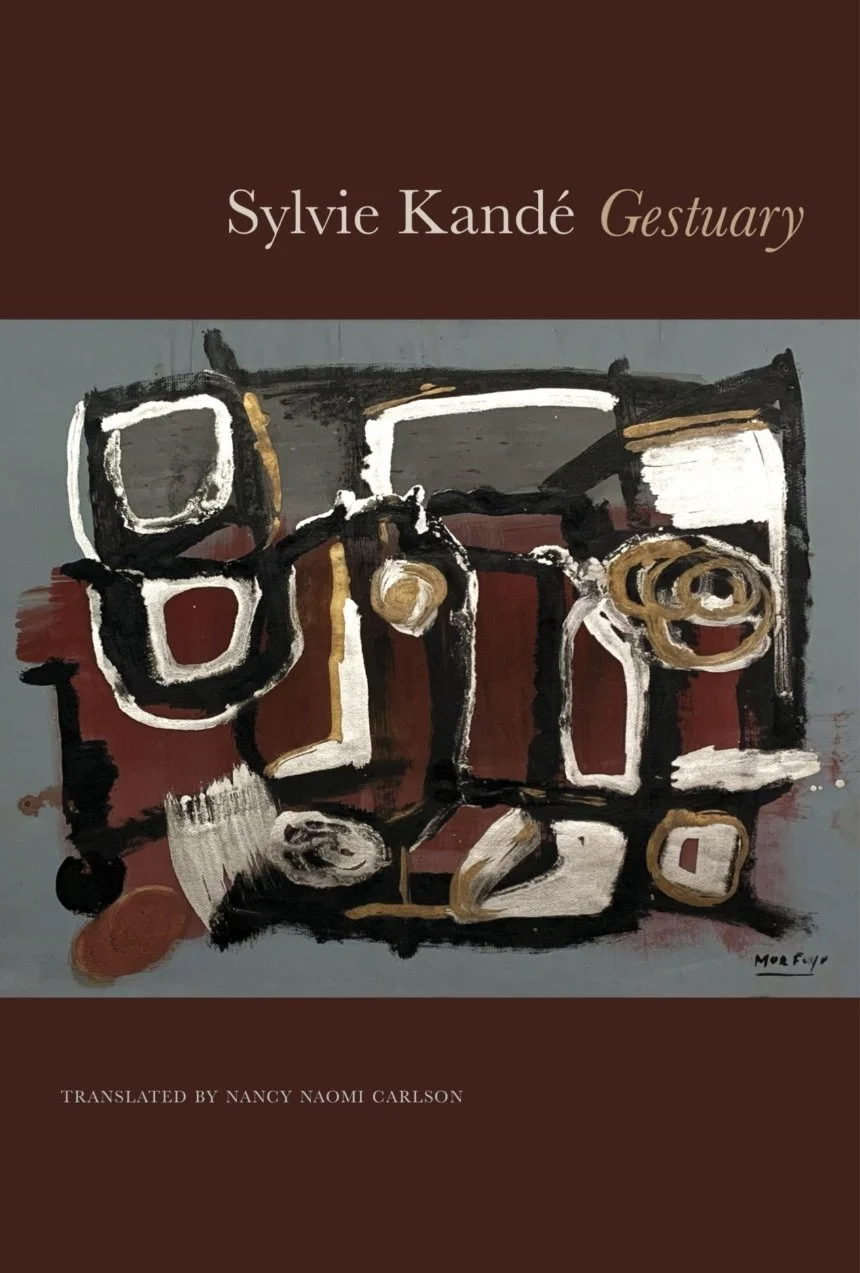
Gestures carry the weight of words. Think of the hand wave that signals “hello” or “goodbye,” or blowing a kiss to someone. These tiny actions can hold such significance. Gestuary by French-Senegalese poet Sylvie Kandé, translated into English by Nancy Naomi Carlson, is a repository for gestures that carry cultural significance and instances of violence, as well as historical significance. The original was published as Gestuaire by Éditions Gallimard in 2016 and received the 2017 Prix Louise Labé. Carlson’s translation, issued by Seagull Books, came out this year.
Carlson, a well-known translator and poet in her own right who is also the Poet Laureate of the Kensington Day of the Book Festival in Maryland, approaches her translation work with sound mapping—an example of which appears in the Translator’s Forward. This technique enables her to replicate as closely as possible the musicality of Kandé’s poems. Like a “Call of Air,” these translated poems “will be—always—/ the best conch.”
Throughout this collection, the author’s father appears and reappears, like a ghost haunting the pages. There are a number of spirits in these pages, from the man seeking release with a servant girl in “Deposits & Withdrawals” to the friends weaving through growing “Sugarcane.” But it is the gestures in these poems that make an indelible impression on the reader.
From “September’s Bird”:
For proof
this tired gesture toward her exotic birds
lying on the sink freshly strangled but still loved
After I’m gone who’d care for them … she asks
From “Scraps of a Portrait”:
perhaps he’d eat lunch
but chewing very slowly
like someone weighing the effort
calculating the cost of each thing
maybe not after all
the way in any case
he’d quickly fold the knife blade into its handle
and pivoting on his hip would stash it
in the vast pocket of his overalls
where he keeps
a coin purse a tobacco pouch
the silver lighter found on a lucky day
In these poems, violence is overt or hidden but ever present. Kandé is showing us that gestures carry undercurrents of meaning. Whether recalling a ceremony for the passing of loved ones or the remembrance of childhood, her poems call attention to body language and how we speak to one another without words even when all we have “left are crumbs/like the ones after a meal/you swipe away with a sponge.” (“Scraps of a Portrait”)
One of the most beautiful poems in the collection, “Departed Night Butterfly of Mine (A sad song),” reads more like a ceremony for the departure of a tempestuous familial soul. In the sending off of this soul, the casket is filled with “distress and some pages…a poem and tender gestures” but the struggle for healing in the wake of death continues for the poem’s narrator.
Gestuary by Sylvie Kandé, translated by Nancy Naomi Carlson, breathes life into gestures overlooked by the unaffected and elevates them into the spiritual.

Sylvie Kande is a French-Senegalese poet. Her three collections of poetry are published by Gallimard: Lagon, lagunes.; Tableau de Mémoire (2000) with an afterword by Edouard Glissant. La quête infinie de l’autre rive : épopée en trois chants (2011) received the 2017 Prix Lucienne Gracia-Vincent (Fondation Saint John Perse). Gestuaire (2016) received the 2017 Prix Louise Labé) and is available in English as Gestuary (Seagull, 2026). She is the recipient of a Golden Dozen Teaching Award from NYU where she built the Francophone literature program, and a SUNY Chancellor’s Award for Excellence in Scholarship and Creative Activities. She teaches in the SUNY Old Westbury History & Philosophy Department.

Nancy Naomi Carlson is a poet, essayist, and translator. Her translation of Khal Torabully’s Cargo Hold of Stars: Coolitude (Seagull Books, 2021) won the Oxford-Weidenfeld Translation Prize. Author of five titles and translator of twelve others, her poetry and translations have been noted in the New York Times. A two-time recipient of translation fellowships from the National Endowment for the Arts, she has also received grants from the Albertine Foundation and was decorated by the French government with the Academic Palms. She serves as the Translation Editor for On the Seawall and a co-Translation Editor for Pleiades.
Serena Agusto-Cox is a Pushcart Prize nominee, editor at The Mid-Atlantic Review published by Day Eight.She coordinates poetry programming for the Gaithersburg Book Festival. Her poems appear in multiple magazines and anthologies. To help poets, she reviews and markets collections through Savvy Verse & Wit and Poetry Book Tours respectively. Echoes Carry (2026, Beltway Editions) is her debut poetry collection.