
“She told me and I remember knowing”
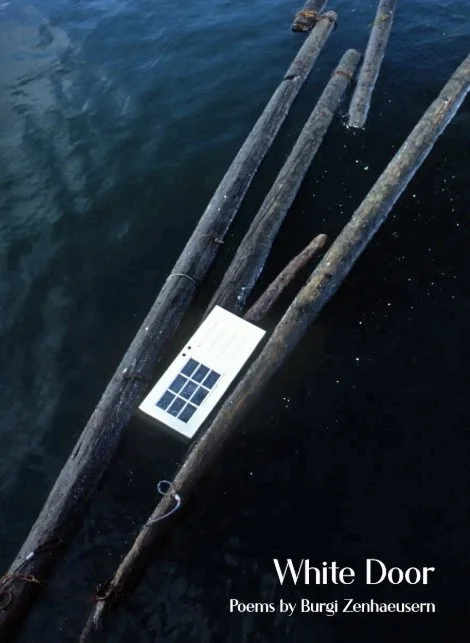
A review of White Door, by Burgi Zenhaeusern
by Gregory Luce
Displacement, memory, raising a child in a new country—these are some of the themes that Burgi Zenhausern treats in her first full length collection, White Door. The fact that these fine poems were written in Zenhaeusern’s second language makes this achievement even more impressive.
Zenhaeusern was born in Switzerland and now resides in the Maryland suburbs of D.C. She is active in the DMV literary community and has published a chapbook, Behind Normalcy (CityLit Press 2020). It is therefore cause for celebration that we finally have a full length book that displays the range of her concerns and her deft handling of language.
The opening poem, “Grandma’s Pin,” sets the tone, evoking poignant recollection of a long past childhood:
“Three silver swallows in flight,
a delicate halfmoon with a needle
too thick for anything but loose weaves,
tarnished as my memory and kept
uprooted in my jewelry box….”
The pin carries the speaker to a past beyond her own memory, a time when travel involved horses and coaches, and tuberculosis was a constant threat.
“She told me and handed the pin to me,
in our language in the sole keeping
of which it is no longer.
She told me and I remember knowing.”
This poem typifies Zenhausern’s skill in treating her themes with great delicacy and avoidance of sentimentality.
“Horizons” beautifully treats the theme that underlies the entire collection:
“Traditions I keep
take hold in this soil slowly—
home grows fainter
until
distant slopes briefly
make me forget who I am,
re-etch longing.”
The book is divided into three sections, each titled with the name of a treasured object that triggers a memory of a long past life. But other poems reflect on her life in America, the often disorienting adjustment to a new culture. For example, “America/Amerika” describes her family’s first confrontations with racial realities:
“Either because their awareness was assumed or the matter a taboo, or both,
no one prepared my Swiss parents for early sixties Durham, NC, segregation….
I don’t know how many a Black person it took to show her the ways
our whiteness mattered….
Back home again, America reverted
to Amerika—stories and a myth in well-kept slides, cherished showings,
none revealing a sign of segregation. It was their happiest time—
the only happy time—in my parents’ marriage.”
The title poem of the next section speaks of yearning for a past companion, possibly the speaker’s mother:
“My yearning for you long
hatched and flown, the heart keeps
a small hollow. How long
can you continue without yearning?...
Compass hidden in the silk
and batting, herring bone and cross
stitches tightly sewn
to a haphazard star. The heart a threaded
space I circle with mother-of-pearl.”
(“Nest in Quilt”)
Further along, “A Bag of Frozen Lima Beans” demonstrates how a seemingly mundane object can trigger recollections of a past love:
“At the kitchen window with pink sky
still showing through the crowns, I trace
the tapering limbs, fine bristles, and
imagine my fingers run across them
tickling, one last time, as spring has started
to knot the branches….
The unpacked beans a lump still frozen.
How they melt apart and slowly soften!”
Note the slant rhyme in the closing couplet, indicative of this poet’s deft craftsmanship.
The third and final section, entitled “Music Box,” turns from evocations of the past to reflections on life going forward. The title poem addresses the speaker’s child, thus connecting memory with the present:
“my pin-plucked off-beat
melody in your small hands
blue canopy
gold-rimmed cresting….
fetching
me from the shelf
and turn the key to my sadness
I weep
as you practice”
In “At the Toystore for a Scooter,” the poet vividly depicts the joys of both parent and child in an an almost carnivalesque setting, quoted here in full:
“Parents on a mission, their child
open to anything rush
into isles of overwhelm and neon glare—
a dragon turned racetrack,
blinking buttons, a robot’s. Are these
real buttons? How about I try one.
Come on. We’re here
for the scooter. Look! There! they say
to a jumble and the child. He picks
a red one, insists on carrying the box.
The register goes beep.
Red lights, green lights—
the ride home. Do you like your new scooter?
Yes, yes! from the backseat.
At home, the child draws. A fabulous robot.”
The book ends on a note that in some ways sums up the entire collection. A white door is seen floating among other detritus in a river:
“a white gleaming
intricacy continues
adrift on masses
crossed so often”
(“White Door in the Flotsam”)
This poem, like many others here, uses unconventional spacing and lineation, which are impossible to reproduce here, to enhance its effects. One would like to quote them and numerous others, but instead I urge you to get your own copy. My only caveat about the book is that the poems are presented in very small type, which might raise difficulties for some readers. They are, however, well worth the effort. White Door is a stunning achievement that even at its length leaves the reader wanting more. Order from Lulu or email carbonationp@gmail.com if you’d like to order a copy from Carbonation Press directly.
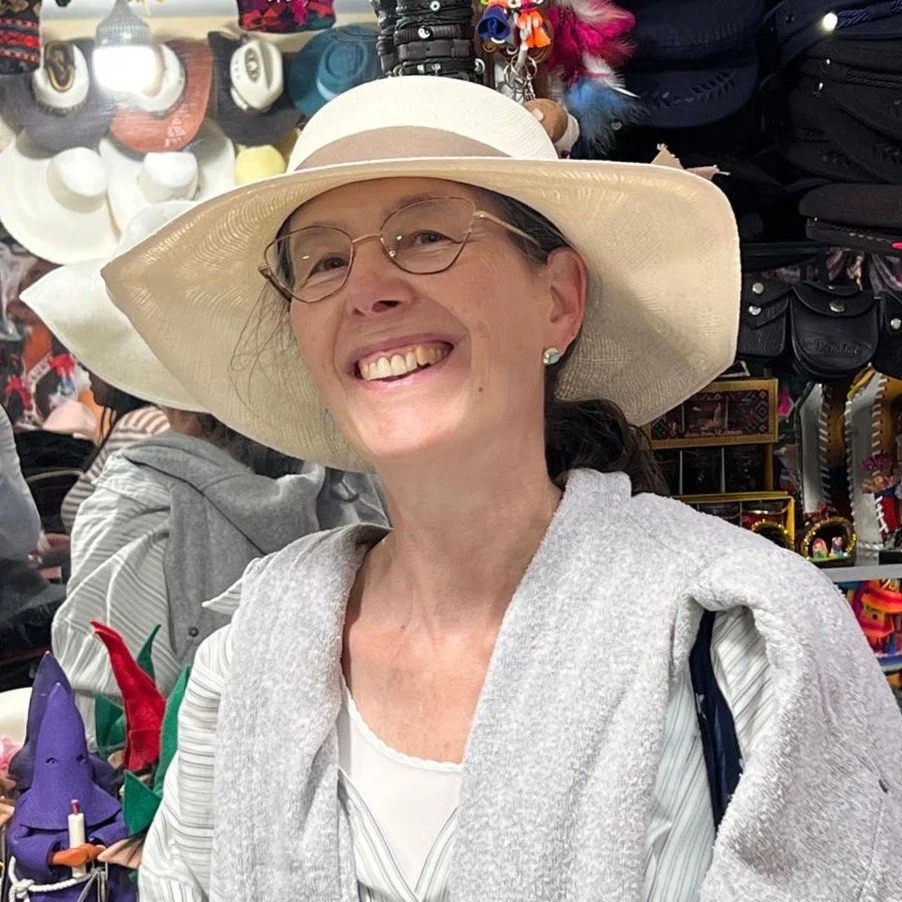
Burgi Zenhaeusern (she/her) is the author of the chapbook Behind Normalcy (CityLit Press, 2020), winner of the Harriss Poetry Prize. Her work appeared, most recently, in Diagram, Glass: A Journal of Poetry, JMWW, Sugar House Review, and as broadside (runner-up in the Ashland Poetry Press Broadside Contest). Originally from Switzerland, she lives outside Washington DC, on Nacotchtank and Piscataway land.
Gregory Luce is the co-founder and poetry editor of Washington Unbound. He has published six chapbooks. He lives in Arlington, serves as Poetry Editor of The Mid-Atlantic Review and writes a monthly column for the online arts journal Scene4.