
Poems of the Unexpected—and the Struggle to Connect

by Naomi Thiers
A review of Locomotive Cathedral by Brandel France De Bravo
Two words I’d use to describe the poems in this collection—their language and imagery—are muscular and unexpected. By muscular I mean the words and images aren’t just substantial, they flex and push against you as you read; a reader feels pulled into grappling with them. Meanwhile, unexpected images and metaphors—that sometimes don’t initially seem to fit the tone—and unusual words surface a lot. This makes the reading experience satisfying work. It doesn’t shut the reader out, but demands something from them.
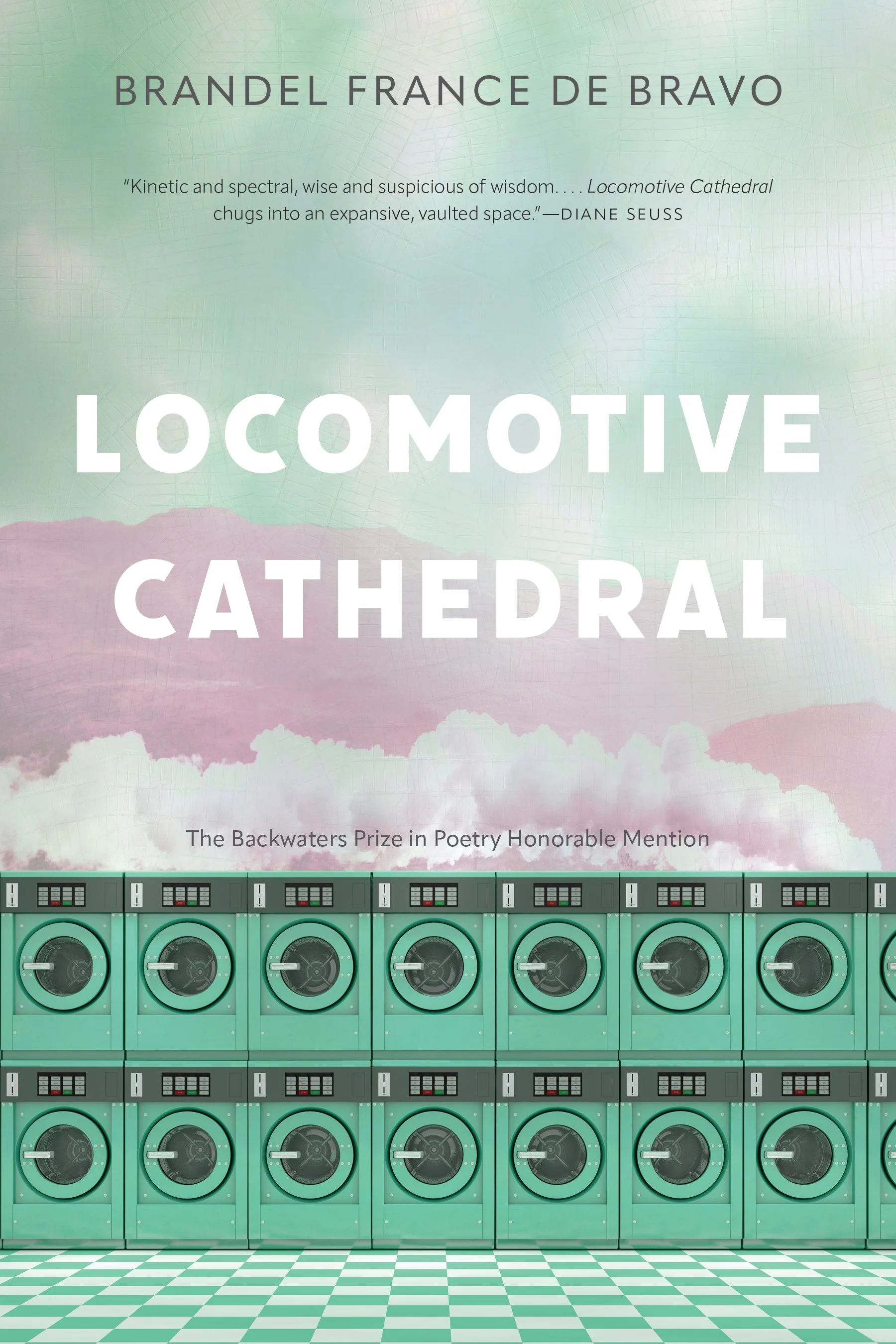
Though it’s hard to pinpoint one or two main things these poems are “about,” several key themes emerge: the difficulty of living well (and connecting to anyone) in our current times, provocative ways of looking at mundane situations (like visiting a laundromat), the complications of family love, especially in flawed families. There are poems remembering what COVID lockdown was like and how it affected us, poems about effects of climate change, and a few looking head on at race-based violence (though I didn’t fully understand it, I loved a poem dedicated to Ahmed Aubrey). The poems in one section all draw from a set of “sayings” (the lojong slogans) used in Tibetan Buddhism to cultivate compassion and enlightenment.
The problem of connecting with others—from the question of how much we want to interact with strangers to the effort needed to truly talk with and stay close to a spouse—is the subtext of many poems, even a rather light poem like “After the Ecstasy, the Laundry.” The speaker recently got an in-unit washer/dryer, so no longer goes to laundromats:
My years of hoarding quarters, jam-jar
maracas are over . . . Do I miss
laundromats? Maybe I miss the locker-room-like looking,
the furtive interest surely shared, given the rule
to never air. Maybe I miss balling socks, folding
underwear, quickly concealing the crotch, on a long table,
where so many strangers’ boxers, nightgowns have rested.
In another lovely poem (“If It’s In the Way, It Is the Way”), the speaker (presumably the poet, who is married to a man from Mexico) struggles to support and be close to her mother-in-law as she helps her shower:
After getting my husband’s 94-year-old mother (suegra, a word she hates)
over the shower wall, into the bath seat, another hurdle
awaits. I aim the handheld at her back, thighs, in-between, but the spray’s
too hot, too cold, too hot, too cold. Again. Just the right
temperature when she undressed, dropping Pull-Ups to the icy floor,
the water is no longer. . .
Then, with tiny twists, I try to dial perfection, a bank safe set to explode
like in the movies. This constant adjusting, life
as a series of hatch marks, numbers I can’t make out.
Yet for all the awkwardness and fragility, by poem’s end, the two are bonded and working together:
Two years
into the pandemic: we hug, faces turned away
from one another’s breath. Always looking over our shoulder.
Our mouths are covered. Still, we sing.
Many poems catch the quality of certain kinds of interactions. “Women Talking,” for instance, captures the free-flowing way women sharing a hotel room at a writer’s conference would likely talk to each other (or aloud to themselves). Others capture the complex realities of marriage—what we give up, why we stay, how we find happiness in the imperfect. One thing I noticed in the poems is a lot of wordplay or fascination with words. This can be fun, but at times becomes distracting; a poem keeps veering into wordplay tangents, making it less coherent and followable.
Despite the sometimes distanced tone, certain poems, particularly ones about the author’s family of origin, reveal laid-bare emotion and vulnerability. “Fractal” shows the complex feelings the speaker has about her father, who left the family before she was born (and who she only met once)—"Bill: serial fatherer, beatnik poet, drunken brawler, gun and weed runner, botcher of plans. . . . Because he died young, Bill became a lake no wind could touch, water on which my imagination could float undisturbed”—and about the stepfather who adopted her and “was as good to me as I allowed.” A few poems treat the death of the poet’s mother, including the raw “Seam and Sieve.” Though I found some stanzas of that one hard to decipher, the blunt language and skilled rhythm of many lines brought the pain of a long deathbed home:
Hospice was a six-month contract we bid on
With one deliverable hurry up and wait. . .
Her loneliness impossible to communicate
Not said, I’m serving a life sentence in bed.
One long poem (“Slogan 59: Don’t Expect Applause”) looks at what it was like for the poet to grow up as a white girl with a semi-poor single mother in a mostly Black part of D.C. and attending majority-Black schools. Though the emotion is muted, the poem shows the complexity of growing up with some aspects of trauma, yet also with white privilege (and grandparents with means).
Perhaps the most unusual perspective on connection in the book are poems that show the author bonding with and even feeling something for a one-legged crow that comes to her balcony every day for food during the lockdown. As days go by, the crow trusts enough to come to the balcony while she sits on it, and draw closer to her; the poet comes to rely on the crow’s regular presence (“every visit is a spell”). Without becoming sentimental, she celebrates this unlikely connection:
Loss of fear isn’t attachment, and greedily taking what I give is not affection. Still, when this consumer of carrion lands next to me to drink, a few drops splashing my leg, I’m thrilled by contact with water from their beak: foreign, intimate, and cool
These muscular, unexpected poems show the reader ways we might look at something like a crow—or a familiar person—more closely and find new ways to connect.
Learns more about Brandel and order the book from the publisher.

Brandel France de Bravo is the author of the poetry collections Provenance and Mother, Loose and the editor of Mexican Poetry Today: 20/20 Voices. Her poems have appeared in Best American Poetry 2024, 32 Poems, Barrow Street, Conduit, Diode, Salamander, Southern Humanities Review, and elsewhere.
Naomi Thiers has published five poetry collections including Only the Raw Hands Are Heaven (WWPH), In Yolo County and She Was a Cathedral (Finishing Line) and Like a Bird Released (Sligo Creek Press). Her work has appeared in Virginia Quarterly Review, Poet Lore, Colorado Review, and many others. She lives and writes in Arlington, Virginia.