
Even broken angels heal

A review of Time and Other Solvents by Claudia Gary
by Serena Agusto-Cox
Looking at the broken angel on the cover of Time and Other Solvents: A Story of Healingsuggests fracture and grief, not restoration. Yet in these poems, Claudia Gary — our local queen of villanelles — reveals how broken pieces can become part of a larger mosaic of healing. But what she explores in these shards is how they fit together into the larger mosaic of who she has become.
Claudia Gary is a long-time stalwart in the DMV literary community. In addition to poetry, she has written music, and she teaches classes in writing formal poetry, among other things, at The Writer’s Center in Bethesda, Maryland.
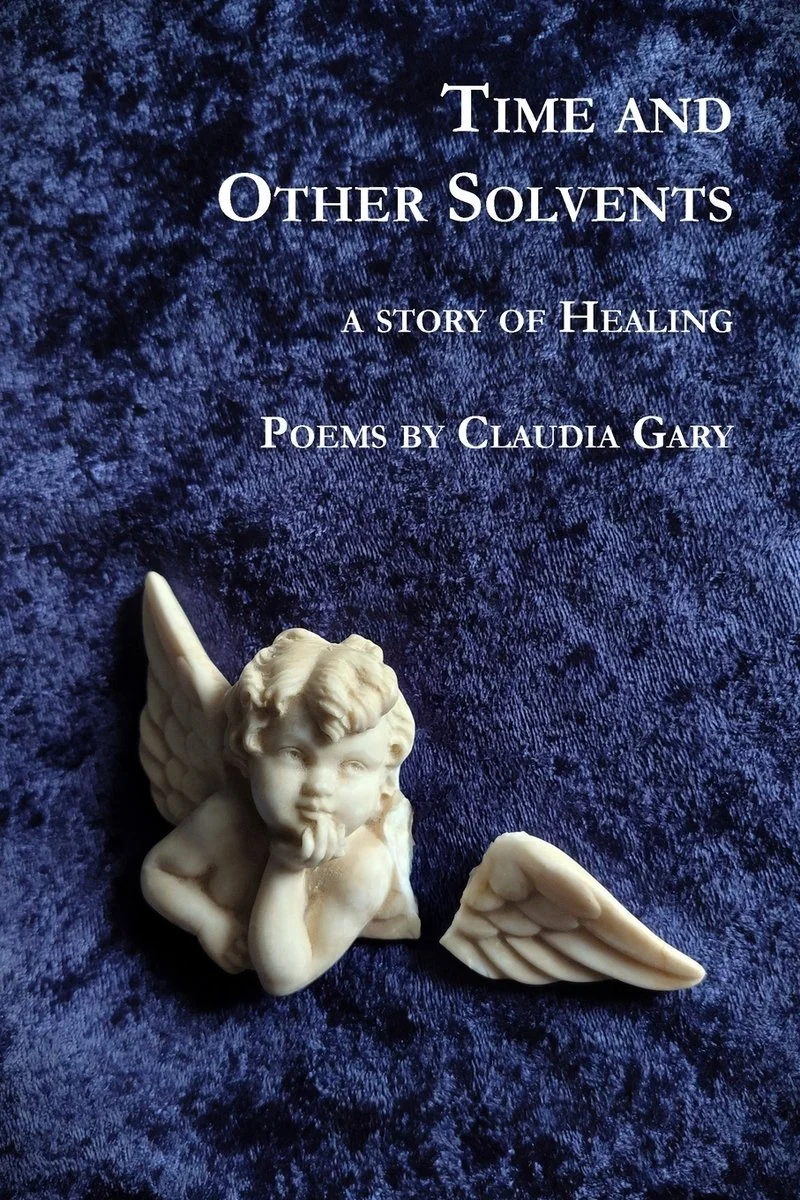
In this collection, Gary uses formal poetry and vivid artistic imagery to transform fragmented memory into a coherent story of survival and healing. These forms provide a structure to memories that often come in waves, presenting fragments of sorrow and happiness. Gary’s poetry sings on every page.
In her opening poem, “American Dreamers,” we see her parents search for an American dream and how the ambition and climbing left so many pieces broken in the dust of the past. Gary sees this composition “just at arm’s length this evening.” (from “Atlantic Beach”)
In “Shading,” we see Gary as a child looking at the world as a curious artist. Learning that beauty cannot be without shadow:
Before making a mark, I broke three rules:
snapping apart a darkly colored crayon;
peeling one half completely (zero cover,
abundant color); then turning it sideways
to drag and swirl its width across the paper.
Here was my shadow, yours, the universe
without a star. Standing the crayon up,
I drew stick figures. They, too, would need shadows.
Using a blank verse form, she is able to demonstrate in poetic form to bend the rules, as an artist would. Bending the rules to see the truth in a new light, just as a poem uses meter and line breaks to shed light on the unknown.
Gary’s journey is an artistic one, coupled with a love of music that is strung through each poem, from “Discovering Classical Music” and “Under the Piano” to “Fifteen Minutes at Julliard” and “Skating Lesson.”
As the collection progresses, her love of painting and art also ties these poems tightly together from early memories of learning art with her mother to her poem “Portrait at Dusk,” which is not overtly about art but paints a picture for the reader through the controlled sonnet form.
In “Portrait at Dusk,” Gary again brings in the shadow, but in this case, it is the darkness from a “solar eclipse” of “losses, false beginnings,/ unruly endings.” Gary slips through time like an observer of her own life, reaching back into her emotions but also into observations that are only recalled with distance.
Her story is essential, tackling despair at a mother changed and, later, an eating disorder. It leads us into the trauma, through it, and on to the other side where she’s found hope. In her poem “Royal Hotline, 1983,” Gary and Princess Diana become compatriots in a silent battle: “Princess Di, you’ll lend this thing your name,/ crowning a hushed disease with regal grace.” This deeply personal collection uses the distance of time as a solvent, dissolving the pain of trauma to reveal the strength the poet has gained in the process.
“Skating Lesson” is among the most beautiful poems in this collection with its surreal and dreamlike state. It’s as if Gary’s narrator has lost herself in the spins and curves of the lines left on the ice.
Gary is not the child we see at the start of the collection learning art from her mother. Her mother demonstrated love through her art, but also held her child to impossible standards. Gary is not the adolescent who struggles with a silent battle and ill-fated choices. She has become an artist herself and through it, she has healed. Gary’s shifts between formal constraint and free verse mirror the tension between control and emotional unraveling. Time and Other Solvents reminds us that healing rarely arrives all at once. It comes through revision, memory, art, and time—through learning how to live with the shadows rather than erase them.
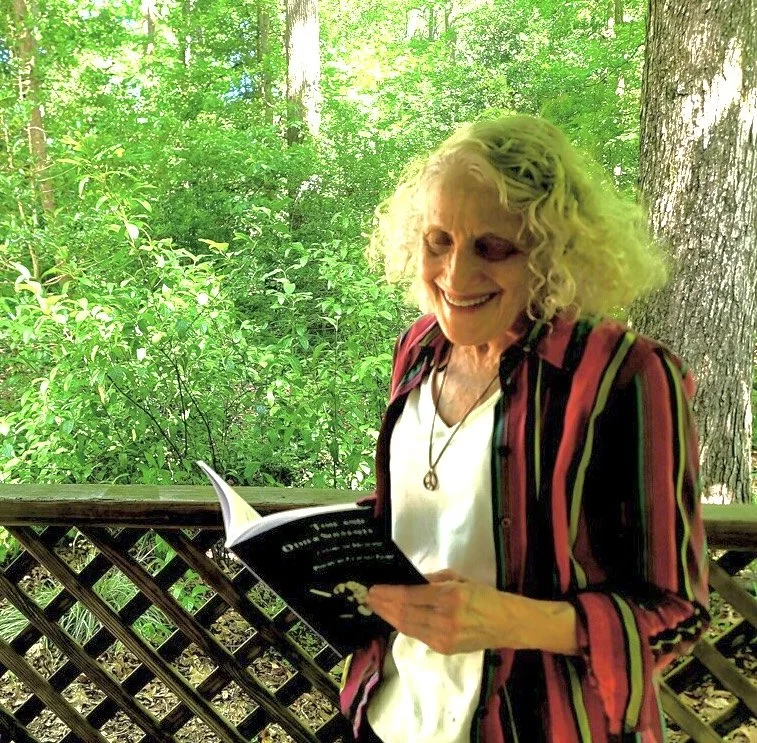
Order Time and Other Solvents from Sligo Creek Publishing.
Claudia has several readings coming up: in Philadelphia on July 8 at Fergie’s Pub as part of the Moonstone Poetry Series. On September 24, she’ll be appearing at The Writer’s Center in Bethesda, MD, as part of the Amsterdam Quarterly reading. October 13 she will appear at Sky Stage in Frederick, MD. And on December 13, she will read at Reston Readings. View a past reading here.
Claudia Gary teaches workshops on Sonnet, Villanelle, Persona Poem, Natural Meter, Poetry vs. Trauma, and more, via videoconference, at writer.org and privately. Her chapbooks include Genetic Revisionism (2019) and Someone Likes You (2025). She is also an advisory editor of New Verse Review as well as a health/science journalist, visual artist, and tonal composer (see pw.org/content/claudia_gary).
Serena Agusto-Cox is a Pushcart Prize nominee, editor at The Mid-Atlantic Review published by Day Eight.She coordinates poetry programming for the Gaithersburg Book Festival. Her poems appear in multiple magazines and anthologies. To help poets, she reviews and markets collections through Savvy Verse & Wit and Poetry Book Tours respectively. Echoes Carry (2026, Beltway Editions) is her debut poetry collection.