A deep exploration of the ordinary

A review of Anne Tyler’s Three Days in June
By Norah Vawter
Three Days in June (Knopf, 2025) is a love letter to introverts, and to anyone who’s ever felt out of place at a party, a business meeting, or the hairdresser. In her twenty-fifth novel Anne Tyler returns to familiar territory and the themes she’s been wrestling with in fiction for over fifty years. Complicated, thorny family relationships. The push, pull, and dance of mother-daughter bonds. Awkward social conventions that seem illogical but also necessary. The quirks and peculiarities of Baltimore. The struggle to communicate. The things we don’t say. The meaning behind the things we do. The attempt to be neat in a messy world, to find order, beauty, and even clarity in that mess.
Laying out these themes, I feel like I’m making this novel, and Tyler’s work in general, sound heavier than it is. The genius of this author, whose writing I’ve loved since I discovered it as a teenager, is her light touch. Because Three Days in June is also a delightfully funny book. And quirky. And light, because while Tyler manages to delve deep into these big themes and questions, she doesn’t get bogged down in their weight.
“It was so typical. We’d be getting along just fine and then he’d say something that reminded me he was this totally other, totally opposite kind of person from me. I yanked my door open and got out of the car. I was halfway up the front steps before I heard him open his own door.”
Tyler’s work tends to skate on the surface of our ordinary lives, in the best possible way, because this is an author who studies everyday moments, noticing the mundane details that make life real, and giving glimpses into a deeper reality, glimpses into whatever lies beneath what we see and hear and say. It’s like there’s a river of feeling flowing beneath Anne Tyler’s words, beneath the granular details that make up a life. But the focus is those granular details. A character’s need to fiddle with a stack of papers before giving bad news. Grandpa Simmons’ mantel clock on a bookshelf because the house is too small and modest for a mantel. An ex-husband showing up several hours early with a cat.
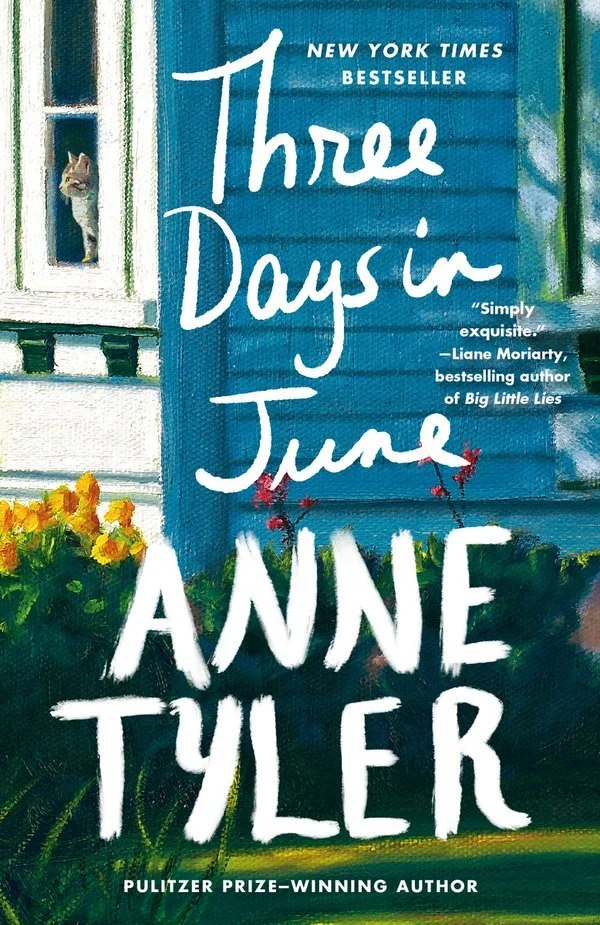
Three Days in June is told from the perspective of Gail Baines, whose weekend is already set to be complicated because her daughter, her only child, is getting married and Gail has been largely left out of the wedding planning. Not because she’s had a falling out with her daughter Debbie, but because she doesn’t seem to know how to talk to Debbie. And then her boss, the headmistress of the school where she is an administrator, tells Gail that not only is she going to be passed over for a promotion, but that she will be out of a job come fall. It’s not misconduct, or unprofessionalism, or even her age, though her age doesn’t help. It’s an inability to communicate effectively. Gail tends to keep everything to herself, except for occasional slipups when she blurts out what she’s really thinking, and her words come across as blunt or rude.
“‘It’s not only a matter of age,’ she told me. She was looking at me with her chin raised, the way people do when they know they’re in the wrong. ‘Face it: this job is a matter of people skills. You know that! And surely you’ll be the first to admit that social interactions have never been your strong point. … All I’m saying is to head a private girls’ school, you need tact. You need diplomacy. You need to avoid saying things like ‘Good God, Mrs. Morris, surely you realize your daughter doesn’t have the slightest chance of getting into Princeton.’”
Like most of Tyler’s stories, Three Days in June takes place in Baltimore, where the author has lived for decades. Over her long career, Anne Tyler has distinguished herself with work that is consistent and familiar but also constantly new. She won the Pulitzer in 1989 for Breathing Lessons, and the Booker in 2015 for A Spool of Blue Thread. While this latest novel doesn’t have the same emotional punch as those prize-winning books, I don’t think it’s supposed to. It’s a slim volume, 165 pages, and the narrative feels deliberately narrow. As the title suggests, the story takes place over three days. We do learn a lot about Gail’s past because she’s preoccupied by memories and regrets. By what could have happened. By things she could or should have said.
This is also a story that is deliberately slow. Gail often appears passive or inscrutable to others, but the reader can see her inner turbulence, her indecisiveness, her fear of failure. Her first-person narration is a reminder that there’s always more going on beneath the surface than we realize from the outside looking in. I kept waiting for Gail to take action, or say her truth out loud, or even to have a big revelation in her own mind, all of which she does to some extent but not to the extent the reader may expect. Because that’s clearly not the novel Tyler set out to write.
Always the master of the small, the mundane, the domestic, Anne Tyler has produced particularly quiet novels over the past few years. In Three Days in June she seems less interested in what happens—and more interested in why it happens. Or doesn’t happen. This is a book about a character thinking. Putting the pieces together. Figuring out her own life. It requires some patience from the reader. But it’s worth it.
Buy your copy of Three Days in June from Bookshop or your favorite local independent bookstore. Learn more about the author on her website:
Anne Tyler was born in Minneapolis, MN, in 1941 and grew up in Raleigh, NC. She is the author of more than twenty novels. Her twentieth novel, A Spool of Blue Thread, was shortlisted for the Man Booker Prize in 2015. Her eleventh novel, Breathing Lessons, was awarded the Pulitzer Prize in 1989. She is a member of the American Academy of Arts and Letters. She lives in Baltimore, MD.
Norah Vawter is the co-founder and fiction/nonfiction editor of Washington Unbound. Her debut novel will be published by Regal House Publishing in 2028. Follow her on Instagram @norahvawter and check out her Substack, Survival by Words.