At the intersection of creativity and community building
An interview with jonetta rose barras
by Norah Vawter
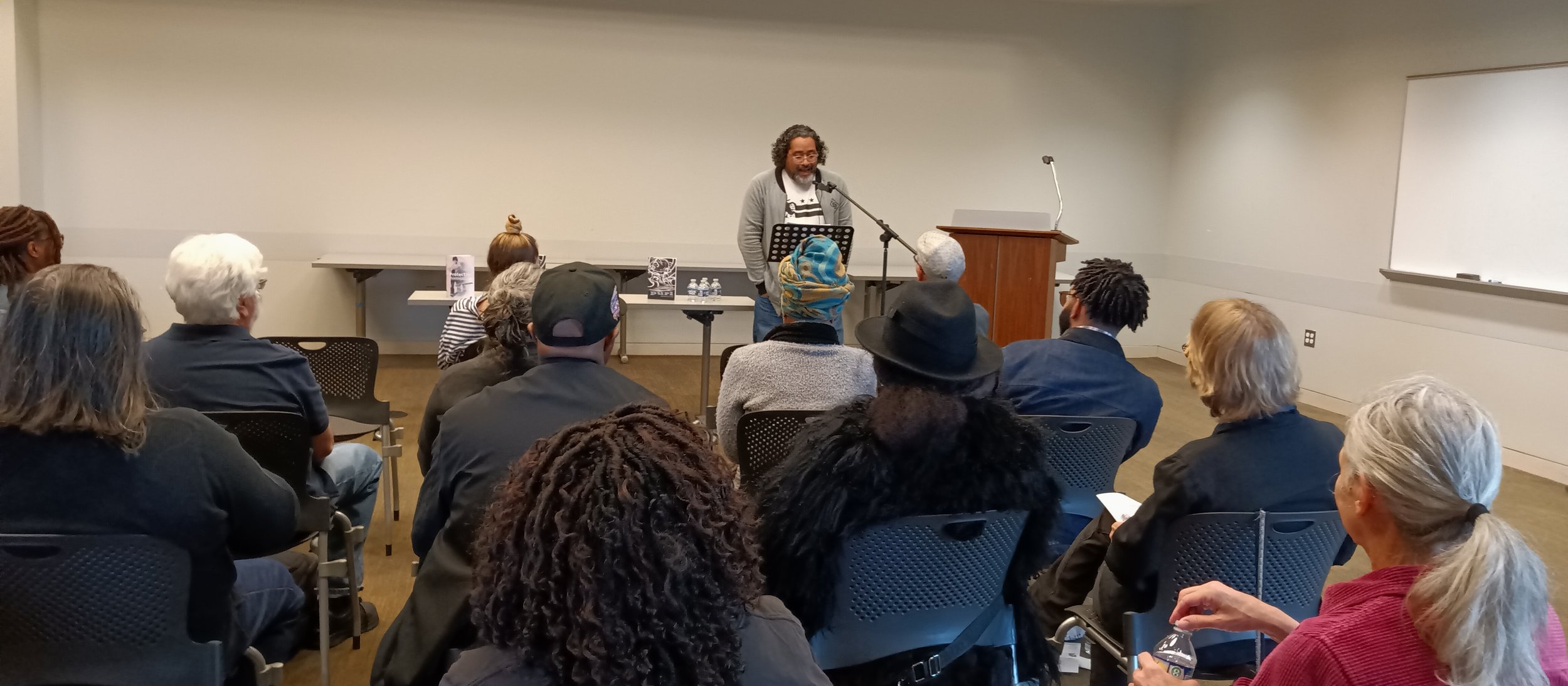
Jonetta Rose Barras is the kind of writer who inspires, both through her words and through her works. I had the pleasure of interviewing her about the MidnightRose reading series, a project she created in 2024 (or perhaps resurrected, as she organized an earlier incarnation in the 1970s). Jonetta doesn’t work alone—that’s not her style—and while I would say that MidnightRose is her brainchild, it is also the product of many voices coming together and building something special. Jonetta worked with her nonprofit Esther Productions and a curatorial advisory group to carefully and intentionally create a series that would do something different from the many local events already happening. To create a unique space for D.C. area writers and readers. One of her key collaborators on MidnightRose, Elizabeth Bruce, joined us for this interview.
We could have easily filled up the time talking about this fascinating—and truly intentional—reading series. But Jonetta Rose Barras has done so much other work as both a writer and an organizer, that it felt impossible to stick to this one topic. And, importantly, when talking about Jonetta’s work, it really is all connected. She’s a creative writer, she’s a journalist, and she’s a community builder. These are not separate endeavors, but rather different ways of channeling the same drive. Which is to make connections with other human beings—to speak, to listen, to empower, to bring people together, and often to heal.
Born and raised in New Orleans, she came to Washington in the 1970s while working as a community organizer for Movement for Economic Justice, and has been based here ever since. Though her first love was (and is) creative writing, she found work as an investigative journalist, which took up much of her time. She’s been active in print, radio, and television journalism and has published investigative reports, breaking news stories, features, essays and op-eds in local and national publications, including The Washington Post, The Washington City Paper, The Washingtonian, USA Today, The New Orleans Times-Picayune, Essence, and The New Republic. She’s published several books, ranging across nonfiction genres, including a bestselling memoir, Whatever Happened to Daddy's Little Girl?: The Impact of Fatherlessness on Black Women. Her organizational work includes co-founding the Institute for the Preservation and Study of African-American Writing, founding the nonprofit Esther Productions, curating the exhibition and symposium African Americans and Children's Literature, and launching the DC Literary History Center and Project.
She continues some journalistic work, including a regular column in the DC Line, but these days she’s pouring much of her creative energy into her first love, creative writing. However, in classic Jonetta Rose Barras fashion, the result has gone far beyond her own words, leading to the 21st century edition of MidnightRose. I left my conversation with Jonetta and Elizabeth feeling so inspired, almost on fire, and I hope you leave this reading experience equally inspired.
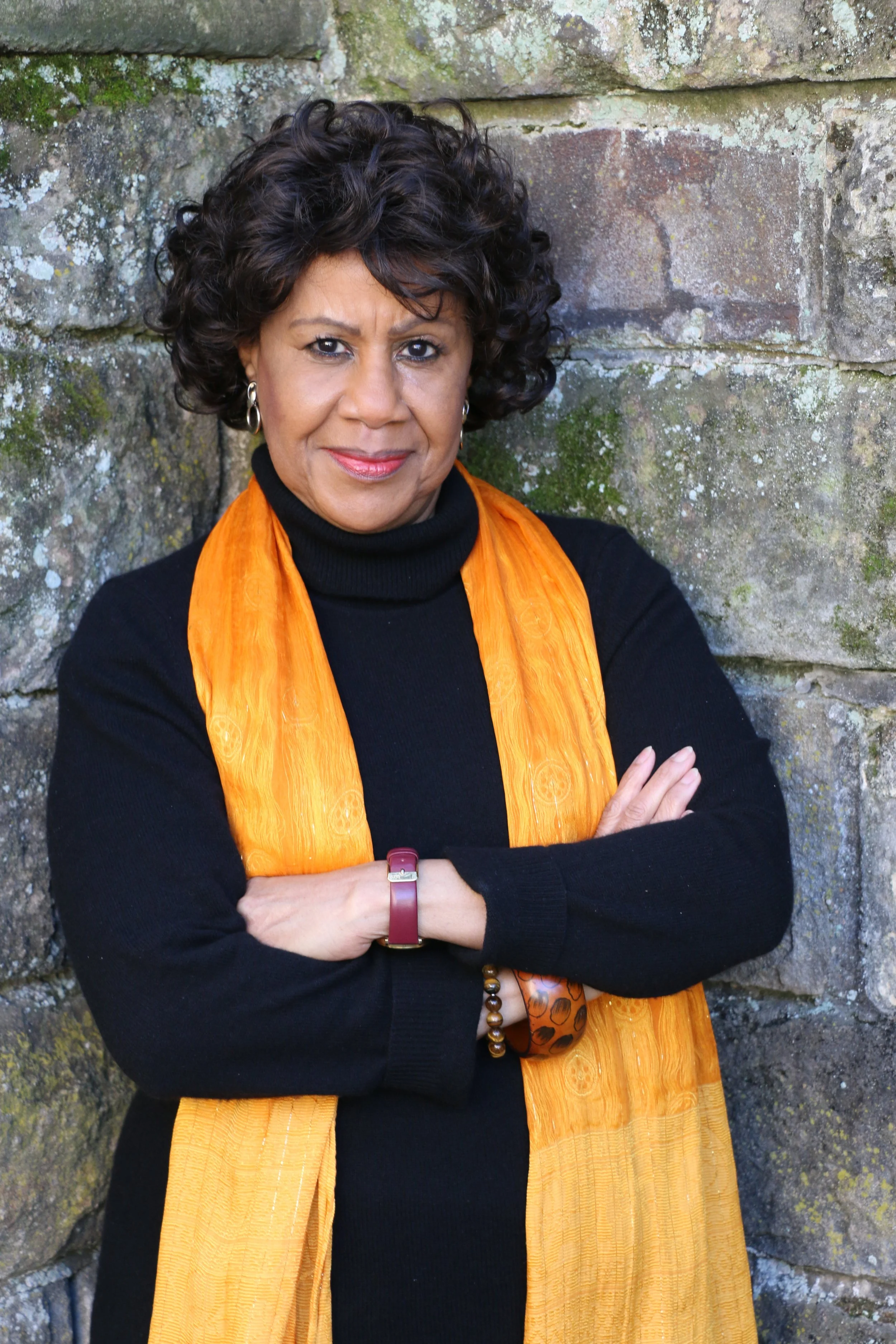
[jonetta rose barras. Photo by Kate Pczypok]
WU: I was so intrigued when I was reading through your website, because I'm familiar with you as a journalist, but you have done so much more than just the journalism. Could you start off by introducing yourself, for people who might not be familiar with your work, or might be familiar with some of it, but not all of it.
jonetta: I actually started off with being a poet, a public scholar, and a journalist. And I'm very careful about how I define my journalism, because I used to be a daily reporter. I used to be an investigative reporter. Although every now and then I will [still] do an investigative story, generally [now] I write columns, and I try to do contextual journalism. My aim is to help people understand where the news, or a particular issue, fits within the stream of what's happening in their community. Or what's happening in the country.
But my passion has always been writing. Journalism allows me to write, but, of course, within the context of writing, I really would prefer to be writing poetry or short stories every day, all day, if I could. But, as we all know, that doesn't necessarily pay the rent, or pay for food or cover the affordability bill, as everybody's talking about now.
WU: Can you define this term, “contextual journalism”?
jonetta: What I find in journalism is that we often do not help people to understand the context in which something's happening. That requires you [as a journalist] to help them, to connect things—maybe something that happened a few weeks ago with what's going on now. For example, I just wrote a column for The DC Line. The mayor and DC Council, which is the legislative body for the city, were discussing finance; they were looking at the current spending issues--how much money is or isn't available for various programs. They were also looking ahead at the city's Fiscal Year 2027 budget, which the mayor is still developing. One of the areas of concern was childcare. The program's growth has exceeded its budget by $32 million. And that same day, interestingly, I got an email from a mayoral candidate, Janeese Lewis George [whose platform includes] the issue of childcare. And so, I included that within the discussion about finances, because here's this candidate who wants to, basically, have [affordable] childcare for everyone. And is that realistic when you think about what the finances are of the city? So, I'm connecting the real financial discussion with her dream, and within the context of what is happening with the Republican congress, and what it is doing to the city with respect to repealing various laws, most recently, the effort to decouple the federal tax code with certain sections of D.C. tax code.
So that's my job--I want to connect these things so you understand as you're weighing or evaluating the ideas of a candidate. Do you understand where we are in the financial reality of the city, and the political reality of the city?
WU: It's so important, because everything is connected. People say, "Oh, it's about the economy," But health care is about the economy, and child care is about the economy, and education is about the economy.
jonetta: And it's not just about the immediate economy. It's about the future economy as well. You hope to have a journalist who is thinking about that, but often journalists can't think about that. Now, if you were writing a piece of fiction and you were dealing with the character of Donald Trump who would propose this for right now, you would already know where you're going to put Donald Trump in the future of your novel. That's something that novelists do all the time. They contextualize their characters, their stories, everything before they even put it out there. That's not something journalists do all the time because they're so busy dealing with the “Five Ws.”
WU: That makes a lot of sense. Along that theme, let's get to the MidnightRose reading series. Within the context of your other work, how did the idea of the MidnightRose come about? And how does this reading series fit into the greater work that you're doing in the Washington, D.C. area, and I guess what you see as the needs of the community?
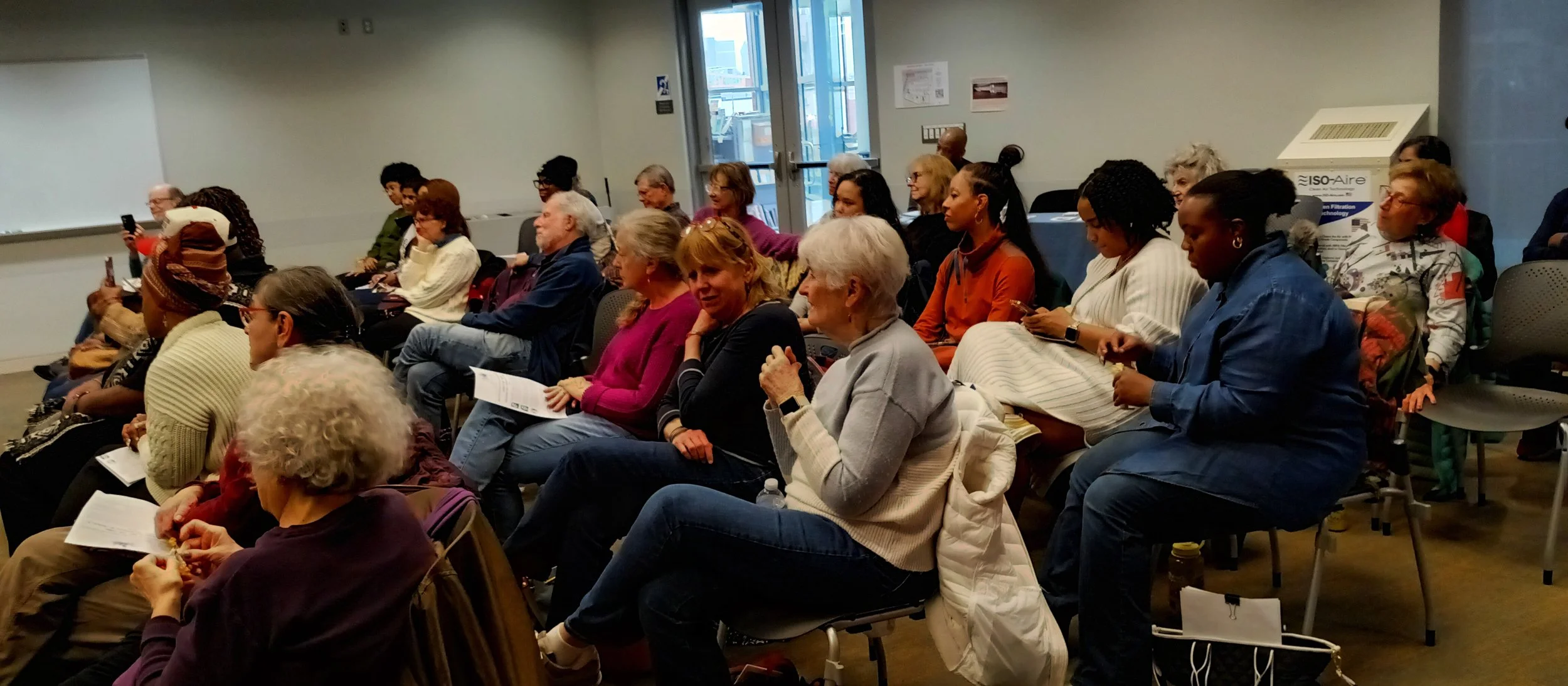
[Audience at MidnightRose Reading in January. Photo by EstherProductions Inc.]
jonetta: Back in the late '70s, myself and two other writers, female writers in D.C., Sheila Crider and Rose Susan Dorsey, began the Institute for the Preservation and Study of African-American Writing. That organization—by its name you get an idea of what we're supposed to do. We're looking at documenting, celebrating, presenting, celebrating the literary history of D.C., specifically African-American D.C. And so, we did that. We had symposiums, conferences. We gave out awards to people like Eloise Greenfield, the Negritude co-founder Léon Damas, Lucille Clifton. And as we were doing that, I added a component called the MidnightRose Reading Series. But it was kind of an intermittent thing. It wasn't scheduled. We didn't see it as something we would do forever, or even regularly.
[Then] I got involved with journalism, really deeply involved with journalism. And so there was a hiatus. There was a period, for about 20 years, where I was not really doing creative writing. Because I was deeply involved in covering national and local news, and also reporting on the intersection between news and culture. I did radio shows and television shows during that period of time.
Within the last five or six years, I've come back to what I left. My first love has always been creative writing. And so, I came back to that, and within the context of Esther Productions [which I started] after I wrote my memoir about growing up without my father. What Esther Productions does … it uses the arts to inspire and empower women. And so, all of this fits together.
[More recently] Elizabeth Bruce approached me and asked me if I wanted to do a reading with her and another person. And I did, but I didn't think I was quite ready yet. I didn't have many new poems that I felt really confident in. And so, as a sort of side job, something to kind of bring me back into the [literary] community without me necessarily performing or reading, [I decided to create] this reading series. And because I really like the name MidnightRose, I brought it forward to the 21st century. That's how we got started. In 2024, I actually created a curatorial advisory group, which included Elizabeth Bruce; and Anne Becker, who was the Poet Laureate of Takoma Park, Maryland; Sierra Fisher, who's a young emerging writer and a couple of other people. They help advise Esther Productions and myself on who we should include [in the reading series].
I wanted to do something a little different than what was being done with other reading series. To have a real focus on deliberately, intentionally crossing and connecting generations, connecting different cultures and writers from different racial groups. And so that's what we've done. That is our whole, I guess, raison d'etre. We [bring together] poets and prose writers, which can be fiction writers and creative nonfiction writers, from different generations. We're interested in both building the writers and building the literary community.
I look at myself because, you know, I didn't do an MFA program or anything like that. My degree is in communications, and I got that degree long after I had already begun and was successful as a journalist. And so, I don't consider myself a "trained poet." We wanted to provide opportunities for young writers, emerging writers, to connect with more seasoned, professional and published writers. To use them as unofficial mentors and guides and connectors into the world of creative writing, from the past to the present. On the other hand, we want writers who are in the senior years of their careers to connect with younger writers, and get a feel for what is happening with younger writers and how they're using language and structure and everything to approach poetry and fiction.
WU: That's fascinating. So when you were looking around at what was currently going on in the D.C. literary scene, at the already established reading series, it sounds like you were seeing a gap or an opportunity—
jonetta: Small gaps in small places where I thought we could make a difference if we did something a certain way. And if we did it in a deliberate way. And I think that’s what happens with reading series ... First off, you're right. There's a lot going on in Washington, D.C. itself, and in the larger region. It reminds me of the Black Arts Movement, where, you know, everyplace you went there was some poetry reading going on, or some book was being published, independent publishers and commercial publishers. There was this explosion.
I think we’re seeing an even greater exposure explosion [in our region] now. I think it runs parallel to a certain extent, to the cultural and political times in which we find ourselves, where we as artists, as literary artists, are really fighting to maintain a space, a place, and opportunities for us. As the political class, or certain members of the political class, are attempting to annihilate that whole ecosystem of the arts. So, what I saw were very successful reading programs, writing programs, and publishing going on. And what I wanted to do—which is what I've always tried to do—is create an opportunity for intersection and interaction with people who wouldn't normally interact, or who would maybe find it difficult to cross the boundary.
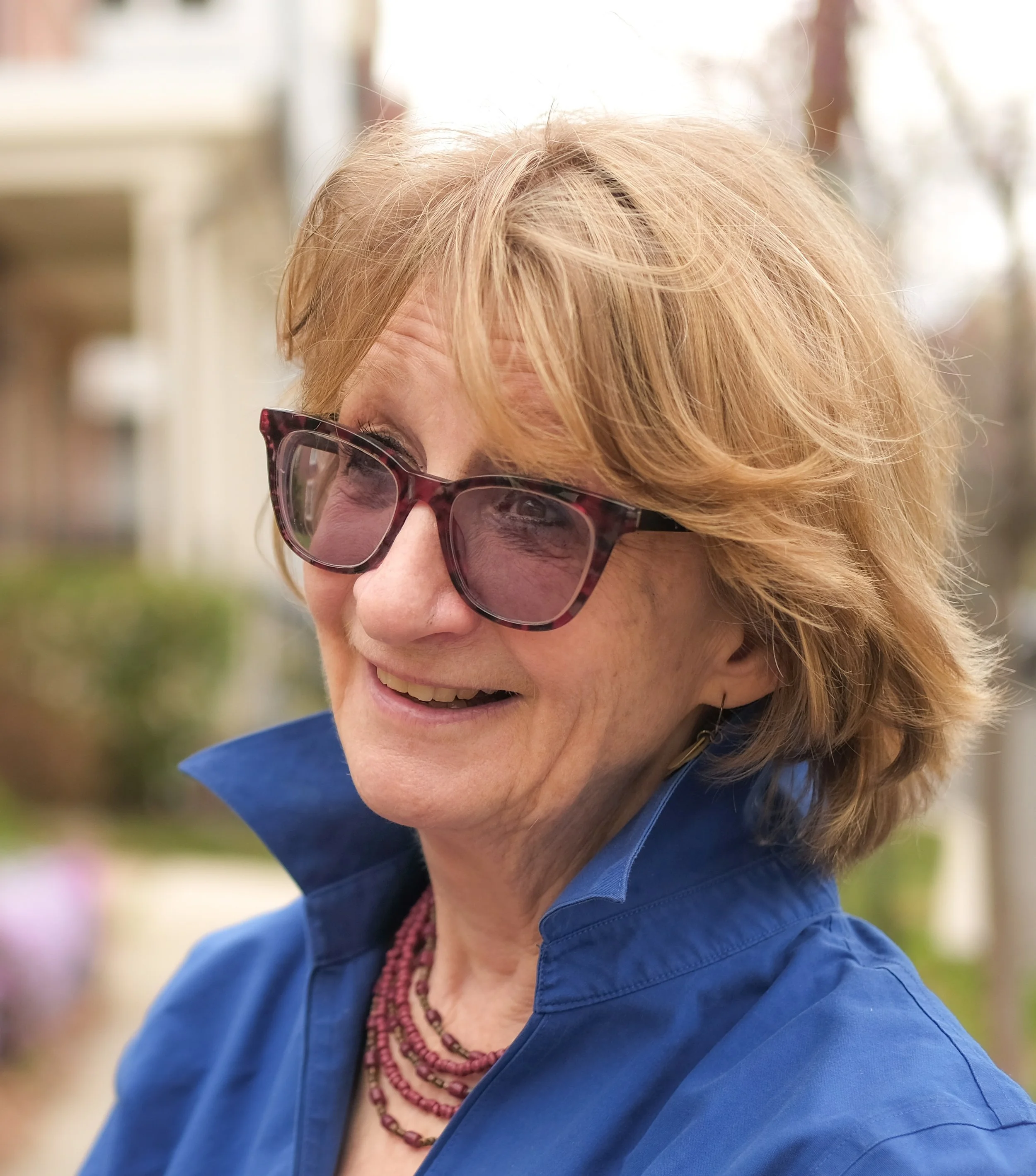
[Elizabeth Bruce. Photo by Nicolas Ortega Ward.]
Elizabeth: MidnightRose is also, as Jonetta said, incredibly intentional. It is intentionally intergenerational. It is intentionally multicultural, multilingual, even multinational. It is an extremely welcoming environment for emerging poets as well as veteran poets, both those who have and do not have formal literary training. You know, there is a proliferation in Washington, D.C.—in the U.S. in general—of incredibly well trained, formally trained writers and poets. Now, the MFA is sort of the default entry point in many ways, or at least the perception is that's your ticket to belonging to a literary community. I think MidnightRose really dissolves that barrier, so it’s incredibly friendly to both published and emerging writers. There's just a collegial and a very welcoming environment that doesn't necessarily make a big deal about a person's formal or informal training.
WU: I do have an MFA and I have a problem with MFA culture in many ways. I went to George Mason. I had a wonderful experience in the classroom, being mentored by these amazing writers, including Susan Shreve—
jonetta: Wow, wow. That was really an experience.
WU: She is like my hero, and a good friend, and just a wonderful, wonderful person. And Steve Goodwin and the late Alan Cheuse. So I had a really wonderful experience, and made lots of great connections with other students. But it’s also complicated, because some people come in with this elitist view. And some people don’t seem to be interested in integrating into the local literary community. I went to Mason because I lived in the D.C. area, and so I was familiar with the local literary scene. I knew the amazing poetry scene, for instance. I’m a fiction writer, but I knew that just about every day of the week you can go to an open mic in D.C. I knew how welcoming those spaces are, incredibly welcoming. But what I found was that most of my fellow students were not already connected to the local scene, either because they moved here from out of state, or because they were locals who had not previously made these connections. They had been living locally and doing their writing on their own time, in a more solitary way. I was surprised when I told classmates about events happening in D.C. or Northern Virginia, and they just didn’t go. Often not because of any elitist views, but because they were too busy, or didn’t see a reason to venture out into the larger community.
The MFA world can be very insular. Because we had our own events, and we were also so busy with our studies and our other work. Some people were teaching. Some people were working full-time. It’s understandable, but I think it’s also problematic. Especially when some people leave MFA programs with a certain view of what it means to be a writer, then they take that out to the world, and they interact with people in a way that makes me feel like I have to apologize for having an MFA.
jonetta: You know it's a two-way street. There are people who do not have MFAs, and look down on people who have MFAs because they think that the MFA group is far too structured, far too uptight. And so, so you've got those dynamics, when you bring [these two groups] together, whether deliberately or by happenstance, it helps trigger [understanding] ... that each is conveying, directly or indirectly, information that the other needs in order to grow as writers and as literary artists.
When we're putting together the [group of writers for a particular reading] we're looking at age, culture, geographic location. We're looking at all of those kinds of things, and who would work well with this particular poet versus that poet. We're looking at how to make sure the audience gets a whole poetic experience or a prose experience, whichever. And in some instances, we've got writers who write prose and poetry, like Elizabeth, and so you want to be able to offer everything, because part of what we're trying to do, as I said, is to grow the community. But you're not just trying to grow the community of writers. You want to grow the community of readers, people who are buying books and who are celebrating poetry, because those are the people who will keep us stimulated as writers. Keep us growing. And keep our environment nurturing.
WU: Absolutely, I love that. I think ultimately, it's about doing the work, and it's about wanting to write and feeling a need to write, and you've just got to get it down and you're just going to keep going. Some people just look at the world and see it in stories or poetry, and it doesn’t matter whether they had formal training or not. They think like writers, and they do the work.
jonetta: It's a part that's inseparable from their core being. The other day, I was talking to someone on a radio show, and I said, there's never been a time when I wasn't writing. I've been writing since elementary school, and when I was in high school, a friend of mine said she expected to see my name on a book, as an author of a book. And I thought, wow, really? Seriously? I mean, I love to write. You know, I never saw myself that way, but she had seen the passion that I had for it. … I don't think I could ever pull away from writing. It is at the core of who I am.
The only other thing that I think that is at the core of who I am is being an organizer. MidnightRose allows me to use those organizational skills. [So does] Esther Productions, the literary programs Esther Productions does. We just did a symposium on Sterling Brown. Two years ago, we did a symposium on African-American authors of children's literature, looking at the kind of challenges that faced them back in the early 20th century, all the way to the present. And so that work with Esther Productions, including MidnightRose, allows me to organize, to get into a community from this literary, artistic perspective, and to ensure that it does have impact. That the people who are coming are getting something. That they're growing from the experience. They're being inspired by the experience. They're being empowered. If they're artists, they're being empowered to continue their work. If they're not artists, then let the work that's being presented be empowering work. So, we don't want too much work that is placing us in a position of victims. Sometimes that happens. I mean, of course, we're in fights, various fights, as we know, but we do want people to be inspired by the work. Because that's what's going to get them engaged in it.
[Poet Sami Miranda, author and co-founder of American Poetry Museum reading in December 2025 at MidnightRose. Photo by Esther Productions Inc.]
Elizabeth: I would add to what you just said, Jonetta, about being an organizer. Interestingly, my perception is that a number of the presenting poets and writers are themselves organizers. Whether they are veterans like Jonetta and me and older, you know, the elders of the community, or whether they're young people. These are people who have really deep, deep roots in their respective communities and are passionate, not only about their writing, but the other work that they do in the community. Whether it is as an educator, whether they're in the health field, people just have … they have dual lives that are merged. And you know, the artist who is rooted and kind of headquartered in academia can have more of a single track life. And I dare say, everybody involved in Esther Productions and MidnightRose has at least a dual, or a tri, or a poly track life. They're just regular folk who've been living and working and engaged in this larger kind of social change [community].
jonetta: You know this Norah, you and Greg. I mean, Greg teaches young kids, and so the work that you're doing with Unbound is similar, you know. You're writing your book, he's writing. But it's all designed to help people to find and use their creative voice and engage their creative soul. Because I do think that often we get disconnected from that. And what we want to do, as artists, is we want people to be connected to their souls. You can't live a high-quality life if you're not
WU Absolutely! It also makes me think of how diverse in age the Mason MFA is, which I think really enriches the workshop discussions. I started when I was 27, which was the median age. There were a few just out of college, but also others starting in their 30s, 40s or 50s. A couple of my professors said they preferred writers to start five years or more out of college. They said, get some experience. Do something else. Be out of academia. Do other work, or have other experiences, travel. Then come and do the MFA, because you’ll have to have something to write about.
jonetta: Oh, Norah, if my granddaughter heard you, she'd be kissing you right now. Because I have said to her, well, why don't you just go straight into the MFA program? She's like, no, I really want to do something else, other than sit in a college classroom. I want to meet people, go places, do things. And so, I'll have to tell her that you've turned me around.
WU: I came in with a lot to write about already. I had a very crazy childhood. But that’s different from having the experience, as a young adult, of working a job. Like as I mentioned before we started recording, when I was a journalism intern for allAfrica, that was something I did before starting the MFA. I also worked as a teacher. I worked at a farm. And in the MFA, one of the stories I wrote was set at the farm where I worked. One of the stories that I wrote was set at the … well, at a version of the alternative newspaper that I helped to start in D.C, which was the Washington Spark. It was a short-lived ...
jonetta: It was a spark.
WU: It was a spark. It was a difficult project to maintain. But it was a really, really cool thing to be part of, and be part of from the very beginning. … So I had all these experiences as a young adult to bring in, and to write about, and those were invaluable. So yeah, tell your granddaughter!
jonetta: I hadn't thought of it that way, but that makes a lot of sense. As a journalist, and as a writer in general, what continues to help me is, like you, I had a rich, sometimes chaotic, but definitely rich background and young adulthood, and continue to have that in D.C. In terms of being able to meet new people because of the work that I do. And so, it does matter that you're connecting at a significant level, at a deeper level, and that you are spreading, not spreading [yourself] too thin, but actually moving around. So that you meet people.
I had said to Elizabeth and everyone on the curatorial committee that when the weather breaks, I want to get out a little bit more because I feel like I need to meet more writers, and engage—especially engage people that are writing but have been unsure of sharing their work. Sometimes it's not a lack of confidence, it's just that you're in a community where there's so many talented people, and you're hearing them, and you're thinking, I can't produce at that level. But you don't have to produce at that level, you produce at your level. And you measure yourself against what you're producing, not necessarily what other people are producing.
WU: I love that. I'm so intrigued by everything that you're saying. And this idea of connections has really been a theme throughout our conversation, and clearly your work. So, some of the readers at MidnightRose are very established, but others are emerging. Does that mean that they might not have published yet?
jonetta: Yeah. I mean, one of the people who is on our committee … when I met her, she came to one of our readings, and she had not published, not really. She had maybe had a couple of poems published in a couple of small anthologies. But hanging out and coming to the readings, it gave her more and more confidence, and it spurred her to spend more time with her work. And just recently, she published a chapbook of new work, haikus. And we had her read with some other writers. One writer is from Tamil, who was writing in her own language. And has now started writing in English. She has asked us about working with her to publish her new English language poems. So, I think people are coming, and they're hearing the poetry, and they're feeling that it's making them feel stronger, and making them feel more comfortable with their own voices, and [increasing] the desire to produce something in a book format.
Elizabeth: I would add that there is a very warm sense of an open door, and an invitation to belong to this ever-expanding literary community. Jonetta has spent her whole life mentoring young people, young women. I think both of us have had the experience of being approached at some literary gathering by a young person who is either new to the area or is just getting into the writing biz, and they're eager to have a literary community, and they don't know how to enter that world. So that's a particularly sweet aspect of the MidnightRose series. And Jonetta has this extraordinary history, also, of working with young girls and young women who are fatherless. And that's a whole other interview of her advocacy. Mentoring young girls and young women who have gone through life without a father present in their lives. It's extremely inspiring.
jonetta: And some of these girls are really fine writers, fine essayists, personal essays. We published personal essays by them a few years ago. We're looking to do more of that next year.
Creative writing saved me. It really helped protect me, it helped to guide me. It helped to mature me, and I think that it does that for people. It sculpts you into the person you imagine for yourself, and it helps strengthen your voice. Not just on the page or a stage, but rather in every setting. You suddenly feel like what you have to say matters, and that's what we want. We want more people saying what matters to them, because that's the way to create a stronger community, a stronger society. When you hear other people's voices, their ideas, you listen to the sound of their soul speaking in these words—then you become more comfortable. … What Maya Angelou says is we're more alike than unalike. I wouldn't say it that way, but the point is that we all have the same song. We're just singing different verses of it, or writing different verses of it. You know what I mean? And when somebody recites that poem and you say, Yeah, I know that. I feel that—that is the connection that's there, you know. And it's a connection that goes across generations, cultures, time, land masses, everything.
And that's what we want. That's what we want as artists. We want to be one people with many voices, and respecting those many voices. You know what I mean?
WU: Absolutely, I love that. I really connect to that. I lost my father when I was eight, and that had a profound effect on my childhood and on my writing, on my whole life. So I know how important that work is.
I’d love to know more about Esther Productions. When did that start?
jonetta: My book, Whatever Happened to Daddy's Little Girl, was published in 1998. It was the second book that I published, and it was a memoir about growing up without my father. The paperback came out in 2000. By 2004, after having traveled around the world, literally, this country and also in Europe, I realized ... I knew when I wrote [the book] it wasn't just a Black issue, but I didn't realize how much it was a global issue. For so many women who were affected by this, young and old. I met 85 year-old women who were still crying and grieving over the absence of their fathers. And so I thought that I needed to continue that work. Even now, when Esther is doing a lot of literary stuff, I still hold onto that mission, because it is so important for women to really come to terms with that trauma, that familial trauma that was a part of their lives. And young girls.
So when we started [Esther Productions, it was to help women and girls heal from that trauma]. But we use the arts to get into it, because it's very difficult to talk about this kind of trauma, childhood trauma. And so we used arts—visual art, dance, and literary arts to get women to share.
Esther Productions’ primary focus is to use arts to [encourage the growth of] women and girls, and to help them become more empowered, wherever they are in their lives, and in whatever community they're in. But literature is our dominant vehicle. Because we believe that literature heals, literature educates, literature inspires, literature empowers, and it does that without a lot of work. Good literature does that all the time, every day, all day. And that's why we do what we do, to try to introduce that into each person's life that we come into contact with. Because we want them to have that experience 24/7. Or at least every day, if not 24 hours a day. You know what I mean?
WU: I do! And thank you for sharing all of this. You’ve given me and our readers a lot to think about.
Interested in checking out the April edition of MidnightRose: A Reading Series of Poetry and Prose?
When: April 18, 1-3 pm
Where: Tenley-Friendship Neighborhood Library, Washington, D.C.
Who: Featuring Alexa Patrick, Caroline Joyner, and Jonetta Rose Barras
Details here.
Learn more about Esther Productions, and find future events, by visiting www.estherproductionsinc.com
Learn more about jonetta rose barras by visiting www.jonettarosebarras.com
You can listen to A Conversation with jonetta rose barras on Elizabeth Bruce and Michael Oliver’s excellent podcast, Creativists in Dialogue.
And find a copy of Whatever Happened to Daddy’s Little Girl? at Bookshop or your favorite independent bookstore.
jonetta rose barras found her voice, experiencing life as a poet, fiction writer, performing artist, and community organizer. Along the way she became a magazine feature writer, investigative reporter and contextual journalist. She has received numerous national and local awards for your journalism including being inducted into the Society of Professional Journalism Hall of Fames. Her strength remains her ability to connect for the public seemingly unrelated issues, enabling them to better understand the impact public policy, politics and culture in America have on their lives. These days jonetta writes opinion essays and books. She also works with Esther Productions Inc. to inspire and empower fatherless girls and women. jonetta is dedicated to living her life with compassion, passion and without training wheels.
Norah Vawter is the co-founder and fiction/nonfiction editor of Washington Unbound. She’s a freelance writer, editor, and novelist. Her debut novel will be published by Regal House Publishing in 2028. Follow her on Instagram @norahvawter and check out her Substack, Survival by Words.