
“Where does tranquility exist?”
A review of True Blue by Susan Scheid
by Gregory Luce
Susan Scheid begins her fine new collection with an elegy for the time before Covid lockdowns:
Do you look out the window
to forget? Or to remember
a time not that long ago
when dusk fell
before you could walk
outside to catch it.
When you were free
and the dark was not
your only consolation.
(“Elegy for Pre-Pandemic Existence”)
True Blue, while ostensibly a journey through the pandemic, in fact ranges widely through interiors (both physical and mental), nature and cities, and memories in search of those consolations.
Scheid is a long-time D.C. poet and activist. For many years she has been associated with renowned local poetry organization Split This Rock, serving as Co-Chair of its board. A fixture at readings, festivals, and literary events around the DMV, she has previously published a collection of poetry, along with a collaborative work combining poetry with watercolors by her sister, the artist Elizabeth Scheid.
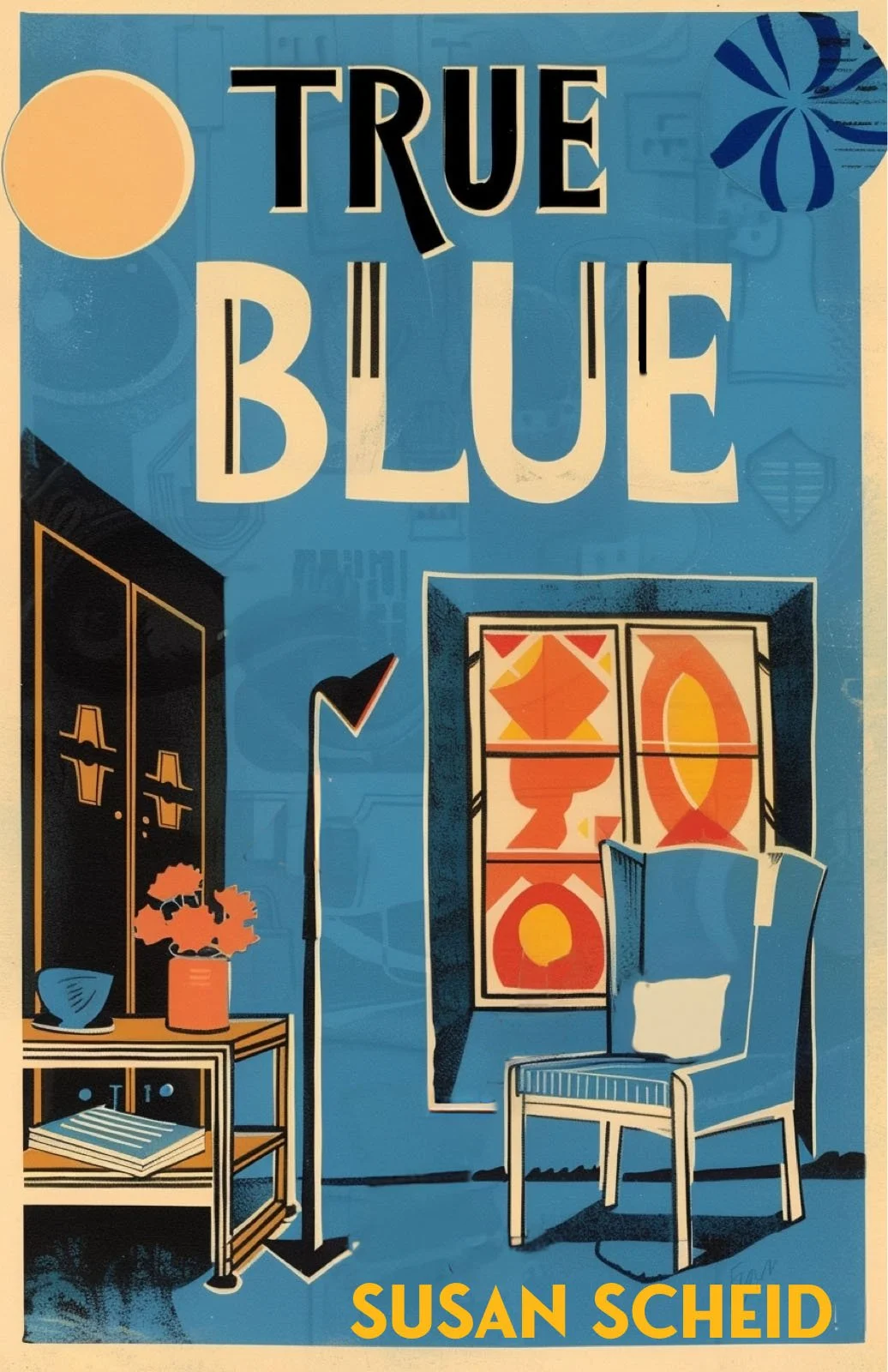
True Blue is a more than worthy addition to her publications. Scheid’s eye for details and her way with a well turned phrase are everywhere apparent, as in “Driving Home”:
There is something about the barn
sitting in solitude amid miles of empty fields
sunlight fills the chinks with corn-colored light
brightening a landscape, where everything
is a different shade of grey.
If hope is the thing with feathers
it is nesting in this barn….
The sudden turn from observation to deep feeling is characteristic of this poet.
Elsewhere, the poet shares memories of childhood and a mother’s love through a similar use of homely details, like a recipe:
There is nothing sacred
about the lemon juice
extracted with bits
of pulp, a random seed,
and added to a family recipe.
But it doesn’t belong.
This recipe was born
in a Midwest kitchen,
amid five kids and no money….
Even as it brightens, this lemon
is out of place
for tastebuds accustomed
to the bland,
made by a mother
who was used to creating
the just-one-more meal
from the ordinary bits
found in her cupboard.
(“Family Recipe”)
Or in a letter to her mother written and left on her gravesite:
Last night I heard a voice say
you were born in the afterlife
I don’t believe it.
Otherwise, I would be sharing a cup
of Constant Comment tea with you,
instead of leaving the pages of this letter
to blow across the pink granite of your name.
(“Letter to My Mother in Her Absence”)
Scheid also relates her own experience as a mother in poems such as “Journey,” which describes taking her son to college:
When we descend to the city’s edge,
Sam declares before the bridge,
“I will only cross this river once,”
meaning that he will not return….
It’s strange to think how empty
the return trip will be,
like Charon and his ferry—
passage only guaranteed one way—
and I, like Demeter, will
barter for a temporary return.
Eat all the luscious red
fruit you want my child.
Be careful of the seeds.
While the pandemic hovers over and around the entire collections, it occasionally puts in an actual appearance::
In a fit of sleeplessness
I realize that I have moved
from anxiety to resignation.
Knives no longer hollow me….
I don’t know if
this dreamless state
is called insomnia or silence
but I’ll drink
from its cup of inky calm
and listen for the sound of metal
hitting the floor around me.
(“Juggling Scimitars”)
That sound of metal hitting the floor is almost perceptible.
Or this heartbreaking depiction, quoted in full, of grief becoming generalized as no relief seems to be impending:
The Weight of It All
Grief grows stronger
as days dwindle by.
We feel the dead walk closer to us,
exhale leaves from their throats.
Grief pours down in golden rays
in the afternoon light,
hangs through bare branches.
We watch Grief shape shift like clouds
racing and returning for days.
What we see is what Grief carries:
all that once was
all that lies ahead.
We burn candles,
to bring in the light, otherwise
we would collapse
from the weight of it all.
The nurturing chaos of nature is contrasted with that of the mind under siege:
where does tranquility exist
the garden thrives on chaos, wild seeds floating in wind
or planted by bird droppings, detritus of squirrel snacks
chaos of the mind is a different animal….
the mind refuses to be tamed as it wishes to be tamed
a conundrum, an enigma, a roadblock
(“Meditation on Chaos”)
But one finds joy or the promise of joy here as well. In “Catharsis,”
Amazement arrives in small packages:
a ground pine poking through dead leaves,
snowy white birch limbs splayed along the trail,
the crisp line of darkness along the ridge at twilight….
It grows slowly,
bathes us in soft fall color
as we remember how to breathe.
The poet is also given to using deft touches of wit:
In evening, the sun refuses
to lay down quietly, instead
it rouses cardinals and robins
to scratch for seeds and crumbs,
sends low-flung beams
to ricochet on walls
long after dinner.
(“The Sun Is an Insomniac”)
Even outright humor is not absent.
Life is Beautiful
I have a tiny Pollyanna
hiding deep inside me.
She sees good everywhere.
She believes the world to be
a beautiful, happy place.
I know she isn’t real,
but I don’t tell her.
I don’t want to hurt
her tiny tender feelings.
Whatever the situation observed or emotion rendered, True Blue is the work of a mature poet working at top form.

Susan Scheid has authored two books of poetry: True Blue (October 2025) and After Enchantment (2012). Susan’s poetry has appeared in a number of literary journals as well as the anthologies, Dear Vaccine: Global Voices Speak to the Pandemic, Enchantment of the Ordinary, and Poetic Art. Susan has received several Individual Artist grants from the DC Commission on the Arts and Humanities. She lives in the Brookland neighborhood of Washington, DC. Learn more at her website.
Gregory Luce is the co-founder and poetry editor of Washington Unbound. He has published six chapbooks. He lives in Arlington, serves as Poetry Editor of The Mid-Atlantic Review and writes a monthly column for the online arts journal Scene4.