A tense, gripping story of survival

Review of Casualties of Truth by Lauren Francis-Sharma
By Norah Vawter
Prudence Wright has made it. She’s overcome a traumatic past, beaten the odds, and is now living a comfortable, upper-middle-class life. Perhaps even the American Dream. Big house in Washington, D.C. Gorgeous clothes. The occasional fancy night out with her husband, Davis. She and Davis are well-educated, cultured, accomplished, and beautiful. And yet she is weighed down by personal challenges—including the stress of raising a child with special needs—and the constant reminder that the color of her skin defines much of her reality. A Black woman, Prudence is never free from racism in the present, or the violent legacy of race in America—and indeed the world.
Lauren Francis-Sharma’s novel Casualties of Truth (Atlantic Monthly Press, 2025) begins and ends in the United States, but alternates between this 2018 D.C. and 1996 South Africa, when Prudence was an idealistic young law school student in the aftermath of Apartheid. The story focuses on the secrets and trauma of her past that she’s tried to bury, and her mysterious ties to a South African man, Matshediso, who she knew during that time and who’s suddenly re-entered her life.
This is a tricky book to write about without spoiling the plot, because it’s a story about digging into the past and uncovering hidden truths. So I won’t give away much more about the plot, but I will say that the connection between Prudence and Matshediso is key.

[Lauren Francis-Sharma. Photograph by Elliott O'Donovan.]
Francis-Sharma has published two previous novels, including Book of the Little Axe, which was a finalist for the Hurston Wright Legacy Award. Based in the D.C. area, she is becoming an author to watch. While the novel is not autobiographical, the idea was inspired by Francis-Sharma’s time in South Africa in 1996. Like Prudence, she interned during law school in Johannesburg and took careful notes at the new government’s Truth and Reconciliation Amnesty Hearings. This was clearly a transformative experience for her, and by writing this novel she offers readers a glimpse into the horrors of the recent past and the murky complexities of a country trying to reckon with the past and move forward in the present.
“Prudence had rarely thought of herself in the context of an ‘us,’ and since she’d been in South Africa, she hardly understood how to think of herself at all. Despite believing she might feel some sense of belonging in Africa, she, in fact, had felt more alone than ever. And the work with Sheryl in the prisons didn’t help. The visits had been affecting her deeply. Seeing the young boys there reminded her of the air of dread that hovered over Baltimore after crack poured into that city. Some afternoons inside those prison walls she felt terrible sad and oddly guilty for how far removed she was from the prisoners’ plights.”
Casualties of Truth is equal parts wry social commentary, scathing socio-political critique, and psychological examination of violence, trauma, and revenge. It asks important questions about what it means to be human in inhumane conditions, as well as about identity, belonging, and survival. The novel flits back and forth between the mundane and the extraordinary, rendering—in careful, minute detail—both scenes of ordinary life and moments that rip the characters away from the ordinary.
Woven throughout is an exploration of sex, gender roles, and the patriarchy—ranging from lighter moments of social norms and expectations to visceral moments of sexual assault that demonstrate the inherent risk of being a woman in a male-dominated society. It also invites the reader to think about white privilege and the stress people of color endure when entering white-dominated spaces—whether it’s microaggressions that make a person feel unwelcome; overt racism that makes a person feel unsafe; or danger that shifts the individual from a feeling of unsafety to true, physical unsafety.
The subject matter is heavy and at times painful, with some sections of the novel exploring violence in visceral and truly upsetting depictions. But it’s grippingly well-written, a character-driven story that would be compelling even if it didn't explore these larger political and sociological themes.
“A small utterance escaped her lips, her dread and imagination conjuring stark visions of what would happen next. She wanted to see his face. It might tell her what she suspected was true, and yet she was also too afraid to look at him again because she could hear his guttural, weightier breaths like a horn bellowing.”
As I was reading, I expected to need to take breaks—particularly because Francis-Sharma does such a good job at bringing the reader into the scene, provoking empathy, understanding and true heartbreak. And yet, Casualties of Truth is so readable, well-paced, and compelling that I found myself unable to put this novel down. I read it over a weekend, utterly absorbed, picking the book up every chance I got, staying up late to finish.
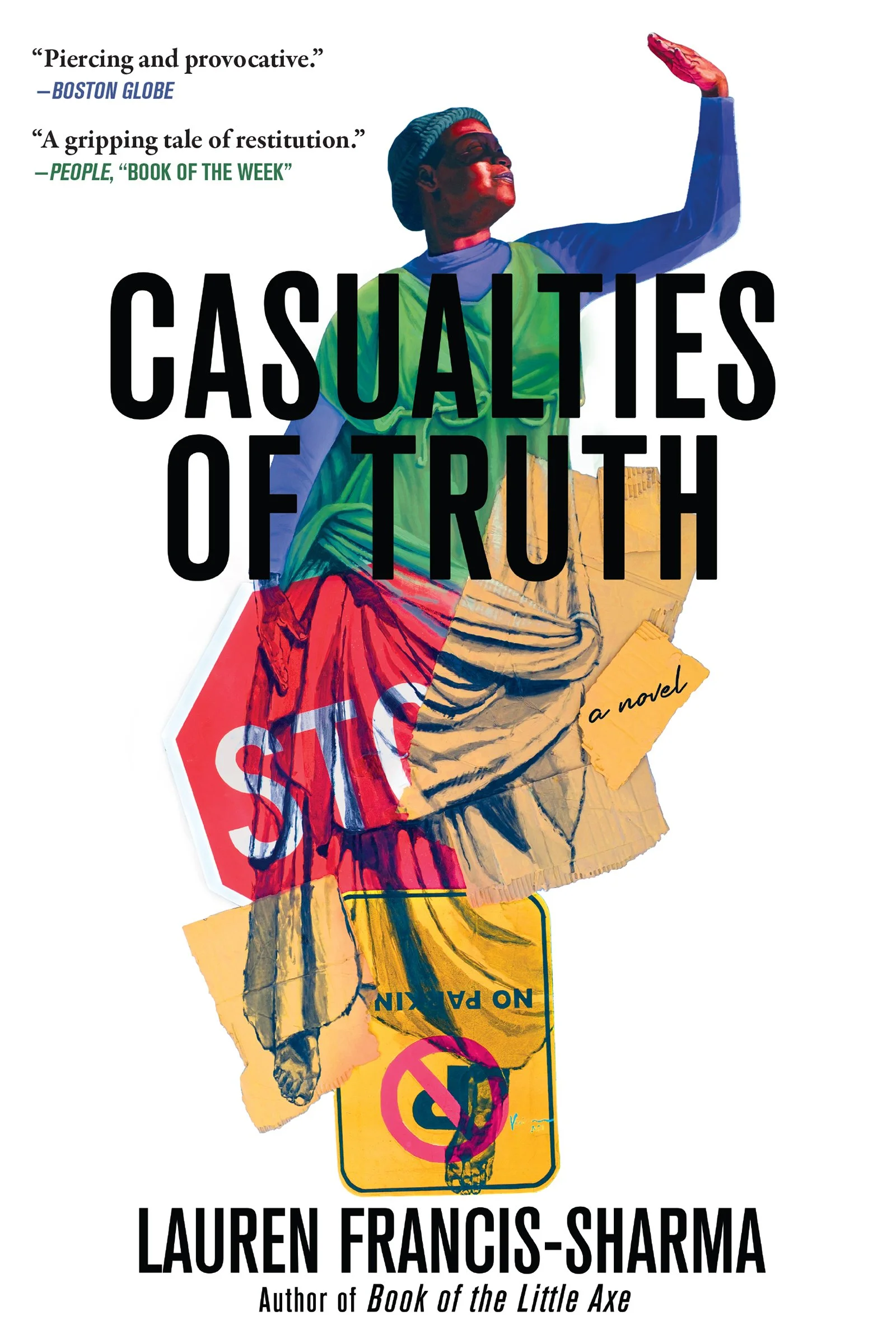
Casualties of Truth is an intense and thought-provoking read that will resonate for readers of color and white readers alike. But differently. For me as a white woman, the novel is a powerful reminder that regardless of other challenges I face personally, I benefit from white privilege by the simple fact that I am welcome in white spaces. Automatically. Even wealthy spaces, to a certain degree. I’m not as wealthy as Prudence. But I don’t have to be. The color of my skin and basic politeness gets me in the door. These are the effects of white privilege, and the legacy of systemic racism and the horrors of the past our culture has never fully reckoned with.
One casualty of truth is comfort, and this novel is often a tense, uncomfortable read. But despite the focus on the murky, even depraved aspects of human nature, at the core of this story is something like hope. This is a story of survival. Prudence shows us what it means to survive, to persist, to keep moving forward each day. To insist on living.
Buy your copy of Casualties of Truth from Bookshop or your favorite local independent bookstore. Learn more about the author on her website: https://laurenfrancissharma.com/
Lauren Francis-Sharma is the author of Book of the Little Axe, a finalist for the Hurston/Wright Legacy Award, and the critically acclaimed novel 'Til the Well Runs Dry. She is the Assistant Director of Bread Loaf Writers' Conference at Middlebury College and resides near Washington, DC, with her family.
Norah Vawter is the co-founder and fiction/nonfiction editor of Washington Unbound. She’s a freelance writer, editor, and novelist, represented by Alisha West of Corvisiero Agency. Follow her on Instagram @norahvawter and check out her Substack, Survival by Words.