
America is a mother
A review of Echoes Carry by Serena Agusto-Cox
By Gregory Luce
Echoes Carry begins with three poems entitled “America is,” each of which articulates some of the themes that Serena Agusto-Cox presents in her fine debut collection.
America is
my immigrant father, who shares
his horticulturist spirit.
An aging American,
who saw both his parents succumb.
(First poem in series.)
the widower who talks, listens
to my disabled brother, a man
with a child’s mischievous nature.
Shows him a golf swing, he’ll re-teach.
(Second poem in series.)
a mother in hot laundry sweat,
basements of nursing homes,
mental hospitals, adding food
to the table, paying the bills.
(Third poem in series.)
Multiple traditions, immigrant roots, the hard labor of making a life in the United States, the joys and sorrows of family life: Agusto-Cox treats all of these and more in this remarkable book.

Serena Agusto-Cox has been writing and publishing poems for many years, in addition to her service as an exemplary literary citizen of the DMV. She works as an editor of The Mid-Atlantic Review, supports writers through her blogs and reviews (including contributions to Washington Unbound), and as poetry coordinator of the Gaithersburg Book Festival, one of the area’s premier annual literary events. Yet she has not published a book until now. Echoes Carry makes a strong case for not rushing into book publication. Agusto-Cox has spent these years well, honing her craft, taking feedback and guidance from both peers and well established poets, and reading her poems in public. Her long apprenticeship has paid off splendidly in this gathering of her work.
Rather than engage in analysis or cataloguing themes, I prefer to present samples to demonstrate the richness and variety of the collection and the beauty of the poet’s language. For example, the poem that follows the three openers is called “Copper Peaches,” mixing the softness and flavor of the fruit with something cold and hard. It is a poem of memory, regret, and sense of loss:
Slipped through my fingers,
brown without rainbow dye,
they are brittle and become dust in hand.
An empty peach hourglass….
Rest upon the ground
bruised from impact and careless trampling
Swiss cheese foil
bronzed and useless for wrapping.
I’ve walked down this wooded way
lined with pine guards armed with sharp needles.
Carelessly treading on crisp rice
echoing pain in the shade.
In “Pergola,” the poet remembers her Vovó (Portuguese for “grandmother”).
I never grew out of cookies
and milk
I grew in.
Someone reflective,
not out loud.
Even behind the smoke,
I saw wheels turn and wondered
where had you gone?
That trip we took together to the Azores
opened my eyes to the backbone you were
a set of vertebrae to hold a family strong….
I knew then what I realize now
like the smoke we fade.
Dissipate into the atmosphere
touching brief lives,
impart advice.
Grace that layers beneath –
a foundation on which I stand
wavering in this mourning.
In “Family History,” quoted here in full, Agusto-Cox discovers an unexpected Finnish ancestor.
For Mikko Hakko
Boys racing down Boston streets,
bananas in exhaust pipes, loud raucous laughter.
No desire to break rules,
drive a sports car, speed over hills,
I felt left behind by their history.
Quiet. Typewriter clickety-clack,
at the four-person kitchen table in summer sun.
My nana cracked eggs, mixed batter, latticed pies.
I wove stories on pages with rubbed-out errors.
Stacks rose with the warmth of the oven.
Surface relationships over the internet beg
for cultivation. Dig deep, an unexpected history,
a great-great-great-grandfather unearthed.
A Finnish poet, his words unfamiliar to me,
we hold hands over my line breaks.
The outside world is likewise not absent when it pushes its way into the poet’s working life in "Remote Work.”
Home office view of the quiet yard.
The birds bang their heads into glass,
a moment of blindness. Mating songs,
angry tweets, territorial posturing on feeders….
Draft client text, peppered with child-like
giggles, rather than COVID-19’s spread.
Not only ancestors, but a succeeding generation also appears when Agusto-Cox describes her daughter’s experiences as a competitive swimmer in “Fly.”
I've watched her swim a dozen times.
Each time something different. Sluggish
movement, lazy stroke, focused form, but
today, a line of firecrackers lit at once….
She drops nearly 5 seconds,
later telling me she missed her heat,
she cried, but when tears dried
she slipped into emptiness and flew.
The parallel between the young swimmer’s development and that of the poet is inescapable.
There is far more excellence on display here than one review can contain, so I’ll close with the final poem, presented here in full.
The Balm
When aflame, it’s hard to imagine
that the smoke would die out
the embers would no longer glow
but the cracks are fissures
with deep red cores
hard to ignore when you’re bleeding
That blood stains
darkens with time
but the searing pain stays
a memory never lost to age
Imagine your arms
as they curl around your shoulders
envelop you, fold you into child
you’re brought back to innocence
a time when hope was nameless
but the balm was everywhere.
For anyone who has followed Serena’s career, it is extremely gratifying to see her work come to fruition in this excellent collection.
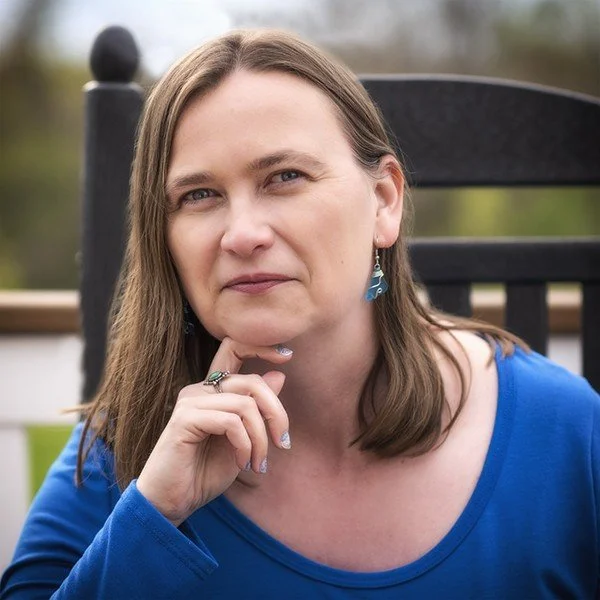
Serena Agusto-Cox is a Pushcart Prize nominee, editor at The Mid-Atlantic Review published by Day Eight.She coordinates poetry programming for the Gaithersburg Book Festival. Her poems appear in multiple magazines and anthologies. To help poets, she reviews and markets collections through Savvy Verse & Wit and Poetry Book Tours respectively. Echoes Carry (2026, Beltway Editions) is her debut poetry collection.
Gregory Luce is the co-founder and poetry editor of Washington Unbound. He has published six chapbooks. He lives in Arlington, serves as Poetry Editor of The Mid-Atlantic Review and writes a monthly column for the online arts journal Scene4.