When Respecting Your Elders Isn’t Quite Right
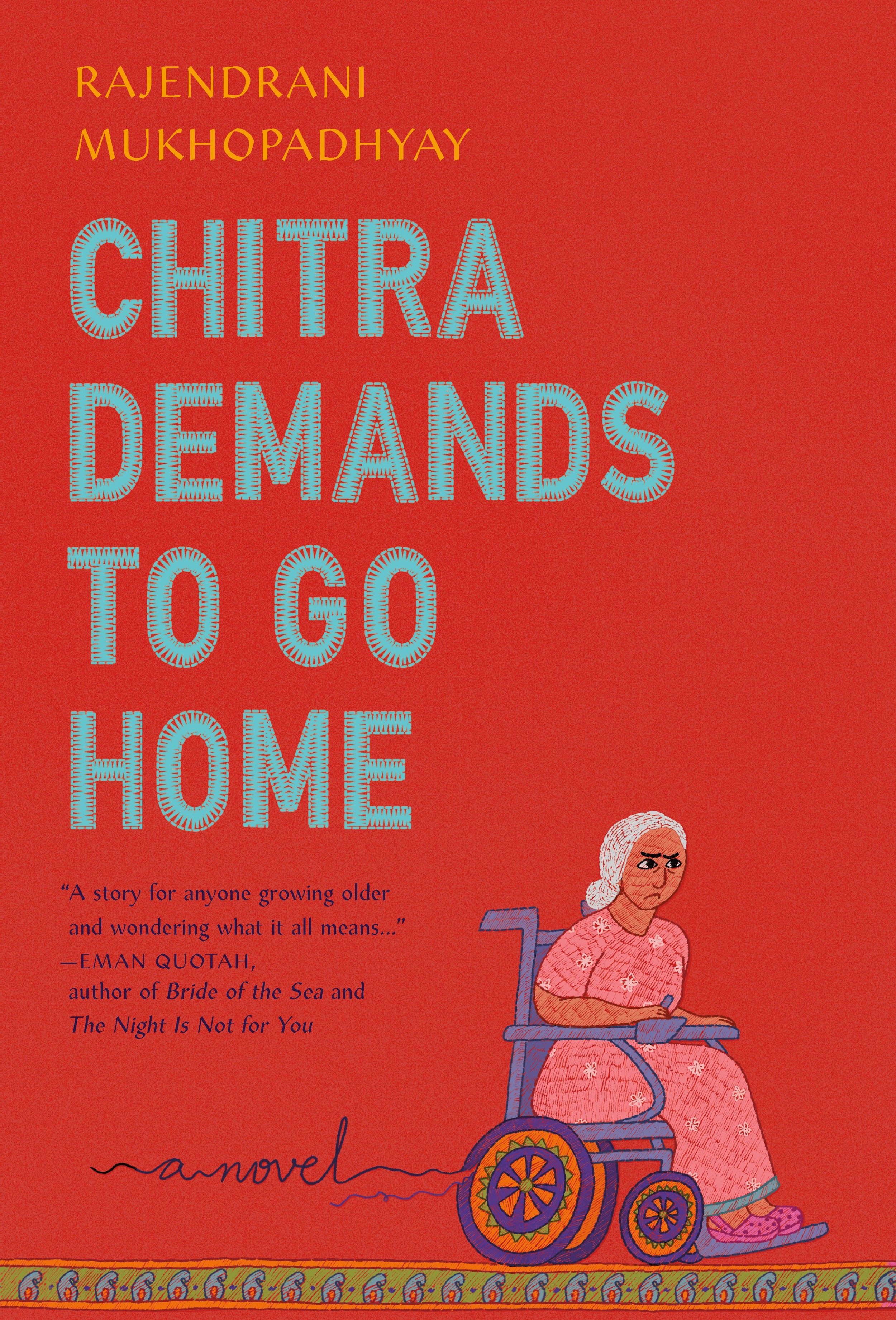
A review of Rajendrani Mukhopadhyay’s Chitra Demands to Go Home
By Katy Gathright
A couple of years ago, a friend told me that she loves to see an old person in a story. The context: a lot of novels and stories don’t feature the elderly, and it sounded a little transgressive to even want such a thing. We gravitate towards coming of age tales, or stories of middle age crisis. Just a couple years ago, Miranda July’s All Fours seized the literary imagination because it featured a woman on the verge of menopause. That was supposed to be pushing the boundaries of a woman protagonist’s age. But what about the actual elderly?
When we do get an older person in a story, they’re often softer, wiser than the other characters. Or, they’re entertaining because they don’t care anymore, have lost their scruples, and charm us as a result.
Chitra, of the eponymous Chitra Demands to Go Home , (Modern Artist Press, May 2026), is neither soft, wise, nor charmingly grumpy. I can’t say I love her for it—her personality is prickly without much to balance it out—but in this debut novel from Rajendrani Mukhopadhyay, I found myself loving the story precisely because Chitra is a character to chafe against.
Chitra is a 75-year old Bengali woman who finds herself stuck in an assisted living community in Ohio after a stroke compromises her ability to take care of herself. She is widowed and her two sons, one of whom she was visiting when the stroke occurred, decide they are unable to take care of her themselves. But she feels strongly that she does not belong in this community—Tranquil Town—and should be sent back to her house in Kolkata, India as soon as possible.
The book’s appeal, to me, was ultimately a triumph of reality over expectations. My expectation was to feel sympathy for this older woman, marooned in a depressing environment, homesick out of her mind, and forgotten by her family. But without giving away the entire arc, Mukhopadhyay is doing something much more interesting: asking us to witness a character whose fish-out-of-water state does not engender sympathy, whose non-American background does not absolve her of her behavior, and whose attempts to grow remain stubbornly nascent, like a seed that cracks open but does not sprout.
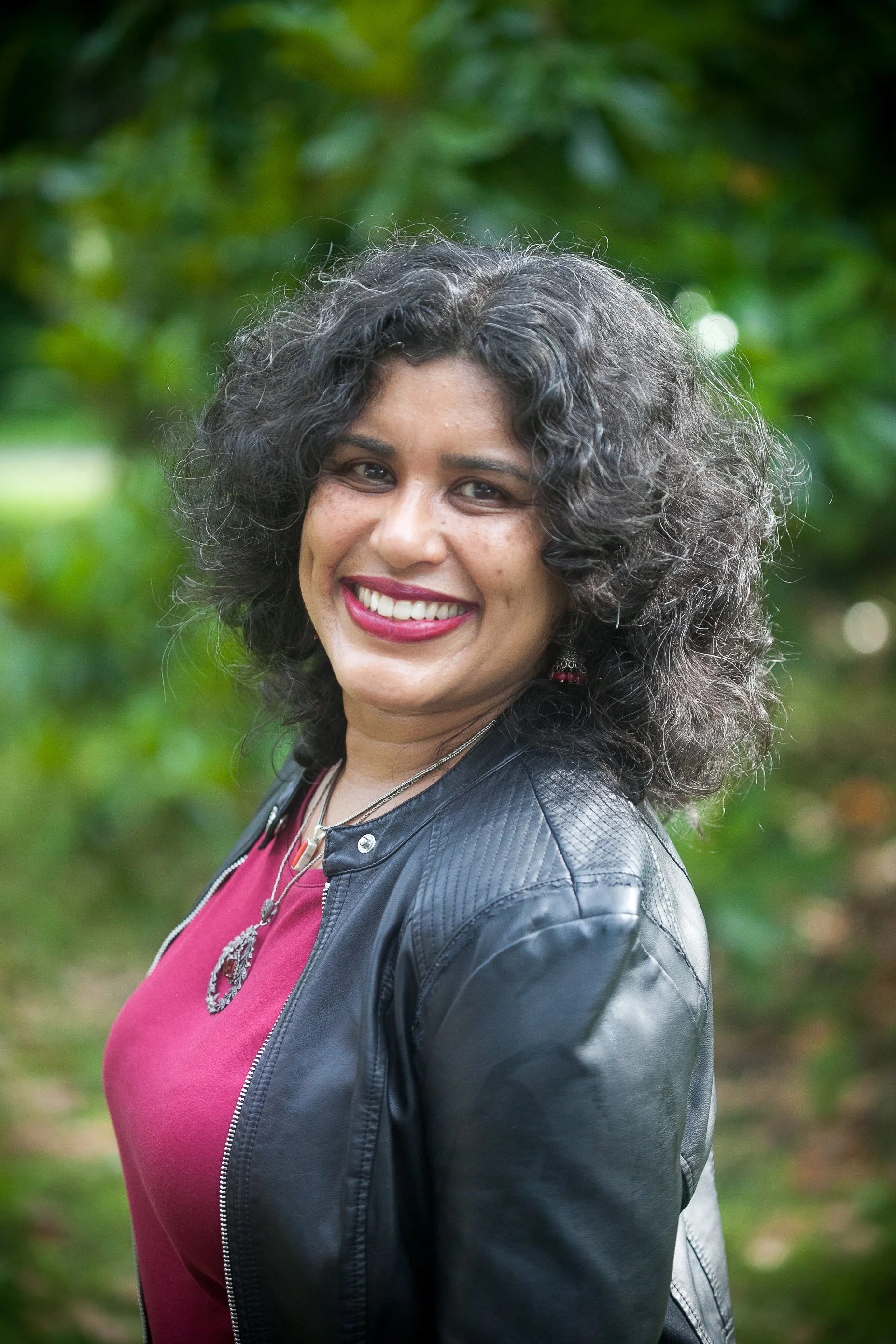
Author Rajendrani Mukhopadhyay
Mukhopadhyay presents the evidence for Chitra’s delusions with matter-of-factness, particularly in relation to her son Prodosh, the one who lives closest to Tranquil Town. In a passage where she brainstorms ways she could leave the community, the narrator says,
“Undeterred, Chitra suggested that Maya and Ajay, Prodosh and Kathy’s twin daughter and son, could be asked to move back home to help her. Chitra was oblivious to the fact that the twins were in college out of state.”
Mukhophadyay does not give us the back-and-forth argument between Chitra and Prodosh on this point. We hear only Chitra’s point of view; the narrator has enough distance from Chitra to call her “oblivious,” but we are left to imagine how Prodosh and his family feel about Chitra’s uninformed suggestion. It is easy to do so: We have all had that relative who makes assumptions about our abilities and our priorities, without any deep attempt to understand our actual experiences.
That is, a reader does not need to be Bengali to understand the family dynamics at play. Although that does present another way in which this book works against the grain of popular culture. Chitra Demands to Go Home eschews a cultural relativist’s take on Bengali familial duty—on which I have no authority, but which is laid out by the novel as the expectation that you will always prioritize your elders and bend over backwards to meet their wishes:
“As an elder in the family hierarchy, Chitra felt entitled to the hospitality of the younger generation. She seemed to forget the fact that because she had lived in the Arabian Peninsula for the majority of her adult life, she had avoided hosting family members herself.”
The novel makes Bengali familial duty feel three-dimensional instead of a flat, untouchable trope belonging to foreigners, as you might see in less sophisticated narratives. Yes, Chitra comes from a non-American cultural background. But the ways in which her own family relates to that background are universal: There are always limits to what you will give. The narrator is sympathetic to those more reasonable interpretations of filial piety, and it’s not just that these relatives are “Americanized” or disloyal to Bengali customs. Her sons, daughters-in-law, grandchildren, nieces, and nephews all set personal boundaries in this book. It is profoundly interesting to see what happens when those boundaries come up against a woman who is very strict in terms of emotional vulnerability, but boundless when it comes to her external demands.
Of course, because this is a novel—and a skillful one—there is movement, both in terms of Chitra’s perspective and several reveals that affect our sympathies for the cast of characters. There is also a friendship that blossoms. But these movements are subtle, and the real beauty of the novel lies in its unsparing accounts of Chitra’s particular brand of self-awareness: “She was feeling something deep in her and was struggling to place the feeling. It came to her: empathy. For the first time in a long time, Chitra acknowledged the same emotion in someone else. But as she thought of what she and Helen shared, she was certain that she felt her loss more acutely than Helen” (89). It is not so much that Chitra lacks self-awareness. It’s that her knowledge of self simply doesn’t prioritize others.
Mukhopadyay, who lives in Bethesda, Maryland, has a writing background that skews more scientific than literary, with a Ph.D. in biochemistry and cellular biology and a long career in science communications. But she writes with the confidence and concision of a seasoned novelist.
When it comes to family dramas, especially intergenerational ones, we are used to the latter format, sprawling narratives that let each family member contribute grace notes that bring larger themes into focus. These themes are satisfying because we all have families, and the long family saga is a particularly good format for reminding us that our own familial discontents put us in good company.
Chitra Demands to Go Home serves up that same satisfaction, but in the unlikely package of a tight, slim novel. I love a sprawling, messy saga, but this novel could make anyone a convert.
Preorder your copy of Chitra Demands to Go Home directly from the small press or from your favorite local independent bookstore. Scroll down on the link above to find book club discussion questions and a recipe card for Chitra’s Bengali fish curry.
You can attend the book launch on May 13 at Wonderland Books in Bethesda. Author Raj Mukhopadhyay will be in conversation with Eman Quotah. Details here.
Rajendrani Mukhopadhyay, who goes by “Raj”, originally trained as a scientist. After earning a Ph.D. in biochemistry and cellular and molecular biology, Raj launched a career in science communications. For nearly two decades, she worked as a science storyteller in various forms, including as a journalist and the leader of an award-winning custom content studio. Her science writing appeared in several print and digital outlets in the U.S. and the U.K. Raj was selected by Poets & Writers to be one of the 2025 Get the Word Out fiction fellows. Chitra Demands to Go Home is her debut novel. Raj has lived in India, Kuwait, and Canada. She is now based in the U.S. with her partner, two children, two dogs, and two cats.
Katy Gathright is a writer and a marketing director. She has been published in The New York Times, The Hopkins Review, Allium, and elsewhere. To learn more, visit: katygathright.co.