An interview with Hasan Dudar
By Norah Vawter
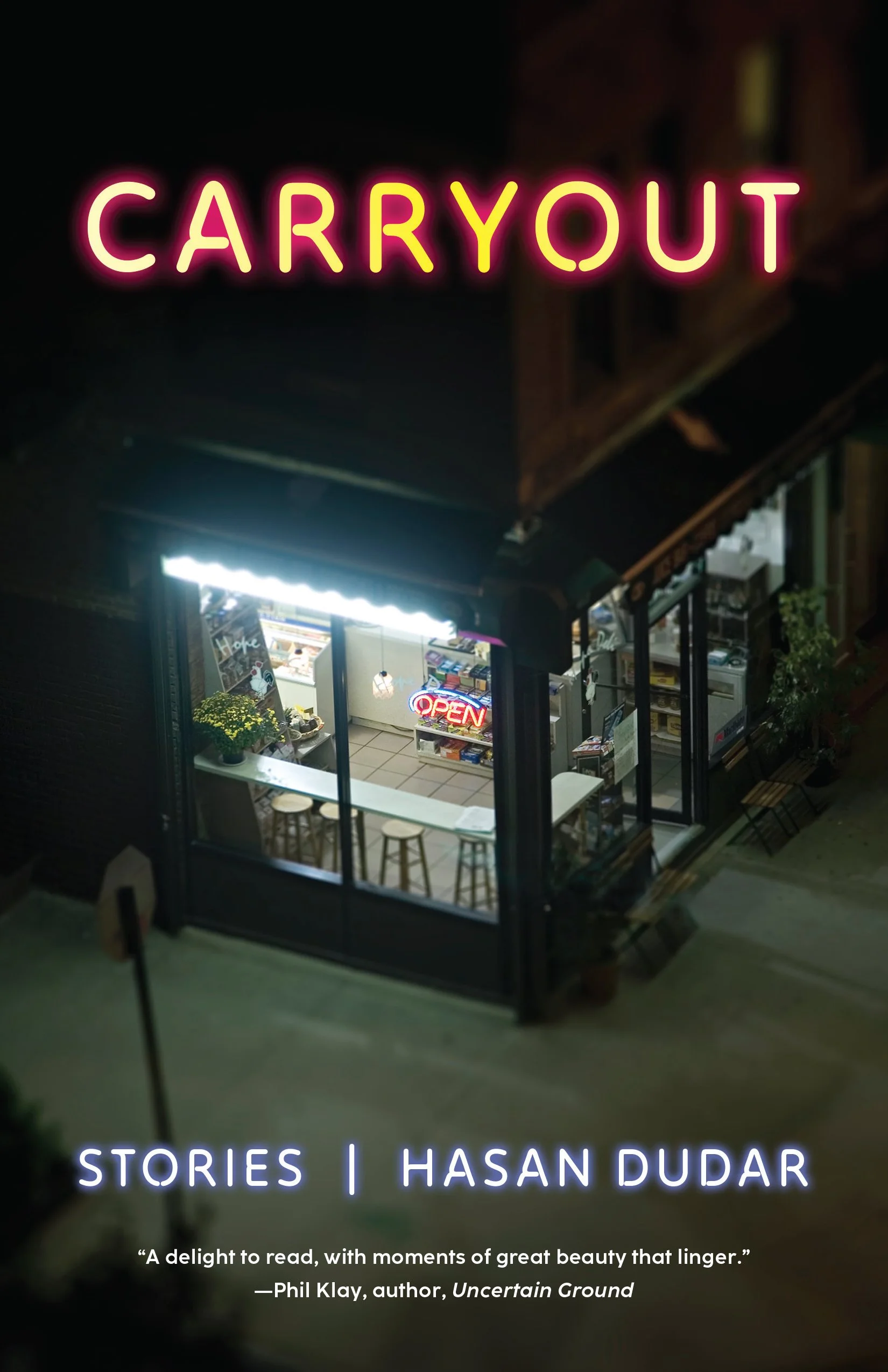
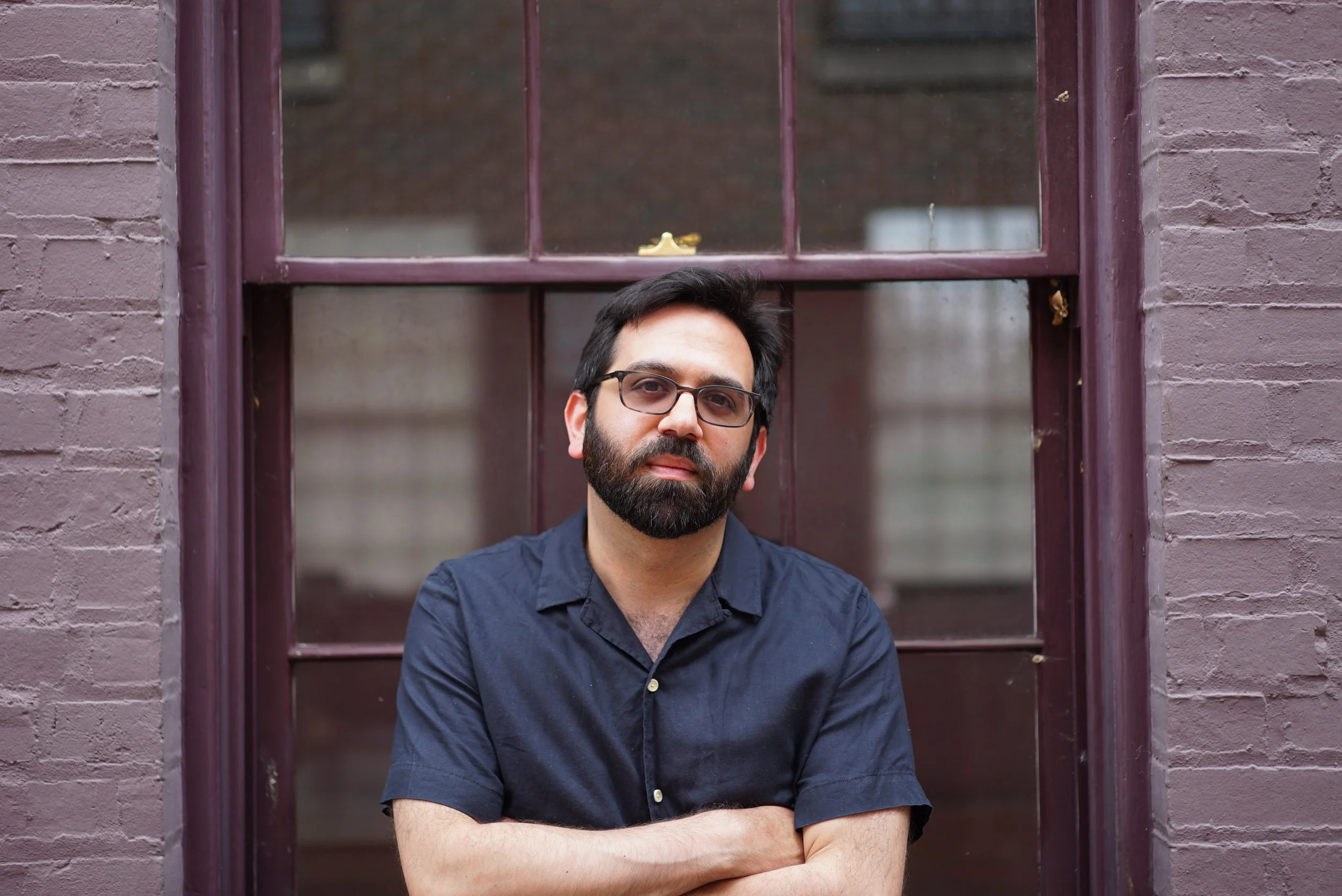
Hasan Dudar’s debut book is a collection of linked stories, Carryout (University of Iowa Press, 2026), centered on a community of immigrants, particularly Palestinian and Lebanese refugees, living in Toledo, Ohio. Dudar grew up in this community, and though he is a journalist by profession he found himself drawn to exploring these stories in fiction. A graduate of the Berkeley Graduate School of Journalism, Dudar has reported for outlets such as USA Today, Detroit Free Press, The Toledo Blade,Bloomberg News,TRT World, and Al Jazeera America. He also co-produced an award-winning documentary, The Last of Little Syria, focused on the last residents of Toledo’s once bustling Arab enclave.
Dudar has lived in the D.C. area for the past eight years and currently works in broadcast media. He was kind enough to join us for a conversation about community, belonging, immigration, choosing to be a writer, and why he chose short stories over a novel for this project. It was a truly delightful, thoughtful, and eye-opening conversation. I left feeling so inspired, and thinking about how I can bring some of these ideas and perspectives into my own fiction, and into my future reading and reviewing.
WU: Can you introduce yourself to our readers? How did you begin writing fiction as well as journalism? And how did the story collection Carryout come to be?
HD: I'm a writer based in Washington D.C. I grew up in Toledo, Ohio, and this collection, Carryout, is mainly set in Toledo, so it's a Midwestern city, kind of mid-sized, next to Detroit, very industrial. [When] I was growing up there, it was going through a lot of de-industrialization and some rough economic times. I was always interested in writing about the city. It's home, and I felt I had a unique and great childhood there. There's a rich immigrant community in Toledo, which I think is kind of overlooked. There’s immigrants from all over. Hungary, Poland, Ukraine. One of the larger groups is the Lebanese, Palestinian, you know, Muslim immigrant group. So there's a very large diaspora there, and I grew up in that community. I was surrounded by it. I didn't want the book to just be about the diaspora or immigration. I really wanted it to be rooted in this community that I think grew organically and kind of became its own thing.
And I felt it was a very unique place in the U.S. I was so drawn to telling stories from that place, from that perspective. From a very young age. I [didn’t write these stories until] I was much older, but I was always inspired by where I lived, where I grew up, by the people who surrounded me, and yeah, I wanted to tell stories in that sort of vein. [About people] being displaced but also forming something out of that displacement, something that's wholly yours. You might have become rootless in the process of leaving Lebanon, or Palestine, or what have you, but you're in the process of growing something new here.
I wanted to explore what comes out of that, what comes out of that kind of process. What feelings come up? What sort of community can grow from that? Belonging, and any kind of, well, hope, or things to look forward to. No matter how small. So I [came to write] fiction quite naturally. I don't know why as a kid I envisioned telling these stories fictionally, building this kind of world out of what inspired me, but making it a fictional world, a world of its own.
I came into journalism kind of by accident. I was studying political science in college, and I didn't know what I wanted to do. I remember learning, oh, there's a student paper, that's interesting, what's that about? I submitted an article, and it got picked up. I thought, this is really great, and I can keep doing this. They brought me onto the paper, and I became an editor there eventually. I really love being in the media. I love reporting on things, and so it just took root quite spontaneously from there. And I think that entire time I still knew I wanted to write a book.
I wanted to write something, and I think that journalism and media appealed to me because it's very near.... Obviously, it's a different kind of writing, but I felt it would put me in those waters of getting out into the world, meeting people, coming across many different kinds of things, many different ways of being, and getting out of my shell, getting out of my own little bubble. And so I think I always gravitated toward a life in media. I've been doing that for more or less the last 15 years. Now, I'm not necessarily working in journalism per se, but I'm in the broadcast side of things. So TV, but broadcast operations.
WU: That’sall so interesting, and I love how it's kind of interweaving, like a collection of linked stories. Were you always writing stories as a kid, or was it just an idea of what you wanted to do someday?
HD: Interestingly, I wasn't always writing stories, not in the sense of actually putting pen to paper, nothing like that. But I always felt surrounded by stories. My parents were always telling me stories. They had an eye for the strange detail, and those details always stuck with me somehow. You take a few details, and your mind can kind of expand them, and it becomes something else. And so I think I was kind-of-maybe storytelling. Internally, in some sense, during those years. But I wasn't actually putting pen to paper. [It was not until] I was in high school, late high school, that I started to write some poetry, try my hand at that. And toward the end of college, I attempted a novel, not really in the same vein as the collection, but I'd given it a shot, and I didn't get very far. Then I was introduced to short stories, when I went to graduate school. I was taking undergraduate writing seminars, and they were in short fiction. I thought, okay, this is a form that I think might work.
WU: You have at least two sides of your writing career, and I understand that as a journalist you're interested in maybe not just facts, but in getting texture and then reporting and learning more about people. But I was wondering if some of the attraction of fiction is that it allows you to present people in a more multifaceted way, and maybe if you're talking about a story about a specific community, fiction allows you to combine multiple points of view and get more than one single story, because most human interactions are multiple.
HD: That's a great point, and yeah, I would agree with that. You can do a lot with journalism in terms of following a great character, or an individual development, but I think with fiction, you can combine a lot of different perspectives, and it can kind of be polyphonic, and you can be a bit more subtle. I think in journalism you need the person to actually speak. In fiction, you can build a world of subtleties. I think most of our world, and most of our life, is built on these subtleties. People are rarely that direct. There's beauty in that, because I think it's part of human connection that even when we're not direct you can still understand what is being communicated, what this mood or atmosphere is. I think fiction allows room for the unknown, right? Whereas in journalism it's, what's the known?
I would meet folks for stories, and sometimes I would feel, oh this person's so interesting. I would go for some random kind of municipal story. The person is really fascinating, and I can't put my finger on [why]. But there's a story behind this person, there's something more here. In fiction, you get the license to [create that story].
WU: As a fiction writer myself, I'm really resonating with what you're saying. It's making me think that so much of fiction is about the unknown. And the uncertain. These uncertainties, these questions, can we ever really know anyone else? So you’re giving me a lot to think about. I would also love to hear more about this immigrant community in Toledo. I'm fascinated by the picture you’re painting of so many different people in this community, from different backgrounds. Are they in community together? Or are there separate communities?
HD: Toledo is really unique. Historically, there were little enclaves. So there was a community called Little Syria, and I don't know how large it was exactly, but it was this little area north of downtown Toledo, and the way folks described it, every other house was either Lebanese, Syrian, or Palestinian. So there was an actual enclave there, dating back to the late 1800s.
So, it’s a very old historic community, and four or five decades ago, it started to empty out. People moved to the suburbs and that sort of thing. Around 10 years ago, I did a short documentary on one of the last remaining families in Little Syria, and it was a lot of fun.… I think the Hungarians were mostly on the east side. There's a really famous place, Tony Packo's, there. I think that each place did have its own little corner of the city, but then it became very mixed. I think people just went their own way.
I can only speak for the Muslim and Arab people there, but even though I didn't grow up with this kind of enclave, I still [experienced] that kind of atmosphere. It still was very connected. People were still very much part of the city, part of Toledo, part of their neighborhoods, their communities, but also very much in touch with each other. There were always gatherings and outings at the parks, and people coming to each other's homes, and families would congregate in one house. [When I was growing up] my eldest uncle on my dad's side [lived one house over from us], and if someone came over to his house, they came over to our house. Sometimes the adults would be all at my uncle's house, and the kids would be in our yard. So, it was this dynamic and spontaneous and very organic community.
WU: I'm always so drawn to fiction with this strong sense of place, and we have so many stories that are set in New York City or in California, we’re often not getting enough of these specific settings in the Midwest, for instance. Though I think that's changing. How did you approach using the setting in this fiction? Were you still in Toledo when you started to write these stories?
HD: I was in Berkeley. Yeah, I was in California. That was the farthest I'd been from home. I was in graduate school. I wasn't sure if I was gonna stay there for good. And I was really missing Toledo and Ohio, and that whole area. I hadn’t realized how much I missed it, or how much it meant to me. California is such a beautiful place. It's unrivaled nature, and beautiful communities and cities, and I love it. But I just missed that sense of community. And I missed my family, of course.
WU: Yeah, your home.
HD: Yeah, I missed home. I missed the atmosphere of people coming by, bumping into people, things kind of happening spontaneously and naturally. I had a great time in Berkeley. I loved it. It's a wonderful place, but yeah, I would go back home on visits, and my parents weren't working at the time, so they always had visitors over. It was kind of frustrating because I wanted to see them on these visits, but it also made me realize how special that was, right? And how special it is to have a community and people who you can share part of your life with. And connect with, joke with, share stories or argue with. It felt priceless to me. So I was working through that material in Berkeley. I would say that the bulk of [the book] was written when I moved back to Toledo, after graduating. I stayed with my parents, and it was very much the same thing. Several years of nonstop people coming and going, but I really relished it, and didn’t take it for granted.
This was kind of a vanishing world. A lot of the younger people were [moving away. For example,] I'm in D.C. now. So I felt [the world I grew up in] vanishing, and thought, this is what's so special. It could be lost, and I wanted to chase after that. I started to be much more intentional about drafting these stories. But life happens. My parents were going through illness and such. So I took my time with [the stories]. I lived my life and tried to be present.
Going back to Toledo gave me confidence to go through with these stories and this project. They weren’t all drafted there. I wrote in Toledo, I wrote in Detroit. I can't remember if I wrote any of this in Egypt when I was there. I feel like the bulk was in D.C. I finished a lot of drafts here. It takes a while.
WU: Did you grow up speaking mostly Arabic or mostly English, or were you pretty much bilingual from the very beginning?
HD: I can't remember if Arabic was my only language [when I was very young]. I imagine that it must have been at some point, because my parents were both Arabic speakers and spoke Arabic together, and I was surrounded by a lot of my dad's immediate family. So I remember growing up, speaking a lot of Arabic from a young age. Of course I knew English, but at home I spoke a lot of Arabic. My parents spoke predominantly Arabic with me, and maybe with my siblings, mainly English [between us]. Also my uncle lived right next to us, and so I was over at their house all the time, and they exclusively spoke Arabic. He spoke really good English, but he was very adamant. So, yeah, I grew up bilingual.
WU: Has that had an effect or impact on your writing at all, or the way you approach language?
HD: Sure. English is a great language. I think it’s so nimble and you can do so much with it. But I do find some things, for instance, humor…I think that there's some ways that Arabic allows for humor because you can structure sentences in so many different ways. I’m no grammarian or anything. But you do a lot of different things with how things appear in sentences. I don't know if that necessarily appears in my work. I haven't analyzed it looking for that specifically. I do feel sometimes when I'm thinking of something, [I don’t necessarily think about it] in the Arabic language, but there's a perspective I think, that the language gives. There's a certain humor, a certain sensibility to it, and I think that there is a lot of playfulness. In daily talk, there are also a lot of formalities. There are a lot of idioms that are quite formal and, in some sense, when you think about them, they're deep kinds of things, but I think the formality also gives you room to lampoon it a bit, or have a funny take on things. When someone is very formal, there's a lot of humor in that. You can dress it down. So, I can't give any specific examples of that from my work, but I am aware that sometimes there's two different ways things are operating in my mind.
WU: I have a question about how you navigate politically charged topics in your fiction. I can tell that your focus is on people, relationships, and communities, not necessarily on politics. But how do you approach ideas about immigration and race and class? And are you thinking about these as political ideas ever, or are you simply thinking about the motivations of individual characters?
HD: I wouldn't say that I'm thinking [in terms of] political ideas. [Unless] I'm in some sense thinking of what traps do I not want to fall into. Or maybe trying to subvert ,or flip, or take a different look at [something familiar]. For instance, you mentioned immigration. Yeah, it's a highly politicized topic, and the question of assimilation and non-assimilation … We use these words, assimilation, but what even [does that mean]? I didn't want to write against anything. It wasn't, oh these characters can't assimilate, or these characters have to assimilate. I just wanted to [demonstrate] that most people are just kind of living their life, and things pop up that might be political, that might be charged, that might be devastating, and they can define your life in some sense, but day to day, you're faced with the mundanity of life. Those kinds of details are many, and in the backdrop there might lurk any number of things, whether it's isolation, or 9/11, or bigotry, anti-immigrant type of bigotry.
I think it was tough to balance, but I was never trying to tackle those subjects. I wasn't necessarily actively avoiding them either, right? I know that these things are part of the characters' lives. 9/11 is part of the life of this community, and of America more broadly. So, it's a tricky balance. But I didn't ever want to feel that I was writing against something.
WU: Or with a message or moral.
HD: A lot of times we have this kind of idea of immigration and assimilation, and an idea of closure, and that was something that came out of the form–writing it as linked stories. More fragmentary. I knew I didn't want to write something that felt like it had closure or coming of age. I think that [there’s an assumption] that at some point any of us immigrants have this kind of final verdict on our life, on our existence, and I don't think that's true. I think some immigrants might feel fully assimilated, and then toward the end of their lives, they might feel, oh man, what am I doing here? Or some people might [spend years feeling] why did I come here? And then toward the end, feel kind of mixed about it. I guess I didn’t want to have this grander narrative that I was functioning under. I wanted to [be working with a narrative] that started from the ground up, and see where it would take me.
WU: I’m curious about the decision to write this as a collection of linked stories. I’m not sure if you would define this as a novel in stories, but why did you choose stories? I’m sure you must have considered the idea of writing this as a novel.
HD: I didn't actually. It's a question that I often get. I think when you're writing anything, you always think, could it be a different form? Or not always, but I think that when you're editing and re-editing, a lot of thoughts come across your mind. I just took it story by story, and I let it grow over time, and I think you could see it as a novel in stories. I’m fine with that. I think readers' interpretations are valuable to me. And now it’s in the reader's hands.
I feel like that's kind of cool, because the reader is filling in something, between the stories. But I wanted them to stand alone as stories, for sure, and I did want it to come together as a whole. You kind of go intuitively, and I felt that something in the story form, and in the linked story form, was doing something for me. It helped me avoid the traditional arc, the traditional immigrant arc, of coming and troubles or assimilating, and then any kind of closure. And it allowed for this fragmentary nature to exist, which I think is, in many ways, the life of an immigrant, the life of a diaspora. It’s fragmentary. At times you feel this way. At times you feel that way. At times you feel you belong. Or you feel on the margins or isolated. [The short story form] allowed that kind of vibe to grow. I was also interested in memory, the memory of a community, of a family, of a people. I think memory is very, very fragmentary. You'll be thinking about one thing here, then another thing there, and they somehow come together and clash. But when I started to put it all together, I realized [what could be contained] within that larger framework of linked stories.
WU: That makes perfect sense. Actually, the more that you're talking about it, the more I see that this project had to be stories, and couldn't be a novel. Linked stories also can be such a great way of approaching community and setting. I do want to shift gears and ask you about another setting. How did you come to the DC area, and what has been your experience with the local literary culture?
HD: This October I think it'll be eight years [that I have been in D.C.]. My wife was down here. We were engaged at the time. I was in Detroit and basically [moved] to be with her. [D.C. is] a wonderful place to write, first of all. It's [great to be in a city that isn’t] too overwhelming, and there's a lot of great institutions that I found. One of them was the Writer’s Center. When I was finishing up the manuscript,and trying to find an agent and get my book out there, there were these mixers [I went to]. I think they were calling them, at the time, immigrant writer mixers. I would attend, and it was mostly social gathering and chatting about writing, and that sort of thing. I had never had a writing community [before], and it's just nice to be around other aspiring writers. It makes you feel not totally isolated. I think when you're writing [it can feel like] you're the only one experiencing what you're experiencing, and it's good to have people who've either experienced it already, or are experiencing it.
WU: Do you have a favorite D.C. area writer? And what are you reading, watching, or listening to now?
HD: There are a couple writers in the area whose work I really admire. Majda Gama, who is a poet in the DMV, and if we can include Baltimore in the area, then Susan Muaddi Darraj, a writer of fiction. I find in Majda's poetry a haunting quality, confronting unknowns. And in her stories, Susan writes from a range of Palestinian experiences with honesty and humor, and I really looked to her work as an example of what is possible. I'm currently reading The Details by Ia Genberg. She is a Swedish author and this book is about a woman recounting about four people from her past and how they've left an impact on her life. It is great, told very conversationally, and it all feels very true to life, in the way that we accumulate these outward details of others and those details stick with us and work on our inner life, guiding us in ways we sometimes only discover after the fact.
Buy your copy of Carryout directly from the independent publisher, or from Bookshop.
Learn more about the author on his website, www.hasandudar.com. And if you want to read more about the book, check out this review in the Washington Review of Books, from our friend Mike Maggio. You can also watch the documentary The Last of Little Syria.
Upcoming events:
This Thursday, September 10, you can attend a virtual craft chat organized by The Writer’s Center and Inner Loop, in which Hasan and fellow fiction author Madeleine Moss discuss short stories versus the novel. Details here.
And next Tuesday, September 15, don’t miss the September Inner Loop Reading, featuring Melanie D. G. Kaplan, Hasan as the Author’s Corner Spotlight, and a great lineup of local writers reading from their work. Details here.
Hasan Dudar is the author of Carryout, a short story collection published by the University of Iowa Press. He is originally from Toledo, Ohio, and currently lives with his wife and daughter in Washington, DC, where he works in broadcast media. His fiction has appeared in Gulf Coast and Pinch, among other places, and was awarded the 2025 Pinch Literary Award in Fiction. A graduate of the Berkeley Graduate School of Journalism, Hasan’s reporting has appeared in various publications including USA Today, Detroit Free Press, The Toledo Blade, Bloomberg News,TRT World, and Aljazeera America. In 2015, he co-produced the award-winning documentary The Last of Little Syria, which follows some of the last Arab American residents living in Toledo, Ohio’s historic Arab enclave.
Norah Vawter is the co-founder and fiction/nonfiction editor of Washington Unbound. Her debut novel will be published by Regal House Publishing in 2028. Follow her on Instagram @norahvawter and check out her Substack, Survival by Words.