
“I often felt better off gone”
A review of Magic Show by Dean Bartoli Smith
In Dean Bartoli Smith’s third poetry collection, Magic Show (Codhill Press, 2026), readers accompany the speaker across space and time to interrogate key moments that have shaped him as an artist – moments both deeply personal, like those involving a childhood bully or a grad school professor, as well as public moments like natural disasters and acts of war. The result is a collection that is at once intimate and expansive, offering readers glimpses into the development of a poetic voice as the speaker navigates tragedies and triumphs large and small.
Smith, a Baltimore native, lived for many years in the DMV and published his first collection with Washington Writers Publishing House, before his career took him first to Cornell University Press and now Duke University Press.
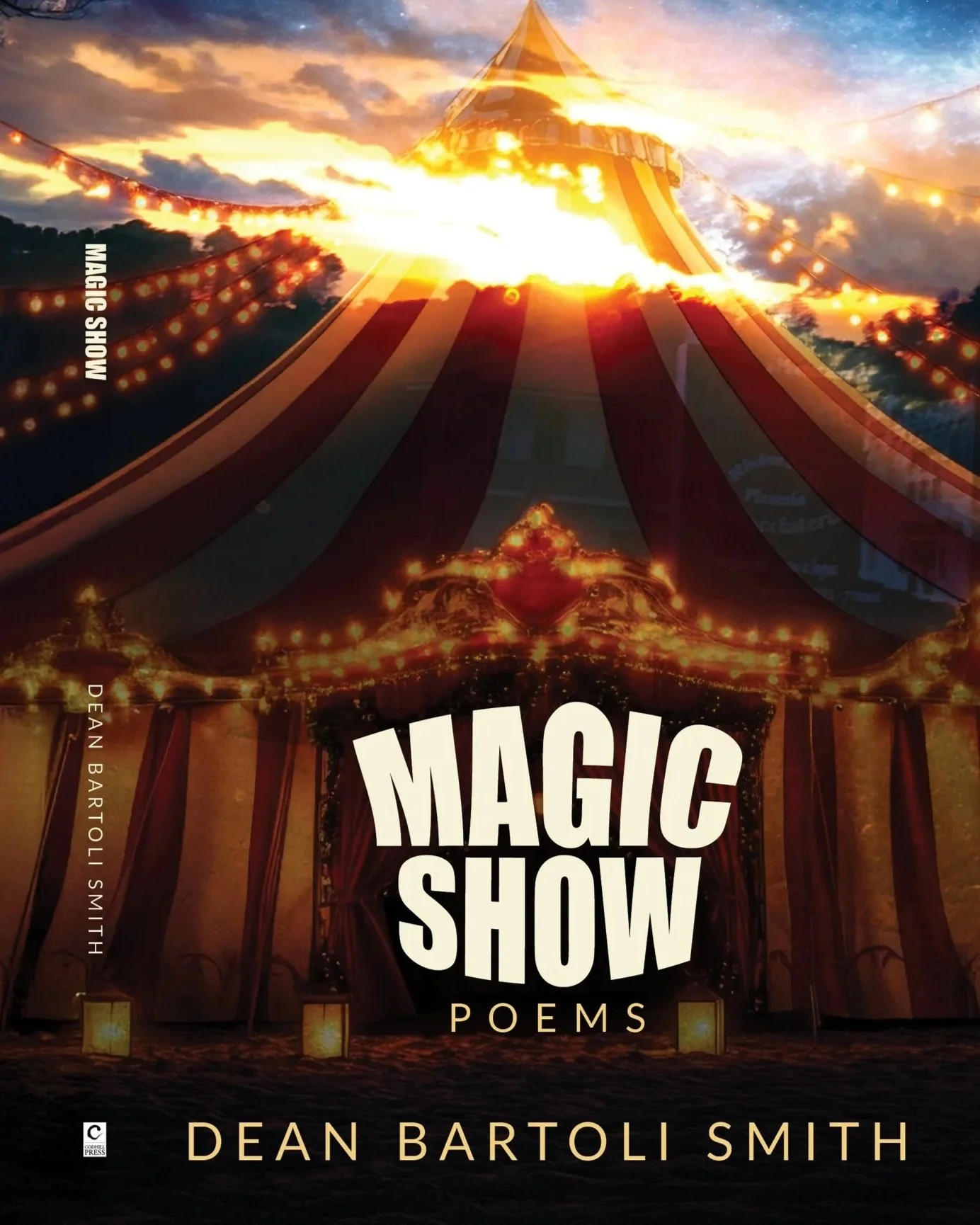
The collection begins with the title poem, dedicated to the late Elliott Smith, an influential singer-songwriter who did not achieve commercial success in his lifetime. A poem about failed ambitions – “My wand goes limp. / No death-defying feats: / this bag of tricks, extinct” – sets the tone for the rest of the book and raises the question, what does it mean to succeed as an artist? Indeed, artists and writers appear throughout these poems as teachers, sources of inspiration, and sometimes purveyors of disappointment.
In addition to addressing themes related to living a creative life, the poems also delve into personal losses, struggles with addiction, and examinations of the circuitous paths we end up taking. Divided into three sections – “Folly Beach,” “The Venus Looking Glass,” and “Ancient Eye” – the collection offers up a vibrant cast of characters who influenced the speaker and ultimately helped him figure out who he wants to be. The poems in Magic Show are largely first-person, and Smith’s voice is accessible and inviting.
In “Wild Things Revisited,” a breathless 50 lines the first 49 of which are a single sentence– the speaker describes his experience skipping Stephen Dunn’s poetry seminar to see the Grateful Dead, failing the class, then working his way back into grad school. In the second short sentence, we learn that after he reached out to Dunn to share his first book, “I never heard back.” Does it matter that the famous poet disregarded the student? Does it matter that the speaker chose one form of art to feed his soul over another? Do any of these choices matter? These questions linger in the background, as does a sense of regret that ultimately gives way to acceptance.
In “Rinpoches,” a prose poem, Smith contrasts two writers: Allen Ginsburg, who was “surrounded by young acolytes who called him ‘Ginzy,’” and Henry Flesh, who “died at St. Vincent’s just as his career had started to take off.” The implicit question concerns what Flesh might have achieved had he lived longer–and whether the work he did leave behind is any less significant because he was less famous than Ginsburg.
In “I Saw You, Classifieds,” Smith seems to turn this question about the purpose and power of art on himself. He witnesses a bicycle accident and helps the victim: “I lowered your head down / onto a makeshift backpack pillow / stuffed with copies of my first book / of poems.” Here, the poems offer comfort to the injured party in an unexpected way, but their importance seems no less significant –particularly since the experience led to “this poem.”
The redemptive power of art occurs in numerous poems, as do images of celebrated writers and artists in less lofty positions. “Welcome to Dreamland” opens with the speaker dreaming of Jerry Garcia busking: “Sitting on a white plastic bucket, he played ‘Loser,’ / his guitar case splayed open, filled with gold dollars.” Later in the poem, Ezra Pound lures squirrels “with treats wrapped / in scraps of unpublished Cantos.” These references are woven into various tales of destruction: fires, floods, 9-11, Hurricane Katrina, and the death of the circus. He writes: “Warheads, robots, and drones / whitewash the globe into theme parks / that celebrate a murderous history // repeating itself.” The poem ends with the speaker and his son in Atlantic City: “Darkness reigned on the boardwalk // where there should have been an amusement park.” The speaker asks, “Will this be the end of our nation?” Jerry Garcia’s answer? “Unchain humanity / with beautiful magic: songs and poetry.” This seems to be Smith’s answer, as well.
Whether Smith is communing with the dead, recounting a childhood memory, or lamenting a lost love, he writes with precision and humility. His use of form is varied and impressive in its interplay with his content–and the variety of formal choices makes the reading experience especially enjoyable. But it is the honesty–not only about his view of this terribly flawed world, but also about his own shortcomings and mistakes–that makes this collection so relatable.
Touching on the same themes that open the book, the final poem, “Coda: Vita,” describes Smith’s late mother, a poet who never had the opportunity to fully engage with her craft. He writes about her dropping him at college, crying: “I thought she was going to miss me / but she was jealous, wanted / to write poetry in Mr. Jefferson’s / Academical Village.” Smith goes on to note the impact his mother’s unfulfilled hopes had on him. He demonstrates his own attempts to be smaller in her presence through the short lines: “I often felt / better off / gone.” In what seems like an act of contrition, after her death he “gathered her poems / into a book / called Vita,” the title reading as both ironic and hopeful. Perhaps through our art, we can outlive our worldly ambitions.

Order your copy of Magic Show from Codhill Press.
Dean Smith is a native of Baltimore. His previous poetry collections are Baltimore Sons (Stillhouse, 2021) and American Boy (Washington Writer’s Publishing House, 2000). He is alsothe author of Never Easy, Never Pretty: A Fan, A City, A Championship Season about the 2012 Baltimore Ravens. He teaches in the College of Professional Studies at George Washington University and is the director of Duke University Press.
Elizabeth Hazen is a poet, essayist, and teacher. She is currently teaching poetry through the Goucher Prison Education Partnership. Her work has appeared in Best American Poetry, Epoch, Threepenny Review, and other journals. She has published three collections of poetry: Chaos Theories (2016), Girls Like Us (2020), and The Sky Will Hold (2026). She lives in Baltimore with her family.