
A poet who converts numbers to beauty
An interview with Lenna Jawdat, author of 70,000
by Gregory Luce
Lenna Jawdat, American-born poet of Palestinian-Iraqui heritage, is the featured writer in October’s Author’s Corner at The Inner Loop. In accordance with Washington Unbound’s partnership with TIL, we are very excited to present our interview with Lenna.
WU: First, tell us about yourself: where you are from, your education, how you got started in writing poetry, etc.
LJ:I was born and raised in Washington, D.C. by two artists who moved to the U.S. after college. My parents encouraged me and my sister to create from a young age, whatever that looked like. We drew, went to free art museums, made dolls out of stockings, wrote and illustrated stories, and acted out our own plays with our cat. We wrote little songs. I devoured stacks of library books. I attended a small international school which was fully bilingual at the time. I did full-day French immersion before first grade, and then the rest of elementary school was half day French, half day English. I think it shaped the way my brain makes sense of language. My parents often spoke Arabic to one another at home when they didn’t want me and my sister to understand, so we started understanding quite a bit, even if we didn’t speak it. My father often spoke Italian with his brothers and his parents, since they lived for a time in Italy. My dad and his brothers love punny and multilingual wordplay and my dad shared his love of poetry with me. One summer I printed out a collection of famous English-language poems from the Encyclopedia Britannica CD and bound them in an anthology.
My school followed an IB curriculum, so in 8th grade we were required to complete a capstone project for the Middle Years Program. I pulled together a collection of stories, written by different family members, and bound them into a book that I kept in a wooden box with a map of my family’s migration patterns around the world. I called it Roots & Routes.
As the oldest daughter of immigrant parents, and the oldest grandchild on both sides of my family, I was instantly an empath and a caretaker. I learned about other people by reading books on psychoanalysis and acting in every school play. In high school, inspired by emo music and all the brooding literature I could get my hands on, I began writing moody stream-of-consciousness poetry. I loved Arthur Rimbaud, Sylvia Plath, Nabokov, Marguerite Duras. There were no creative writing classes at my school but I took IB World Literature and drama class, and I took acting classes outside of school. In 10th grade we had another big project, this one called the Extended Essay. I wrote mine on symbols of hope within Sylvia Plath’s poetry. In college there was no creative writing degree, but I was able to take my first intro to creative writing class and then an advanced poetry seminar by application, which ended up zapping my desire to write altogether. I didn’t have enough autonomy or confidence in myself and my writing as a 20-year-old to trust what I enjoyed about my own writing, and so I let the professor drain my poems of their lifeforce like a vampire. All I was left with were corpses. After that I stopped writing for myself. I graduated with my BA in Psychology, worked a few years in the field, where I mainly wrote meeting and conference minutes for the APA, and then went back to school to get a Masters in Clinical Social Work and become a therapist.
It wasn’t until the COVID-19 pandemic hit that, alone with myself and my thoughts, I began waking in the middle of the night to pour words onto the page for hours until I was completely depleted. Then I’d take that raw material and shape it into poetry, or prose. That’s how I began writing for myself again after 12 years and where I feel like my writing journey began in earnest.
WU: Your heritage is a mixture of Palestinian and Iraqi. How important was that in your upbringing? When did you first realize that you were different from other Americans in some significant ways? What were your first experiences with Islamophobia?
LJ: I went to a small international school from the age of 3 to 17 where I knew all my classmates. We learned about and celebrated the foods, music, and customs of families at the school, talked about the history of segregation in this country, and how we were all equal. It was pretty crunchy granola at the time. I learned we were all unique in where we came from, and that’s what made us special. I didn’t see myself represented in much mainstream media, but I didn’t see my classmates represented either, necessarily. My family was fairly assimilated and white-presenting, but I felt an affinity for the foods, the language, the tatreez cushions that set my family apart. I felt special when we learned about the Ancient Sumerians (we learned world history chronologically) in the “cradle of civilization,” the very same place my dad grew up! I was thrilled to learn of the origins of algebra or the Disney film Aladdin, even when I knew on some level that it was a flattened, white-washed and Orientalist version of the real thing. My dad spoke to us about discrimination against Arabs and racist portrayals in the media, but it felt pretty separate from my own life until 9/11. That’s when biases against Arabs and Muslims began to feel like a real threat to my bodily and emotional safety. I didn’t grow up religious at all, but I knew that didn’t matter, that the general public were conflating all sorts of identities that may or may not co-exist or overlap. They were heated, jumping to conclusions. I heard of hate crimes against Sikhs, who had truly nothing to do with 9/11, so I knew none of this was logical, which made it all the more dangerous.
Being both American, with mixed European heritage and light skin, and “other,” Arab, Iraqi, made me feel conflicted inside about where I belonged, could be accepted and safe, and who would see me as a threat or a target.
WU: How does your psychotherapeutic practice influence your poetry and vice versa?
LJ: They’re certainly connected, in that they both center around authentic emotion, intimate connection, human experience, story-telling, and meaning-making. My therapeutic practice has given me tools that ground me while I’m in the process of self-excavation, that allow me to closely observe myself in nonjudgmental ways, to know when to keep pushing into something hard or back off, or when a trauma response needs expressing. My skills as a trauma therapist keep me from retraumatizing myself as I write about some of the most devastating experiences I have had or have witnessed.
WU: What moved you to start writing 70,000? Did you have the entire design in mind from the beginning, or did it grow gradually as you continued to explore your themes?
LJ:I had no idea what was happening to me! In the best way. I think it’s important to trust your intuition and let your work surprise you.
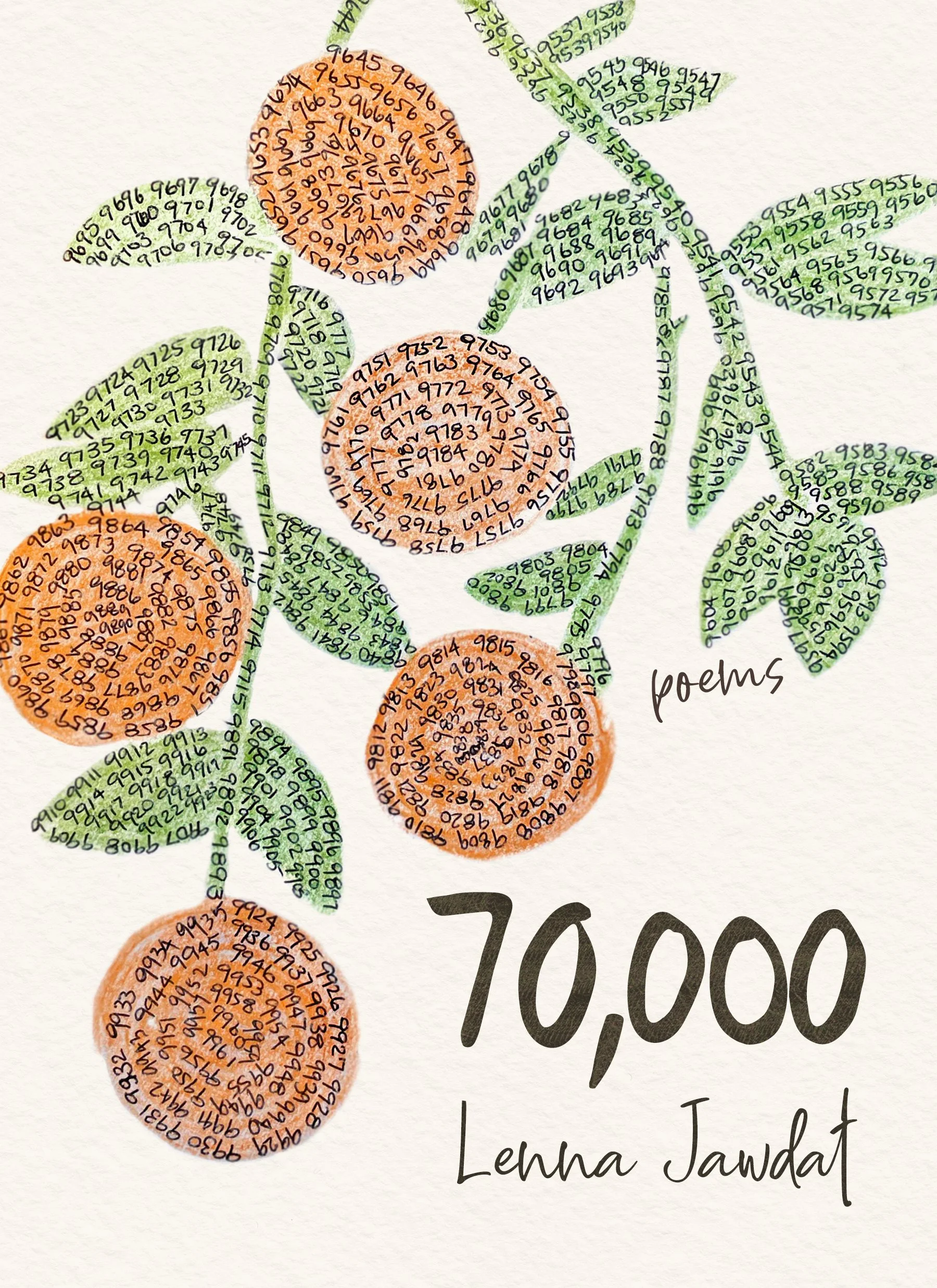
I was moved to tears by a footnote in Rashid Khalidi’s book The Hundred Years’ War on Palestine that described the theft of 70,000 books from Palestinian homes and private libraries by Zionist forces around 1948, which is around the same time as my maternal grandparents and over 700,000 other Palestinians fled. I wanted to write a poem about it, because it is such a huge and intentional violent erasure of culture and existence— one that I knew nothing about— but I couldn’t process such an enormous loss. I was flooded emotionally, and my brain couldn’t make sense of such a large number. So I started writing the numbers by hand in an attempt to slow down the process and digest what that kind of destruction meant. It was an exercise, a process, that I never thought would be the end result.
I was so fortunate to be in an MFA program at the time and mentored by the brilliant poet Layli Long Soldier, who encouraged me to keep writing the numbers and to trust the process. She gave me permission to break the form of the number-writing, which began with top-to-bottom, left-to-right lines. So I used my trauma therapy training and followed where my body took me, letting my writing inform the visual elements and vice versa. Thinking back on it right now, it feels almost like an extended Yoga Nidra practice. (I’m also trained as a yoga teacher with specific training in Nidra from Tracee Stanley-Newell.) In Yoga Nidra, we guide awareness through five koshas, or layers, from the outermost physical body, through the breath and energetic body and nervous system, the mental/emotional body, intuition, and then the bliss body (total peace). I think I sort of intuitively worked inward like that, maybe with some movement back and forth between the layers, and definitely without reaching the bliss body. I discovered early on that I had to keep writing the book until I had finished writing the numbers. I let the content and themes unfold as I did so.
WU: What is the significance of the title? And please explain the role of numbers in the poems.
LJ: 70,000 refers to the 70,000 books systematically looted and confiscated from Palestinian collections by Israeli forces, militias, and librarians around the time that the state of Israel was established.
The hand written numbers each represent one book lost or destroyed during that time. Because I don’t know any of the names of those books, or the content, writing numbers gave me a way to memorialize those books and make sense of their loss. My hope is that by writing them down, I allow the reader to also conceptualize a loss too immense to grapple with.
WU:What other Palestinian writers would you recommend to readers who want to know more about Palestinian literature?
LJ: This is an incredibly difficult question to answer because I want readers to discover all sorts of Palestinian literature. Even my own awareness of who is out there is shaped not only by my own scope but by systemic attempts at silencing and censorship, especially of the voices coming out of Palestine directly right now. Mahmoud Darwish (1941-2008) is widely considered one of the most eminent Palestinian poets. Refaat Alareer was so integral in conveying the realities of living in Gaza that he became a direct target of an airstrike and was killed in 2023. Mosab Abu Toha faced similar targeted threats to his life and family. Their work right now is incredibly important as evidence of what is currently unfolding. Susan Abulhawa’s work is cannon at this point. Fady Joudah is prolific. Some more of my favorite contemporaries: Hala Alyan, Sarah Aziza, Lena Khalaf Tuffaha, George Abraham, Noor Hindi, Zaina Arafat. I actually would recommend picking up a copy of Heaven Looks Like Us, a 2025 poetry anthology edited by George Abraham and Noor Hindi that I was published in, and then looking up any one of the included poets in that collection. I’ve tried to team up with some of them as I’m organizing my DIY book tour and am so honored that I get to read with Summer Farah, leena aboutaleb, Janine Mogannam. I’ve also had the privilege of doing events with Palestinian writers Zeina Azzam, Mahmoud Khalil, Hasan Dudar, and Ramsey Hanhan.
WU:What have been your experiences in the DMV literary community? Have there been any individuals who have been especially helpful to you? What are you thoughts in general about the DMV literary scene?
LJ:As I mentioned, I returned to writing during the early isolation days of the COVID pandemic, after over a decade of not writing creatively, so my literary community has been shaped by that. I started writing again in an extremely solitary way, because not only was I writing alone, but I was also living alone and not seeing anyone face to face. Then I began taking classes online, and I began making connections with other writers regardless of their location. This whole world of writers opened up on the internet, but it felt pretty disembodied. I attended online classes and workshops, and eventually residencies and a low residency MFA program, where we all traveled to be in the same location for up to a few weeks at a time before going our separate ways. There were certainly writers I met from the DMV but not ones I met in person locally. In the last couple of years I’ve met a few of those local poets IRL for the first time at AWP, completely out of context, and I don’t think I’ve quite figured out how to turn any of those connections into in-person ones, because of the way my entire writing practice has been shaped.
In 2024, my mother, who is a visual artist, was asked to present some of her work at a reading during Palestine Week at Busboys and Poets, and we had the idea to present together since we had been working on a chapbook, where her art inspired some of my poems and my poems inspired some of her pieces. At that event, I met Majda Gama and Zeina Azzam, both of whom I’ve continued to bump into over and over in the DC scene and who have been incredibly encouraging. Majda was the one who suggested connecting with the Inner Loop’s Author’s Corner program when 70,000 came out and I was at a loss for how to organize readings and promotion for the book, which feels like it may have unlocked a whole new literary community.
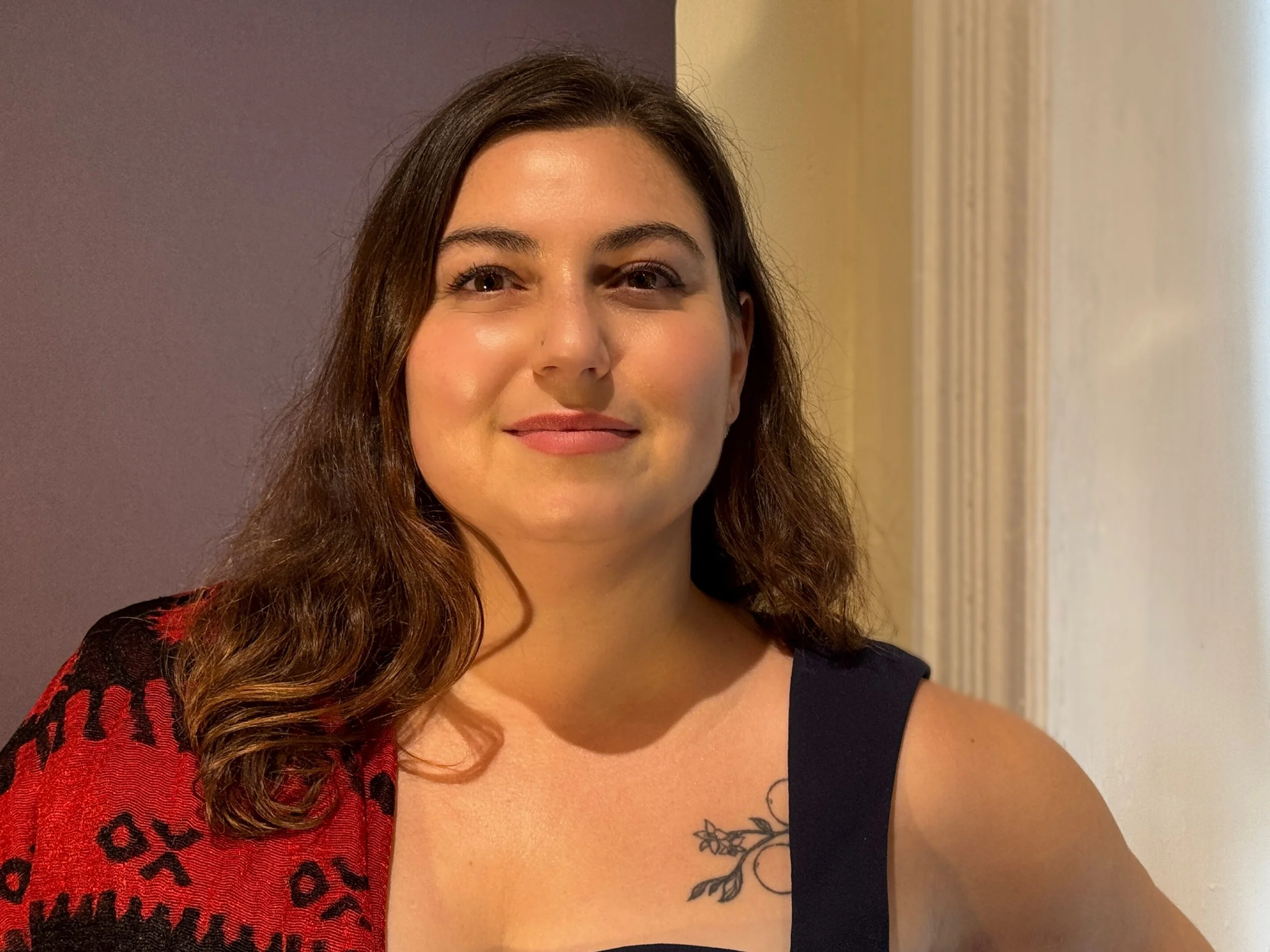
Order 70,000 here. Meet Lenna and hear her read at one of the following events:
The Writer's Center, October 8 at 7 pm. In Baltimore at Charm City Books, October 10 at 6:30 pm. Inner Loop reading October 20 at 7 pm.
Lenna Jawdat is a poet, writer, professor, and psychotherapist of Palestinian and Iraqi descent. Her writing, which explores trauma, identity and resilience, has appeared in journals such as Poet Lore, The Margins, Passenger’s Journal, Rogue Agent, among others, and in the 2025 Haymarket Anthology Heaven Looks Like Us. She was a 2021 Best of the Net nominee for her poem “Ode to the Psoas,” a 2022 Sundress Academy for the Arts summer resident, and has attended Tin House Workshop for poetry and creative nonfiction. She is also co-organizer of the poetry vigil series In Water and Light. Lenna received her MFA in Creative Writing from the Institute of American Indian Arts in May 2024. She lives in DC with her partner and two cats.
Gregory Luce is the co-founder and poetry editor of Washington Unbound. He has published six chapbooks. He lives in Arlington and writes a monthly column for the online arts journal Scene4.