
“What’s More American?”
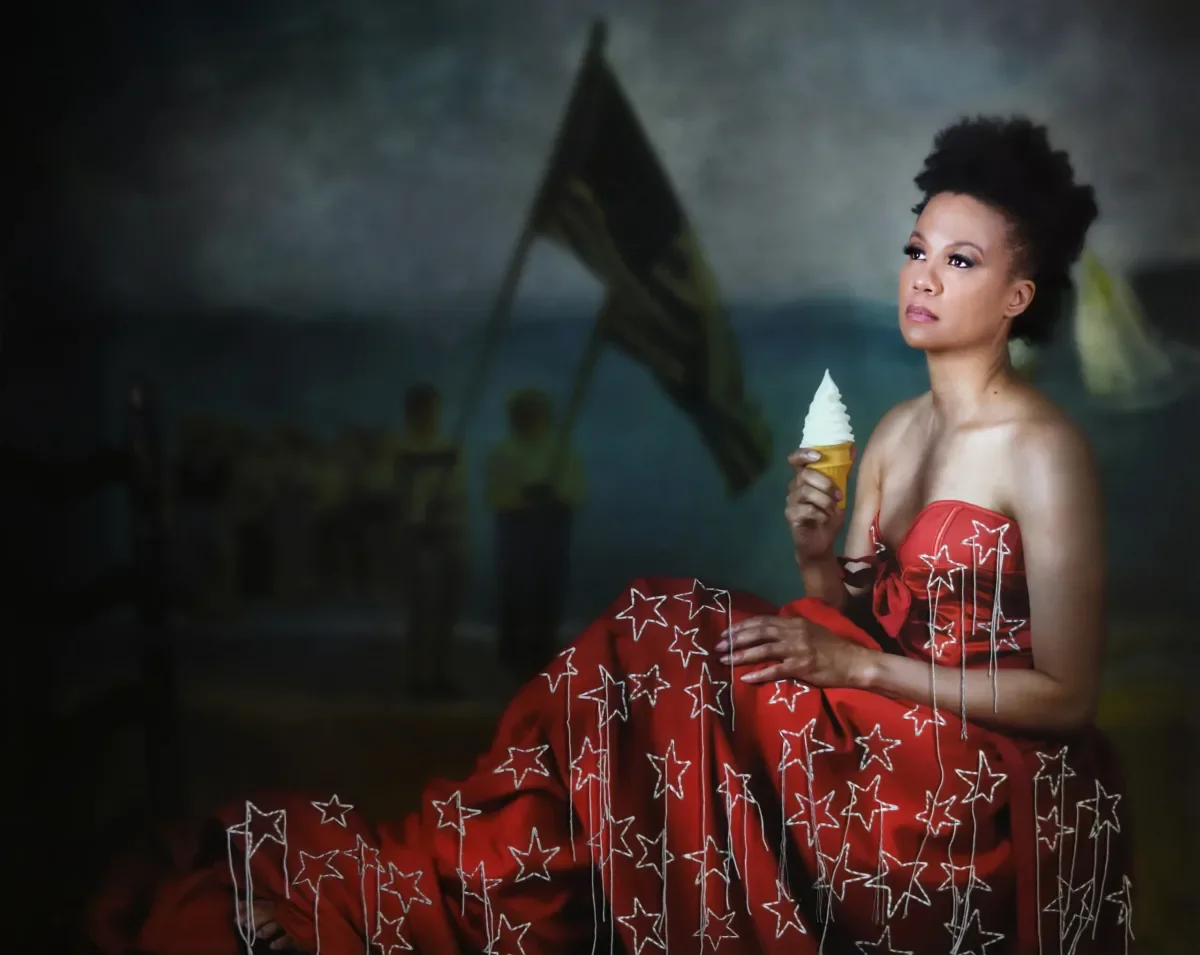
[What’s more American than Vanilla icecream?, from the series “The Reconciliation,” 2024-2026; Embroidery on archival pigment print,
52 × 60 in.; Courtesy of the artist and Galerie Myrtis; © Tawny Chatmon]
A review of “Sanctuaries of Truth, Dissolution of Lies,” an exhibit of the work of Tawny Chatmon
Tawny Chatmon’s art would be well worth seeing for its sheer beauty alone. But come closer and look deeper: These pieces contain multiple levels and tell important stories. It is because of this historical and narrative dimension that we have chosen to review a visual art show in our publication.
I recently had the opportunity for a private press tour, led by the artist herself, of Tawny Chatmon’s exhibit at the National Museum of Women in the Arts in Washington, D.C. I was not familiar with the work of this relatively young Black artist, and I found her work stunning in both its execution and content.
Tawny Chatmon, born in 1979 in Tokyo, Japan is a self-taught artist residing in Prince Georges County, Maryland. She began her career as a commercial and editorial photographer, before turning to fine art photography while documenting her father’s struggle with cancer.
Tawny Chatmon’s work is difficult to classify. Her website describes her as a “photography based artist.” She begins her process with a photograph, taken by her, often of family members or friends, before placing it on a painted background and embellishing the image with other materials, such as gold, paint, or threads. To call her pieces mixed media is accurate, but falls short of indicating the complexity of the way the images are layered and the textures are deepened.
At first look, the above image, What’s More American Than Vanilla Ice Cream? appears to be a simple photograph of a beautiful Black woman reclining in a red, star-covered gown, savoring a vanilla ice cream cone. But look more closely at the soft-focus background: A pair of men carrying American flags (whose stars seem to have fallen off and adorn the woman’s dress) advance from left to right. According to the artist, this image is based on a Library of Congress archival photograph from 1959 depicting white men and women protesting school integration in Little Rock, Arkansas. The demonstrators are resisting the integration of schools following the Little Rock Nine, screaming and waving American flags in a hostile display. Beneath that layer, we find what could be a detail from an Impressionist painting—the work, say, of Monet or Manet. So what in the beginning appears to be a lovely portrait is suddenly complicated by not one but two deeper layers of history.
It is the complex, multi-layered nature of this work that leads me to call it ekphrastic, albeit in a somewhat unconventional way. (“Ekphrasis” is a literary term that refers to a piece of writing that responds to a work in another medium, usually a piece of visual art.) For example, the ice cream cone is not simply a warm weather treat, it stands in for the historical role of Black chefs in creating and popularizing ice cream. Thomas Jefferson’s enslaved chef, James Hemings (who also brought macaroni and cheese to American tables), created recipes for ice cream that was served at Jefferson’s banquets. (In a typical act of erasure, Jefferson is often given credit for both culinary developments.) At that time, the dish was complicated and expensive to prepare so it was reserved for the upper class. But in the 1820s, Augustus Jackson, a Black chef who had worked for President James Monroe, left the White House and started making and selling a simplified version of ice cream. The confection thus became more available and popular and Jackson began to be known as “King Ice Cream.”
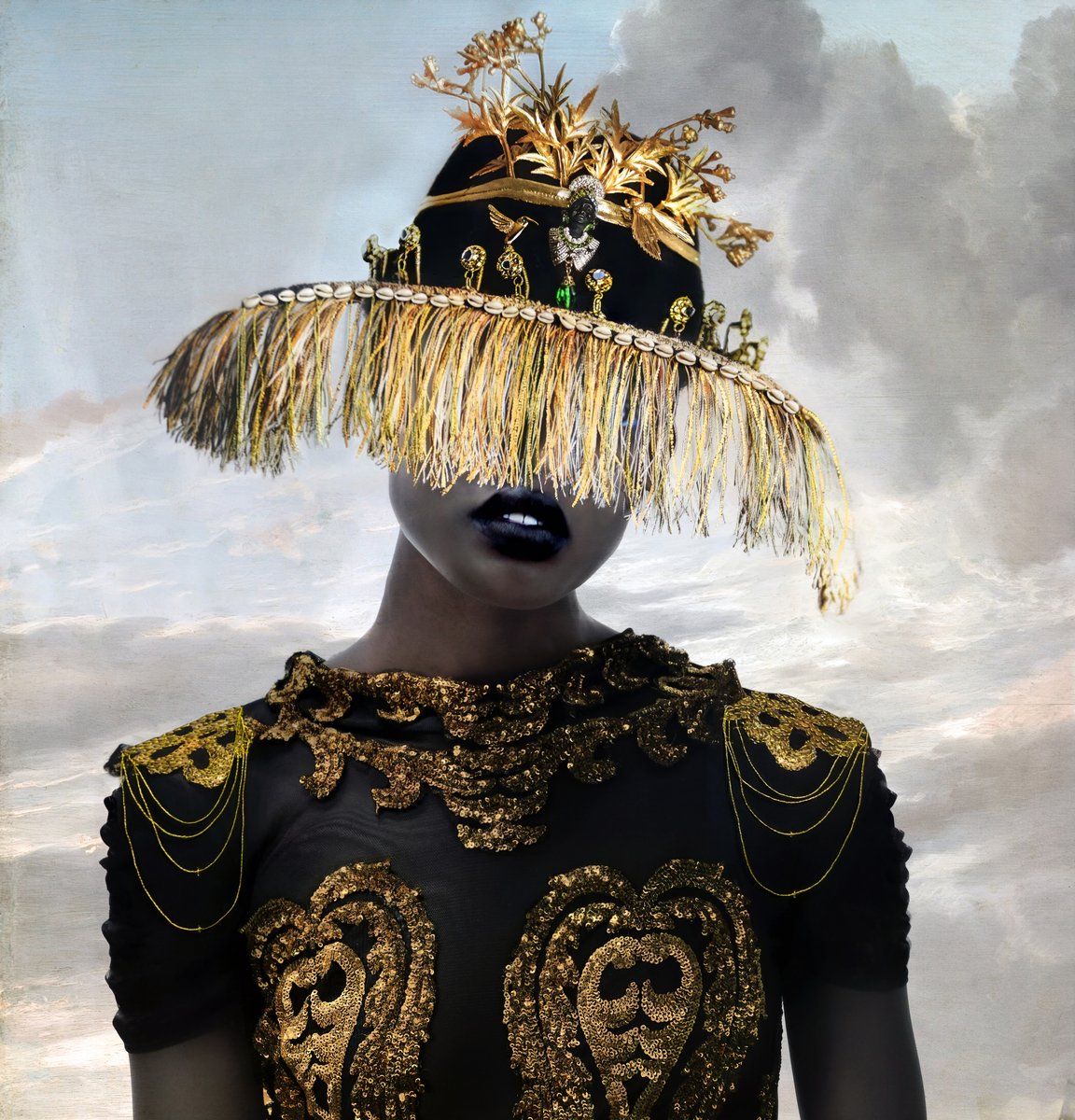
[Not Your Blackamoor, from the series “The Restoration,” 2025; Cowrie shells, acrylic, and thread on archival pigment print, 50 x 48 in.; Courtesy of the artist and Galerie Myrtis; © Tawny Chatmon. Photo by Lee Stalsworth]
I Am not Your Blackamoor (above) exemplifies the theme of Black beauty and also reveals much about Chatmon's techniques and brilliant—in both senses—use of materials. Once again, a photograph of a beautiful and enigmatic Black woman juxtaposed against an Impressionist sky is enhanced with other materials. The fringe on the woman’s hat is composed of actual cowrie shells (a traditional ornament in much African art) and gold thread. A further complication here is the use of the word “blackamoor,” both an old racist term for Black person and a style of decorative art that uses stylized images of dark-skinned human figures.
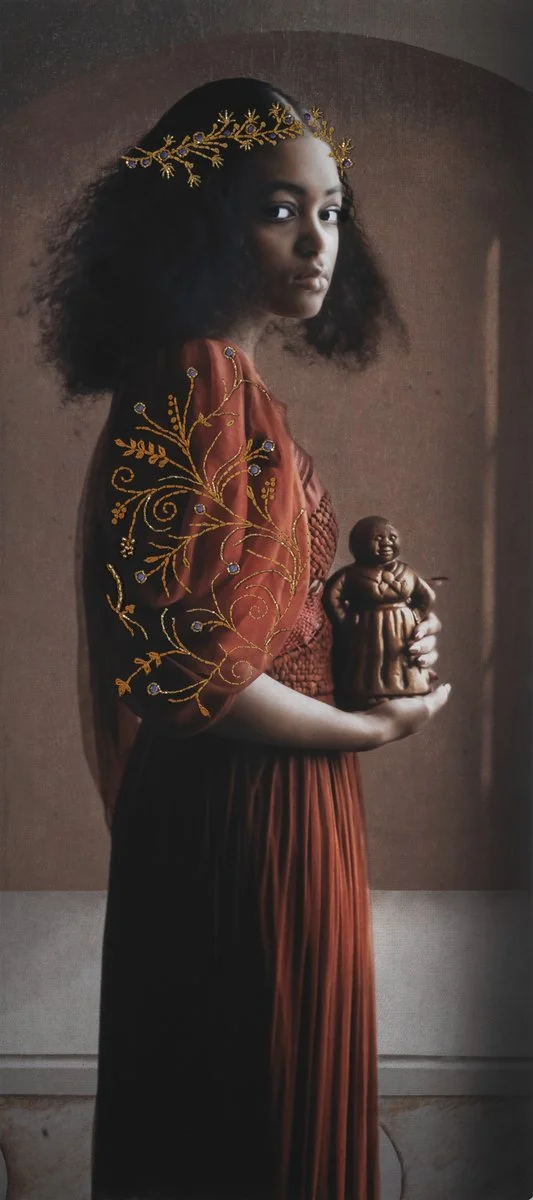
[Tawny Chatmon, We Hold Her Sacred, from the series “The Restoration,” 2025; Embroidery, acrylic, and mixed media on archival pigment print, 62 x 25 in.; Courtesy of the artist and Galerie Myrtis; ©Tawny Chatmon. Photo by Lee Stalsworth]
The theme of beauty is further depicted in images of the artist’s children. We Hold Her Sacred depicts Chatmon’s teenage daughter, richly dressed and facing the viewer with a wary, almost defiant gaze, daring us to judge her as anything other than beautiful. Atop her head rests a crown of what appear to be golden laurels, suggesting poetry. Another suggestive element is the light that spreads over part of her face, implying growing enlightenment. And a final complicating and ironic element is delivered by the title itself. On first look, one assumes that the girl is what is being held scared. But a closer look reveals that she is holding a “mammy” figure, a classic racist image. By including this figure, Chatmon reclaims and negates the image, removing the aura of racism it otherwise carries. This reclamation seems particularly critical now in the face of a rising tide of White Supremacy and attempts by the current presidential administration to whitewash American history. (Chatmon collects racist figurines, toys, advertising images, et al., some of which are displayed in the exhibition.)
Depicted in Let Him Grow (below), the artist’s young nephew looks out at the viewer with a solemn, confident expression. Aside from the boy’s beautifully rendered face and hair, the only other visual element is some sort of cloth around his neck, suggesting a hoodie or a sweater. This piece is both powerful and poignant, implying that the boy’s future is yet to be written and implicating the viewer (“let him grow”) in his development.
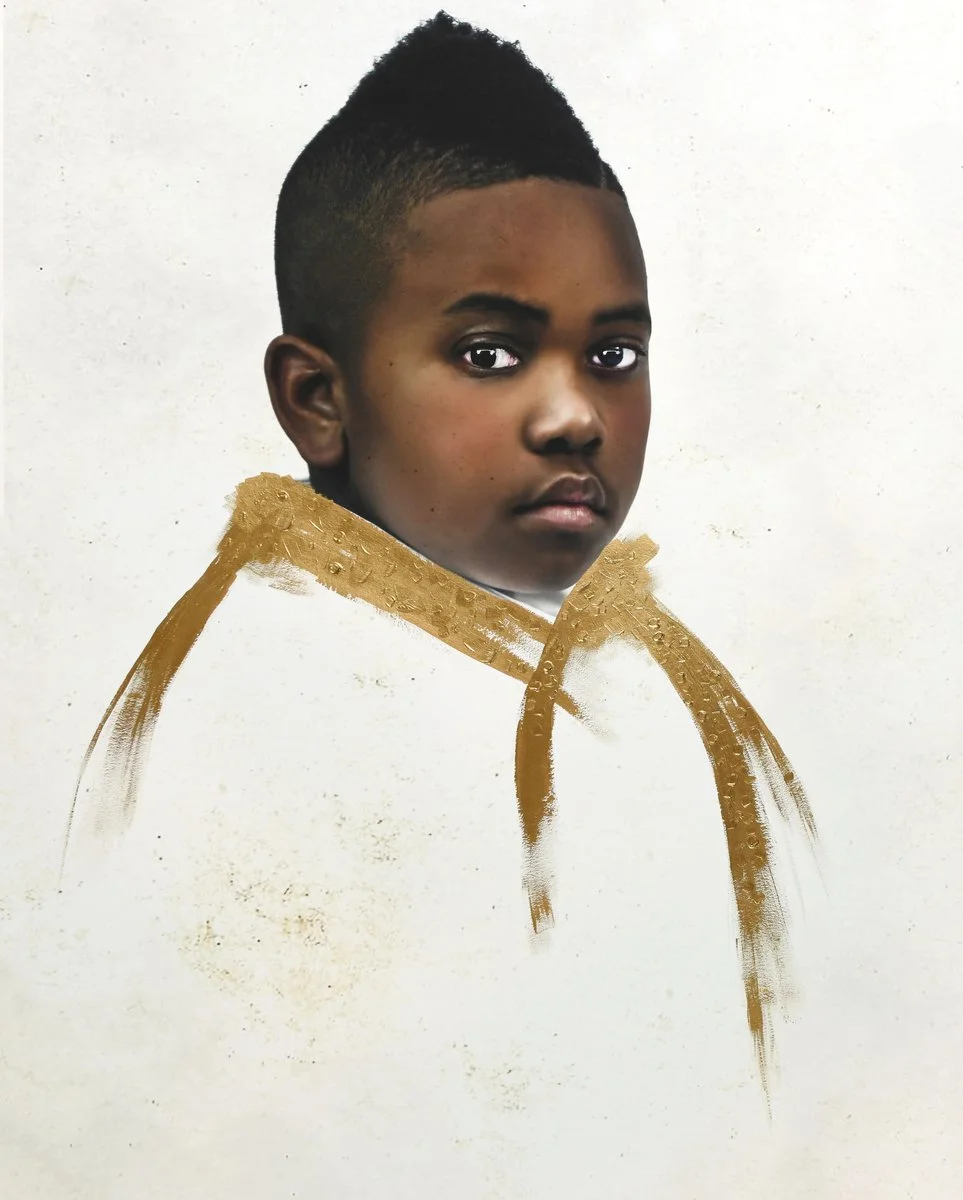
[Tawny Chatmon, Let Him Grow, from the series “The Redemption,” 2019; Acrylic on archival pigment print, 44 x 36 in.; Collection of Dr. Aliya and Reginald Browne; © Tawny Chatmon. Photographer: Galerie Myrtis]
One entire section of the show is devoted to food and, as with the image of the woman eating ice cream. rectifies the omission of Black creators and cultivators. Inverting racist tropes, Economic Heritage (below) depicts a beautiful Black female in a lush setting holding a watermelon. Besides the ironic nod to the racist trope of the lazy, watermelon-eating “darky,” this piece reminds us that watermelon, like many other staples, was brought to America by enslaved Africans. Further, in the aftermath of the Civil War, cultivating watermelon brought economic rewards to Black farmers, hence the title, and sometimes drew attacks by whites threatened by the possibility of Black equality, as shown in “What’s More American Than Vanilla Ice Cream?”
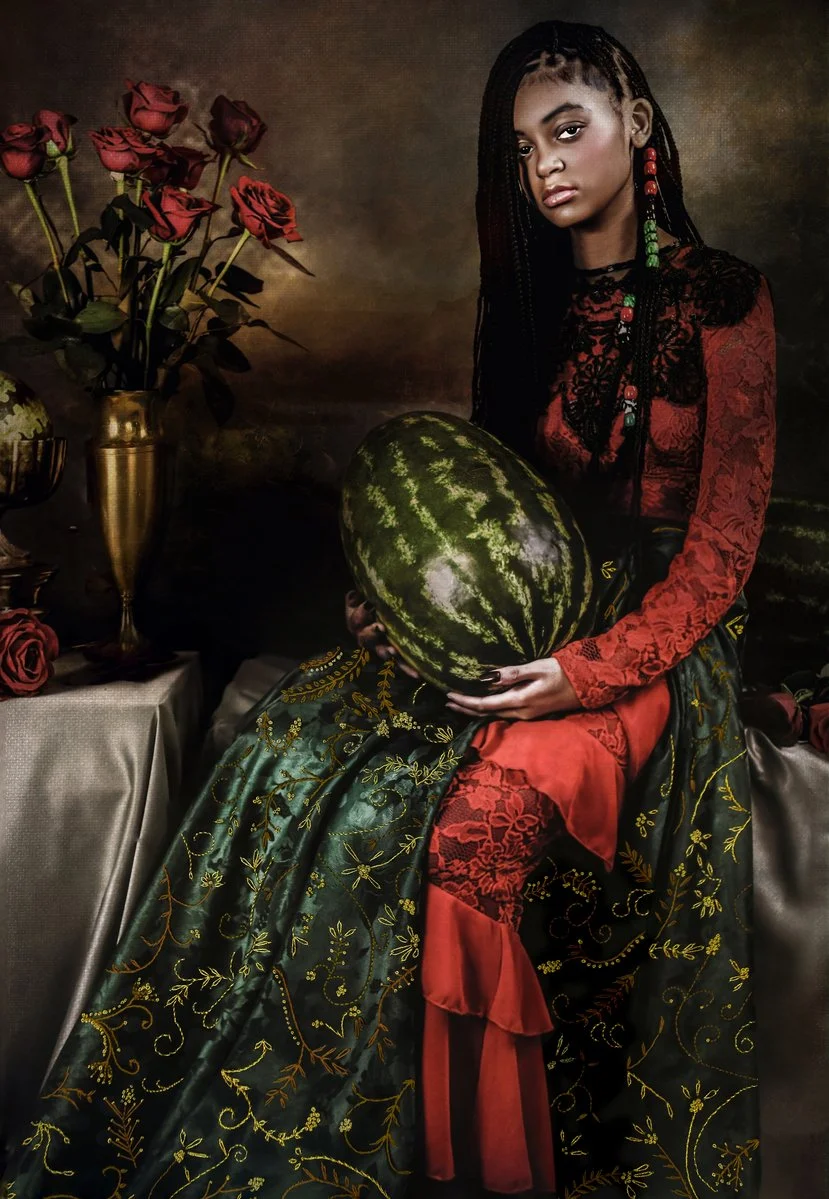
[Tawny Chatmon, Economic Heritage, from the series “The Reconciliation,” 2024; Embroidery and acrylic on archival pigment print, 58 x 42 in.; Courtesy of the artist and Galerie Myrtis; © Tawny Chatmon; Image courtesy of the artist and Galerie Myrtis. Photographer: Galerie Myrtis]
This exhibition contains far more than one review can possibly cover. The show runs through March 8, 2026; though it’s not large, the richness and variety of the works on view.would reward multiple visits. Visit Chatmon’s website to see more images and learn about the artist.
The National Museum of Women in the Arts (NMWA) is the first museum in the world solely dedicated to championing women through the arts. NMWA is located at 1250 New York Avenue, NW, Washington, D.C. It is open Tues.–Sun., 10 a.m.–5 p.m., until 8 p.m. on the third Wednesday of the month. Admission is $16 for adults, $13 for D.C. residents and visitors 70 and over, and free for visitors 21 and under. Admission is free on the first Sunday and second Wednesday of each month. For information, call 202-783-5000 or visit their website.
Tawny Chatmon is a self-taught artist based in Maryland. Through a layered process of photography, painting, and hand-embellishment, she creates works that honor and celebrate the beauty of Black childhood and the Black family, while at times confronting historical misrepresentation and erasure.
Gregory Luce is the co-founder and poetry editor of Washington Unbound. He has published six chapbooks. He lives in Arlington, serves as Poetry Editor of The Mid-Atlantic Review and writes a monthly column for the online arts journal Scene4.