When music speaks truth to power
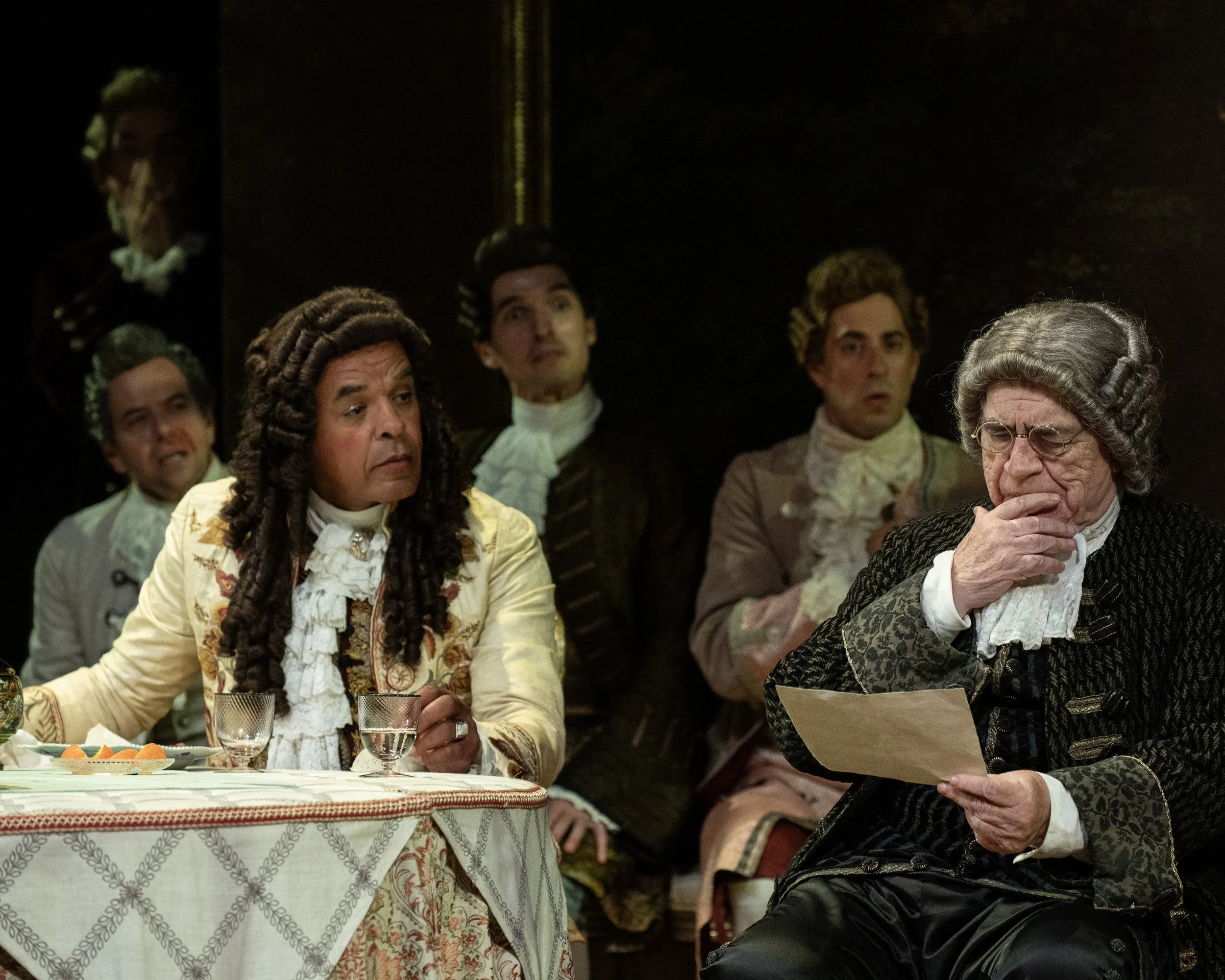
[Peter de Jersey and Brian Cox with Christopher Staines, Toby Webster, and Matthew Romain in The Score. Photo by Teresa Castracane.]
A review of The Score at the Shakespeare Theatre Company
by Gregory Luce
When Europe’s greatest composer meets Europe’s most powerful ruler, one expects sparks to fly. And so they do, in Shakespeare Theatre Company’s powerful production of The Score by Oliver Cotton. But also wit, large doses of humor, and profound meditations on art, power, and spirituality.
The play turns on a legendary meeting in 1747 between Johann Sebastian Bach (Brian Cox) and Frederick the Great, the king of Prussia (Stephen Hagan). The king has summoned Bach to his court in Potsdam, purportedly to examine his collection of fortepianos. Though reluctant, the composer finally agrees, in part because the visit will allow him to visit his son, Carl (Jamie Wilkes), one of Frederick’s court musicians. So at his wife’s urging and despite his declining health, Bach makes the journey.
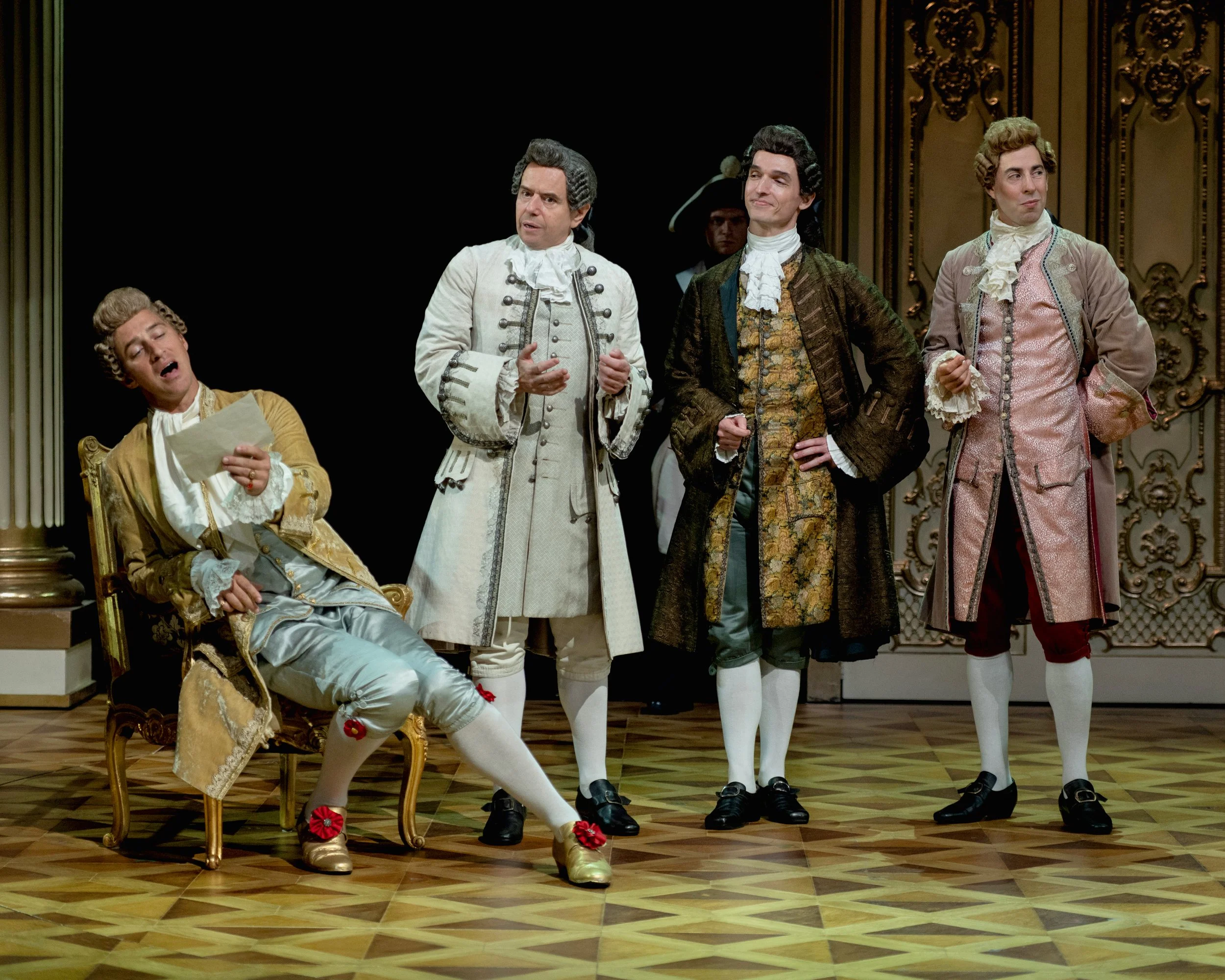
[Stephen Hagan, Christopher Staines, Toby Webster, and Matthew Romain in The Score. Photo by Teresa Castracane.]
Unbeknownst to Bach, Frederick has colluded with three of his court musicians to humiliate him by creating a musical theme that even the great composer will be unable to improvise upon. Bach surprises the king and his retinue by not only creating the three-part improvisation demanded but a further six-part one. Yet a sudden turn in Bach’s mood brings about a confrontation between composer and king, which represents a profound conflict between spiritual and material views, and between art and politics on a grand scale. The fact that neither man entirely “wins” the argument is a testament to the play’s genuine exploration of these issues.
Bach returns to Leipzig, reunites with his loving wife, and undergoes surgery for his failing eyes. While recovering, he receives an unexpected guest: Frederick himself, incognito as a Prussian officer. They resume their argument, but this meeting is tinged with mutual respect and sympathy. The play ends, leaving us full of thoughts about the implications of these great men’s encounter.
The drama—or perhaps dramatic comedy would be a better designation—moves along briskly under the masterful direction of Trevor Nunn, making his directorial debut at STC. The pacing is ably assisted by Robert Jones, set and costume designer, who has created a set that allows for rapid transition between scenes, in part by means of a turntable that moves actors and props on and off stage quickly. The sets are beautifully rendered, ranging from the almost stark simplicity of Bach’s home, to the much more elaborate rooms within Frederick’s palace. His costumes, too, are magnificent, period-accurate clothes that indicate the relative status of the various characters. Frederick’s flamboyant attire is particularly outstanding, and the bright crisp colors of the Prussian soldiers also make a strong impression in their brief appearances.
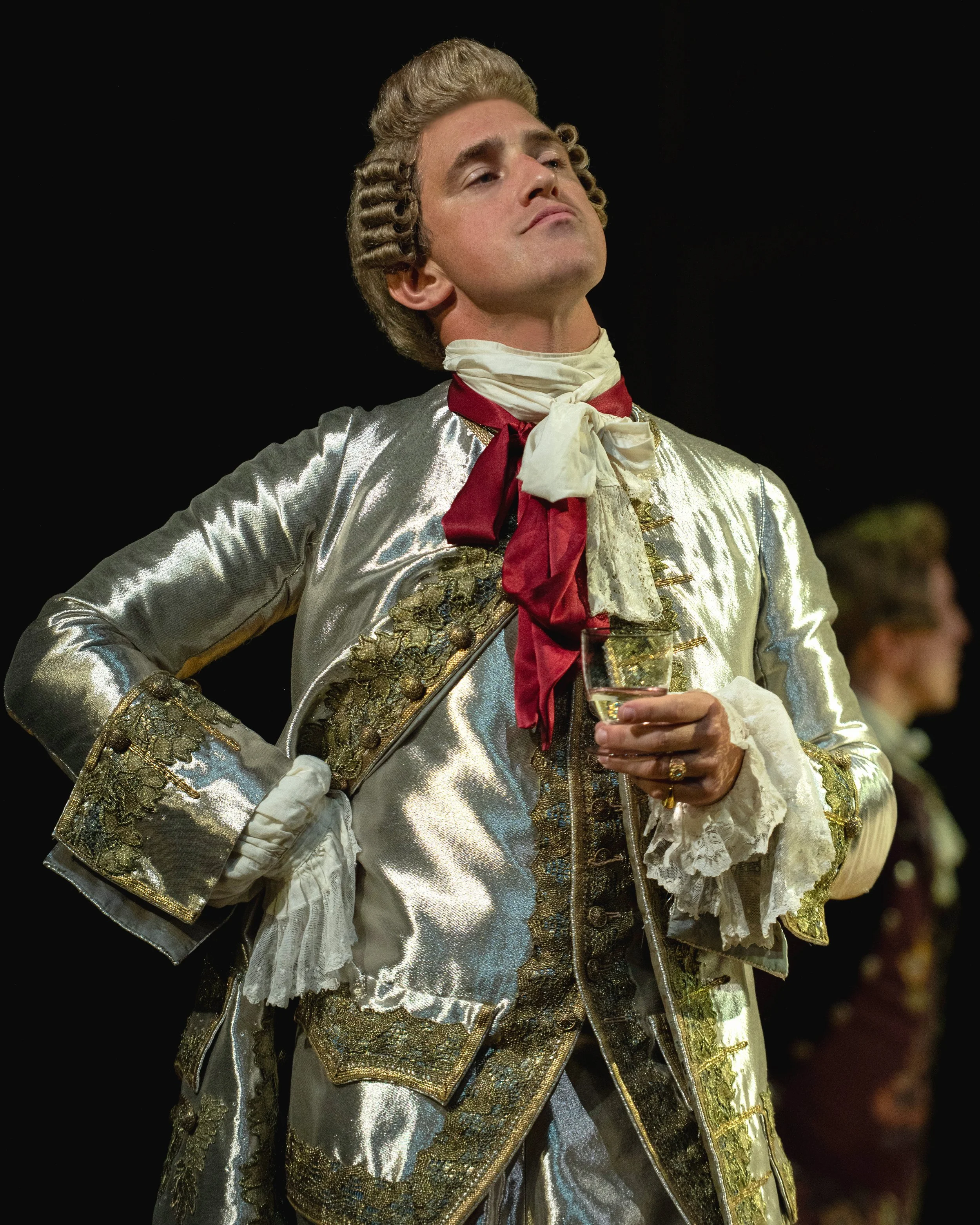
[Stephen Hagen in The Score. Photo by Teresa Castracane.]
Sound designer Sophie Cotton has strongly enhanced the production with her presentation of snatches of Bach’s music, and the excellent coordination of music with action when characters appear to be playing one of the several harpsichords adorning the stage.
All these design elements create a space for some uniformly excellent acting. Brian Cox, as those familiar with his powerful work in such dramas as HBO’s Succession or his many roles in film would expect, gives a powerful performance as Bach, moving between tenderness, wit, and displays of temper seamlessly and believably. But he is far from alone in exhibiting acting virtuosity. This show is a true ensemble production. Stephen Hagan as Frederick has almost as much stage time as Bach, and he is truly remarkable in his ability to express a range of emotions, from assertions of power, through a somewhat sadistic sense of humor, to grave doubts about his actual beliefs. His dialogue is frequently quite witty, and he delivers it with notable relish.
Though in a somewhat smaller role, Peter de Jersey as Voltaire also makes a strong impression. Speaking in a comically exaggerated French accent, his flamboyant dress and performance only lightly mask his genuine regard for Bach and his music, as is made clear in their first meeting and reinforced in subsequent encounters, though on the surface he must maintain his loyalty to the king.
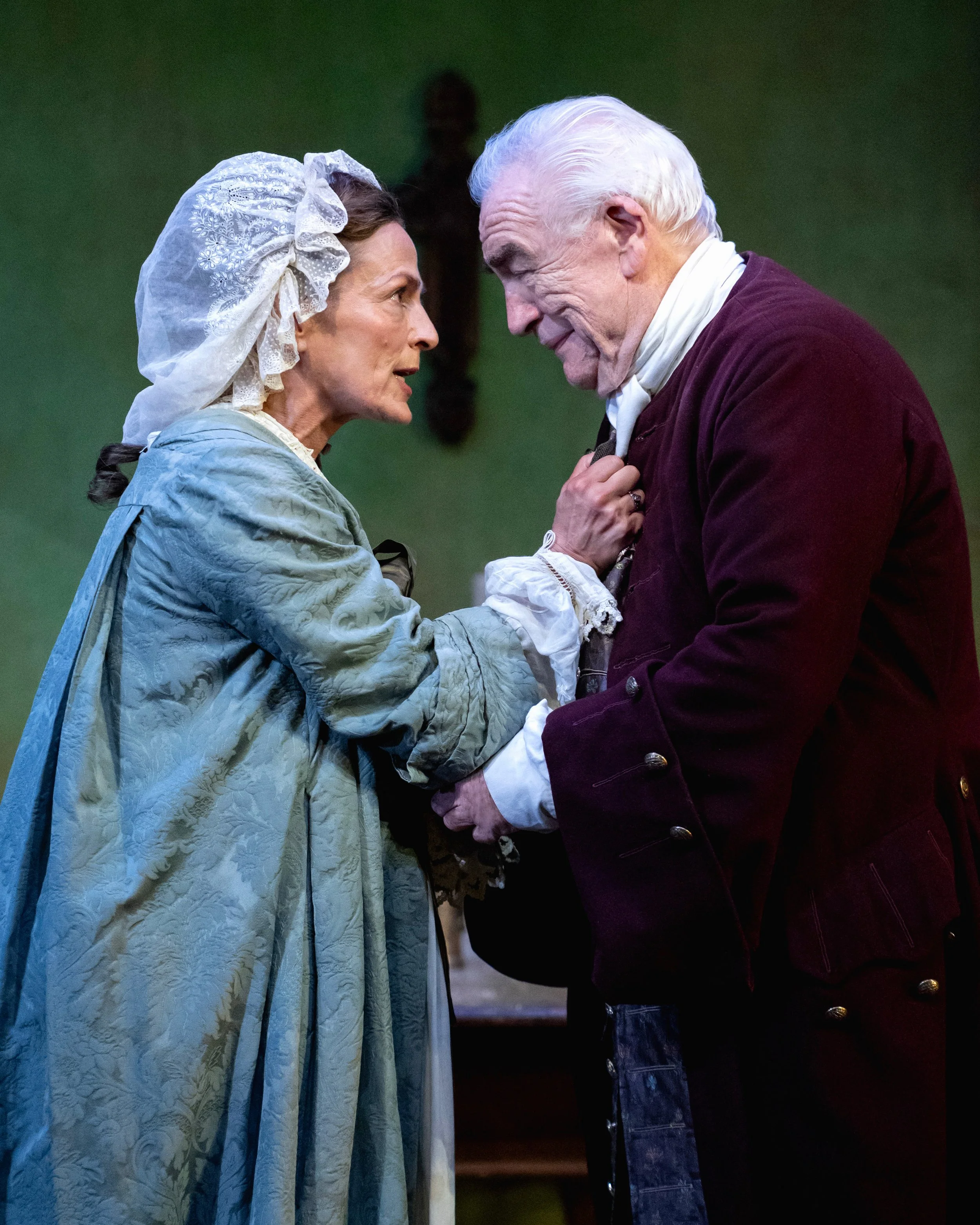
[Nicole Ansari-Cox and Brian Cox in The Score. Photo by Teresa Castracane.]
Other characters are lesser in stature but no less powerful in performance. Jamie Wilkes plays the somewhat harried but devoted son Carl Bach, managing his father’s mercurial temper while never faltering in his display of filial love. Their relationship is one of the most touching things about the play. Likewise, Nicole Ansari-Cox (Brian’s wife in real life), though she has relatively little time onstage, shines as the loving but forceful Frau Bach. As depicted, their love and deep affection comes through clearly, as does her unwavering support for the sometimes difficult Bach. She absolutely commands the stage in a short scene in which she upbraids and drives off a Prussian officer seeking to billet soldiers in the Bach home.
Another standout, in a small but decisive role, is the servant Emilia played by Juliet Garricks. She is the most grounded of all the characters, her personality as large as her physical size. In one crucial scene, she relates to Bach the details of Frederick’s difficult childhood as the son of the stern, even brutal King Frederick I. This conversation provides critical insights into the character and behavior of Frederick and generates a great deal of sympathy for the man known as the “enlightened despot.” Indeed, he holds his own in his disputes with Bach and we can respect his positions even as we prefer those of the composer.
And finally, Matthew Romain, Christopher Staines, and Toby Webster, playing respectively Carl Graun, Johann Quantz, and Franz Benda, a trio of court musicians now largely forgotten, provide further comedy. Their devotion to their careers is greater than that to music, and they are complicit in Frederick’s scheme to embarrass Bach, even going to the extreme of locking Carl Bach in his room so that he can’t divulge their plot. The play at this point verges on farce but never crosses that line and provides a clear contrast between “kept” musicians and serious artists.
A scene near the end brings the play to a powerful and thought-provoking conclusion. Bach has returned to Leipzig and is recovering from his much delayed eye operation when Frederick unexpectedly arrives in the guise of a Prussian soldier. Despite his usual imperious manner, he is clearly troubled and resumes his old argument with Bach about spirituality, this time in a more questioning spirit. This encounter allows Bach to assert that music opens on to the spirit and, perhaps, to God Himself. His delivery is heartfelt and far from sermonizing, and seems to have an effect on Frederick before he dashes off.
Our final view in the play is Bach alone, exhausted with his eyes wrapped in bandages. Yet one is left thinking that while his sight is almost gone, his inner sight is undiminished. It is a fitting conclusion, and Cox is able to convey these meanings with only posture and small gestures.
Contributing Writer Naomi Thiers attended the performance with me and offered a number of insights that greatly helped me clarify my own thoughts.
The Score is extended through October 25 and is playing at The Shakespeare Theatre Company’s Harman Hall, located at 610 F Street NW, Washington, DC 20004. Runtime is two-and-a-half hours with one intermission. Tickets can be purchased online or by calling the box office at (202) 547-1122.
Gregory Luce is the co-founder and poetry editor of Washington Unbound. He has published six chapbooks. He lives in Arlington, serves as Poetry Editor of The Mid-Atlantic Review and writes a monthly column for the online arts journal Scene4.