An interwoven tapestry of belonging, family, and homeland
Review of Tamar Shapiro’s Restitution
By Norah Vawter
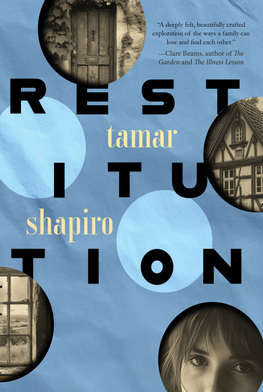
Restitution (Regal House, 2025) is a quiet but powerful novel about place, belonging, and family. It asks us to consider what it means to belong to a place, to a person, or to a people. And what does it mean to not belong? What do we owe each other? And can we ever understand the truth of the past?
This debut novel by Tamar Shapiro—who is now based in the D.C. area but grew up in both the United States and Germany—follows the daughter of a German mother and American father as she pieces together her family’s complex history, which is intertwined with the thorny political history of East and West Germany. Growing up, Kate and her brother Martin are not rooted in either culture. They live in the United States but spend each summer in Germany with a mother who never feels comfortable or integrated into American society, and a father who is increasingly distant from the family. This displacement echoes an earlier loss. The mother’s family fled the increasingly autocratic, one-party rule of East Germany in the 1950s, arriving in West Germany as refugees. Details of the family history are hidden from the children. The novel explores how burying or suppressing stories, questions, and emotions leads to generational trauma, as unexplored grief and loss festers.
While Shapiro did not write an autobiographical novel—the characters and situations are fictional—she does one German parent and one American parent. The book is clearly inspired by her cross-cultural experiences, as well as her deep, personal understanding of the various settings. It’s the sense of place that keeps us grounded and makes this book work.
“I can still feel the cool air of our German childhood summer mornings on my skin. Never the hot, hazy sun of Illinois, but a gentler sun that lit Oma’s garden without warming it. And I remember Martin and me outside, just the two of us.”
Restitution is a complicated web of a story, spanning 50 years and bouncing around in time as Kate and Martin try to understand the past, asking questions and listening to stories of the older generations. Shapiro’s narrative choices, including the decision to write a book about memory, regret, and uncovering the past, are risky because the reader is being pulled in multiple directions. But Restitution is unified by its strong sense of place and era. Not only is there verisimilitude, but there's an emotional connection, and an overarching theme of wanting to belong somewhere. The novel also explores the theme of family being inextricably linked to our relationship with homeland.
The story opens with the sudden, shocking fall of the Berlin Wall in 1989 and the subsequent reunification of Germany. It seems miraculous that Kate’s family can finally visit their homeland. But is it their home anymore? Through the story of this individual family, Shapiro tells the story of German reunification in microcosm. And it’s messier and more complicated than the Western-centered narrative most of us grew up with.
A visit to the family’s old house in the East German village of Grimma leads Kate and Martin to start asking questions about what really happened back in the ‘50s. They also learn that under a West German policy of “restitution” they may be able to repossess their grandparents’ old house. A home where a new family has been living for decades.. Kate has no interest in the house, or displacing people who stayed and made a life in East Germany. But Martin, always the sibling who speaks his mind and stirs up trouble, wants the house. Or maybe he just wants restitution.

Kate sometimes feels like a passive narrator as she pieces together her family’s story from older family members and other people she meets in Germany. Her brother drives much of the action in the present. The stories of the past are seen through Kate’s perspective because they are told to her, but they are driven by her grandparents and others in their generation. This narrative setup, with Kate as observer and archaeologist but not a traditional protagonist, is realistic, but it does create challenges within the structure of the story. Of course Kate’s struggle to reconcile the past and present is one of the great themes of literature and gives readers so much to think about. But at times I felt less invested in Kate as a character and found the past more interesting than the present.
The good news for readers of Restitution is that all of this is purposeful and carefully plotted by the author. This is a book about memory and recovery. Yes, the past is the focus, but the present offers the opportunity to not only reclaim one’s history, but to finally move forward and be free. What Kate is really driving is the investigation.Throughout the novel, she asks questions and stays open to new ideas, particularly when she tries to empathize with others rather than making snap judgments. By working through all this generational trauma instead of pretending it’s not there, she is remaking herself and creating new, freer possibilities for her future sel and her own daughter.
“I was suddenly fully awake. Martin had fit pieces together I hadn’t even considered. He’d found the gaps. Tante Lara turned toward Mom, her profile illuminated by the lights of a car heading the other way, and asked, ‘Now?’
Mom hesitated for a moment, then said, ‘Yes, I’d like to hear it too.’ As if if were someone else’s story.”
The more we learn about life in East Germany, the more ethically complex the situation gets. Kate’s family must flee because they do not join the East German communist party, and they make small but admirable choices to hold onto their own values. But there are no straight-up heroes or villains. When we learn about characters who informed on others for the Stasi, for instance, their actions aren’t excusable, but they are understandable. If anything, the system of oppression is the true villain. Or perhaps it’s the horrors of history. What any of the characters did during World War II is not explored much. We know the grandparents weren’t Nazis, but the level of cooperation is unclear, along with their trauma and grief during the war. Even as Kate and Martin probe into the truth of the 1950s, the ‘30s and ‘40s feel off-limits.
There's a pervasive, quiet sadness here, along with angry outbursts and the discovery of ugly choices. But Restitution is filled with a sense of compassion for its characters. Ultimately, this is a kind book because it is both empathetic and intellectually curious. Shapiro is willing to look at the world’s ugliness and its beauty, examining the humanity of all her characters. There is so much hope in empathy.
The complicated, messy tapestry of Kate’s family history is still being added to as the book comes to an end. There are more stories to uncover, more relationships to mend. There’s a lovely sense of the story being finished and not finished, because life continues and we’ll never uncover all the mysteries of the past. Restitution drew me in immediately and was immensely fulfilling, both emotionally and intellectually. I’m glad to end my year of reviewing on such a high note. We’ll see you all in 2026!
Buy your copy of Restitution from Bookshop or your favorite independent bookstore. Learn more about the author on her website: https://tamarshapiro.com.
Tamar Shapiro’s debut novel, Restitution, was published in September 2025 and named one of the 49 Must-Read Books of Fall 2025 by Town and Country Magazine. Her writing has also appeared in Poets and Writers, Electric Literature, and Literary Hub. A former housing attorney and non-profit leader, Shapiro is a 2026 MFA candidate at Randolph College in Virginia. She grew up in both the U.S. and Germany and now lives in Washington, DC with her husband, two children, and the world’s best dog.
Norah Vawter is the co-founder and fiction/nonfiction editor of Washington Unbound. She’s a freelance writer, editor, and novelist, represented by Alisha West of Corvisiero Agency. Follow her on Instagram @norahvawter and check out her Substack, Survival by Words.