Review of I Hope You Find What You’re Looking For by Bsrat Mezghebe
By Tom Navratil
How fortunate we are, as Americans, to live in a country that attracts—or did, until the last year or so—people from around the world. The Washington, D.C., area has long been a major beneficiary of this ongoing cultural enrichment.
Bsrat Mezghebe’s debut novel, I Hope You Find What You’re Looking For (Liveright/Norton, 2026), is an affecting portrait of three Eritrean women living in Alexandria, Va in 1991, as their country’s long war for independence from Ethiopia enters its final push. In her youth, Elsa, now 34, served with the Eritrean People’s Liberation Front until she left with newborn Lydia, who is now 13. Their relative Zewdi, 50, a vibrant figure among the diaspora, has become the matriarch of their family and a second mother to Lydia. The story, weaving the prosaic and the extraordinary, juxtaposes day-to-day struggles in the DMV with the brutal war for independence back home. It unfolds through the alternating perspectives of these three strong-willed characters.
The book’s title aptly captures the central issue. These are words spoken to Lydia by her cousin, who has arrived from Africa to live with Elsa and Lydia. What Lydia wants is information about her father, who died during the war, and about Elsa’s life before America. While Lydia presses, with increasing determination, for her own origin story, her mother remains maddeningly mum. Over the course of the novel, answers emerge in a series of vivid flashbacks covering Elsa’s decision to leave high school and her experiences as a soldier.
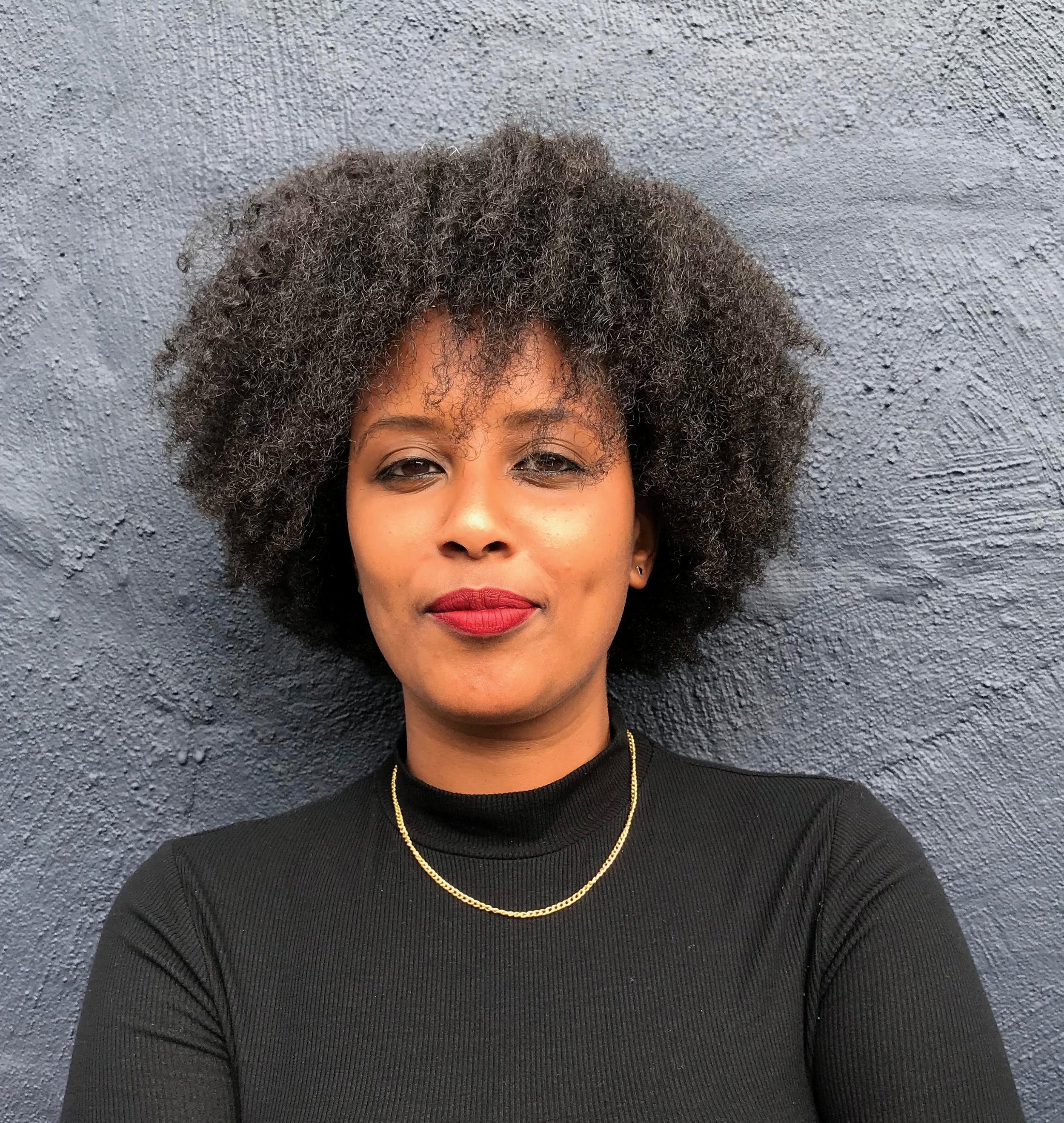
Mezghebe is one of this area’s stellar homegrown talents. She grew up here in the Eritrean community, and lives here now. She earned an M.F.A. in creative writing from New York University, and has published essays in The Paris Review and Guernica. Her assured, understated novel reflects insider knowledge, family lore, and serious research (supported by a Harper-Wood Creative Writing & Travel Award from Cambridge University). She is a remarkably skilled storyteller.
In a reversal of the usual expectations about younger people being more inclined to look ahead, it is Lydia, the youngest of the POV characters, who focuses on the past. She stands in for the reader, channeling our curiosity, and is also the character whose life most closely parallels the author’s. Mama Zewdi, the most senior of the three, whose own eventful life story gets doled out as we proceed, primarily looks to the future as she navigates an unexpected courtship and a significant entrepreneurial opportunity. Whereas Elsa dwells on the knife-edge of a perpetual present, surviving day to day as a hot dog vendor on the National Mall in Washington, D.C., but harboring no hopes of reviving her youthful dreams. Her choices, then and now, may provoke questions and dissent from readers. By the end, her actions become understandable, though still eminently debatable. (Book club alert!)

Prominent among the pleasures of this novel are numerous gems sprinkled throughout:
At the joyful gala celebrating Eritrea’s winning independence at a large Washington hotel, the subdued bartenders are Ethiopian.
Lydia, observing her community, muses: “There was some mysterious formula of shared hardship, village proximity, and tonnage of coffee consumed together that resulted in the dubious status change from friend to family.”
During one evening at home with her cousin, Lydia notes: “Berekhet usually thought his commentary was essential to the viewing experience, while Lydia’s movie-watching philosophy was to let the actors do the talking.”
In a classic understatement early in the book, Elsa thinks: “Not all the news after the war ended was going to be good.”
Indeed, as the war ends, it becomes much harder to keep the secrets concealed. The climactic scene, the mother-daughter truth-telling that Lydia, with the reader by her side, has hungered for from the outset, gets described in a single paragraph, as if the author had absorbed Elsa’s reluctance to share her experiences. It’s a summary of a conversation in the parking lot of their building, and records Lydia’s dawning understanding of what Elsa went through, putting her life on the line for a noble cause. I admire the artistic audacity of writing an entire, complex novel about an appealing adolescent’s yearning for family knowledge, and then keeping the reader at arm’s length when the girl finally does find what she’s looking for. But given the exceptional nuance and power of Mezghebe’s prose, I wanted to be right there in that car, watching Elsa’s face through Lydia’s eyes and feeling the impact of every truth bomb. The decision to avoid repeating what the reader already knows is understandable, but this novel is well-paced and not overly long, so granting a bit more space to allow us to partake directly in what Lydia is going through at that inflection point in her life would have been very welcome.
I Hope You Find What You’re Looking For calls out patriarchal Eritrean mores, back in Africa during wartime and before, and in America in 1991. This constitutes a parallel war of independence, in which, happily, the freedom-fighters also prevail. Male characters enter and exit the stage, but don’t occupy the spotlight for long. They are secondary, and we only ever see them through the eyes of one or another of the three POV characters, who are lovingly rendered in close-up.
The book paints, with confident verisimilitude, a fascinating portrait of the Eritrean diaspora community. It also provides a unique lens on Washington, D.C. The story does not come across as trying to teach the reader anything, but we learn a lot. It is, above all, an invitation to curiosity, to open our minds and extend our empathy to the people around us, regardless of, or especially because of, where they came from. It will appeal to anyone who has ever been inspired by any of the DMV’s many “ethnic” restaurants or stores to wonder about faraway cultures that are, perhaps, not so distant after all.
Is this novel an immigrant story, a war story, a multigenerational set of coming-of-age stories? Yes, and more. It is an Eritrean story, certainly. And a quintessentially American one.
Buy your copy of I Hope You Find What You’re Looking For from Bookshop or your favorite local independent bookstore. Learn more about the author on her website: https://bmezghebe.com/
And if you’re in the D.C. area, check out these two local, upcoming author events featuring Bsrat Mezghebe’s discussing this novel:
March 15 at Mary Riley Styles Public Library in Falls Church. Free but register. Details here.
March 21 at Mojomala Book and Record Shop in Silver Spring. Details here.
Bsrat Mezghebe received an MFA in Creative Writing from New York University. Her writing has appeared in Guernica, The Paris Review, and the anthology Well-Read Black Girl: Finding Our Stories, Discovering Ourselves. She lives in the Washington, D.C. area.
Tom Navratil is the author of Dog’s Breakfast, a comedy of international intrigue (and a very thoughtful April Fools’ Day gift). Read Norah’s interview with Tom, covering his novel, his past career in the U.S. foreign service, and many things in between.