“O beware my lord of jealousy. It is the green-eyed monster”

The cast of Othello at Shakespeare Theatre Company. Photo by Teresa Castracane.
A review of Othello at The Shakespeare Theatre
by Gregory Luce
The Shakespeare Theatre’s current production presents us with a very different Othello than we might expect. The set is simple—no ducal palace or vast battlefield—and intimate, all the better to allow the audience to follow Iago’s intricate schemes. The plot has been streamlined to focus on the essentials: Iago’s machinations, Othello’s gullibility and vulnerability to manipulation, Desdemona’s innocence and inability to understand Othello’s transformation, Emilia’s growing awareness of her husband’s diabolical plans.
Othello has returned to Venice from his successful war against the Turks, having secretly married Desdemona, daughter of a Venetian senator. His Blackness is an affront to some Venetians, and his heroic accomplishments are a source of resentment for Iago, purportedly his friend and colleague, who is also angry that Othello has promoted another officer, Cassio, rather than choosing to advance Iago’s career. These events set in motion Iago’s plot of revenge, which ultimately leads to tragedy.
The pacing of the play is remarkably effective, indicative of the masterful directing of Simon Godwin. Scene changes are marked by flashing or dimming of the lights, drumming or electric guitar, or in one case, thunder and lightning representing the violent storm that fortuitously sinks the Turkish fleet, sparing Othello’s army from having to fight.
During these intervals, the ensemble cast, dressed in military garb as soldiers under Othello’s command, changes out the few props while dancing or marching, expertly choreographed by Jonathan Goddard. The sound design by Christopher Shutt with music composed by Shiloh Coke comprises electric guitar, drumming, and even amplified stomping.
In fact, the staging, design, lighting, and sound deserve a review of their own; they work together beautifully in support of plot and players. This is a modern dress version, with costumes designed by Susan Hilferty and Sarita P. Fellows. Most of the cast is dressed in military style, Othello is frequently in a splendid dress uniform. The Venetian politicians wear business suits; and the three actresses are costumed appropriately for their station: Desdemona fashionably, her attendant Emilia in jeans and t-shirt (with messy hair and excessive lipstick), and Bianca, Cassio’s lover, in short skirt, stockings, high heels, and tight top.

[Ben Turner and Wendell Pierce in Othello at Shakespeare Theatre Company. Photo by Teresa Castracane.]
The play opens on an encampment with a fire burning in a barrel, a few boxes, scattered trash…and Iago (Ben Turner), ruminating about resentments and envy. His wife Emilia lurks in the background, but his remarks are directed at us. Turner immediately takes command and, though he is not the titular hero, he is arguably the central character in this interpretation of the play.. He will have more time on stage than any other, and Turner is more than up to the part. His presence is captivating and his delivery forceful. He does nothing to make himself likeable at any point, but we can’t take our eyes off him..
Played superbly by Daniel Velez, Iago’s supposed friend Roderigo seems like a slightly comic Romeo figure, handsome but not too bright, a perfect pawn for Iago’s scheme. Joey Collins is splendid as Brabantio–with his pinched face and spectacles, slender frame in a suit–looking and acting more like a bureaucrat than a powerful politician. Like virtually every other character, he is easily swayed by Iago.
One of the fascinating things about this particular production is that Othello’s race plays a relatively small role in the drama, despite this play being known for its frequent expressions of racism by Othello’s enemies. The only racist epithet retained from the original play is Iago’s notorious address to Brabantio: “Even now, now, very now, an old black ram is tupping your white ewe.” This remark thus seems to be intended to trigger Brabantio’s racism. Iago appears to be driven by his jealousy, envy, and resentment, in particular concerning the perceived unfairness of his having been passed over for the promotion that was given Cassio. Otherwise it is nearly impossible to discern exactly what Iago hopes to gain. He is not lusting after power, nor does he seem to desire Desdemona himself. This mystery haunts the entire play, which is partly why Ben Turner’s performance is so compelling.
Lucas Iverson as Cassio does a fine job of conveying his character’s obliviousness to Iago’s plotting. He makes it difficult to believe that he would have the audacity to love Desdemona, much less actually consort with her. His sudden turn to violence when drunk is utterly convincing as well.

[Wendell Pierce, Olivia Cygan, and Ben Turner in Othello at Shakespeare Theatre Company. Photo by Teresa Castracane.]
We finally meet our hero Othello stumbling out of his wedding ceremony, Desdemona clinging to him with the sounds of riotous partying following them. He sometimes seems more like a besotted lover than a noble warrior. Wendell Pierce portrays the heroic general with just the right mixture of dignity, joy bordering on giddiness over his love for Desdemona, and commanding presence. Yet he quickly conveys the essential weakness of Othello. When not behaving like a lovestruck teenager around Desdemona, he is rather stiff, self-satisfied with no corresponding self-awareness, and easily swayed by Iago’s insinuations. When required to defend himself against the charge of using witchcraft or dark arts to win Desdemona’s heart, he asserts that she was moved to pity and love by his stories of his dreadful early life. He tells his accusers “She loved me for the dangers I had passed, [a}nd I loved her that she did pity them.” This would seem to be a rather slender reed for a great love to cling to.
Nevertheless, beautifully played by Olivia Cygan, Desdemona is clearly in love with Othello. Though her character lacks complexity, Cygan makes the most of it: Her turn from innocent, wholehearted love to bewilderment and grief at Othello’s accusations is almost as heartbreaking as her murder.
Outside of the leads, some of the strongest performances are given by the female characters. Giovanna Drummond in the small but juicy role as Bianca, Cassio’s lover who is falsely accused of Roderigo’s murder, does a saucy turn, defiant even as she’s led away by the authorities.
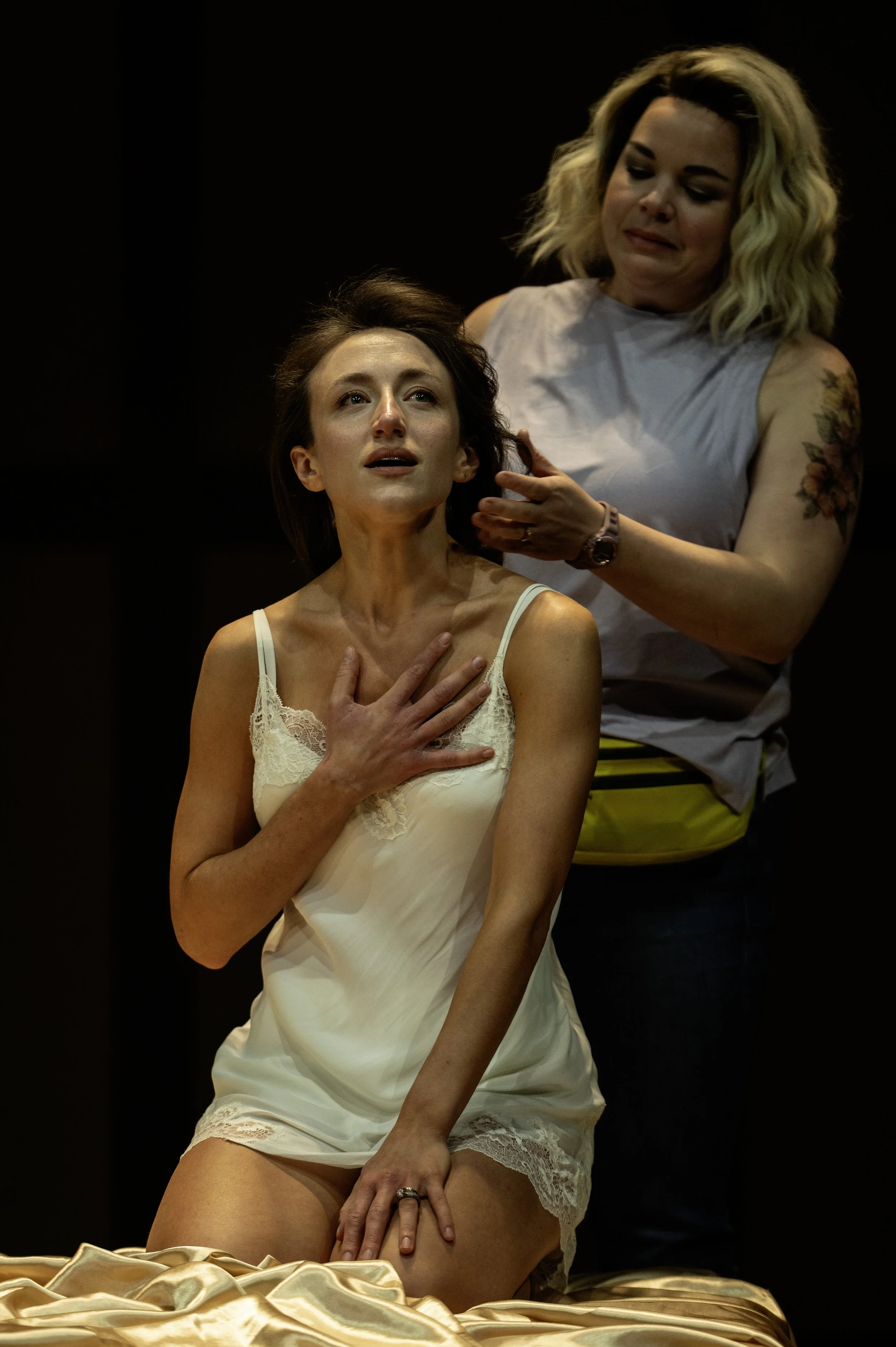
[Olivia Cygan and Melanie Field in Othello at Shakespeare Theatre Company. Photo by Teresa Castracane.]
The most stunning of all is the growth of Melanie Field’s Emilia, Iago’s wife and Desdemona’s attendant. Beginning as an unwitting and rather indifferent pawn in Iago’s scheme, Field conveys her dawning awareness and final turn against Iago. Her powerful final speech, in which she reveals all, is riveting, her murder by Iago devastating. I would love to see her in a starring role.
The ensemble cast deserves plaudits. Their electrifying physical performance in changing out props and filling the stage when a crowd is called for is a joy to observe. And even when standing in array behind the principal characters, they convey meaningful emotion through facial expressions and subtle body language.
As I sat gathering my thoughts after experiencing this amazing drama, I was struck by two things in particular. First, the play contains rather a lot of comedy for a work labeled a tragedy. Much of the humor consists of sexual innuendo, both verbal and gestural. (For example, the slang phrase “beast with two backs” made its first appearance in written English in Othello.) Absent the murder of Desdemona and the bloody denouement, the play could almost be presented as a classic Shakespeare comedy. with confusions of identities, complications strewn in the path of true lovers, and a humorous comeuppance for Iago. This production has chosen to emphasize the comedic elements in the opening scenes, which makes the turn to tragedy even more shocking.

[Lucas Iverson in Othello at Shakespeare Theatre Company. Photo by Teresa Castracane.]
And finally, one is left wondering what is our final takeaway from this production? There is no grand restoration to order—Othello is stripped of his command and dies by suicide. No redemption comes for Iago (who remains defiant to the end). And finally, we are left with no real understanding of Iago’s motivations or why his pawns and victims are so easily manipulated. And then it dawned on me that these mysteries are the point. Humans frequently behave in incomprehensible ways. One can be an enigma to oneself. Whether Shakespeare, the masterful theatrical psychologist, who has given us so many complex characters, would agree, this production leaves us with one of the most unsettling psychological truths of all: There are things about people that we cannot and will not fully understand.
Othello’s run has been extended through June 28. The show I saw was a full house, so best to get tickets right away. The beautifully designed sets, the exceptional sound and lighting, and most of all, the uniformly magnificent performances are not to be missed.
Gregory Luce is the co-founder and poetry editor of Washington Unbound. He has published six chapbooks. He lives in Arlington, serves as Poetry Editor of The Mid-Atlantic Review and writes a monthly column for the online arts journal Scene4.