
“O, what may man within him hide, Though angel on the outward side!”
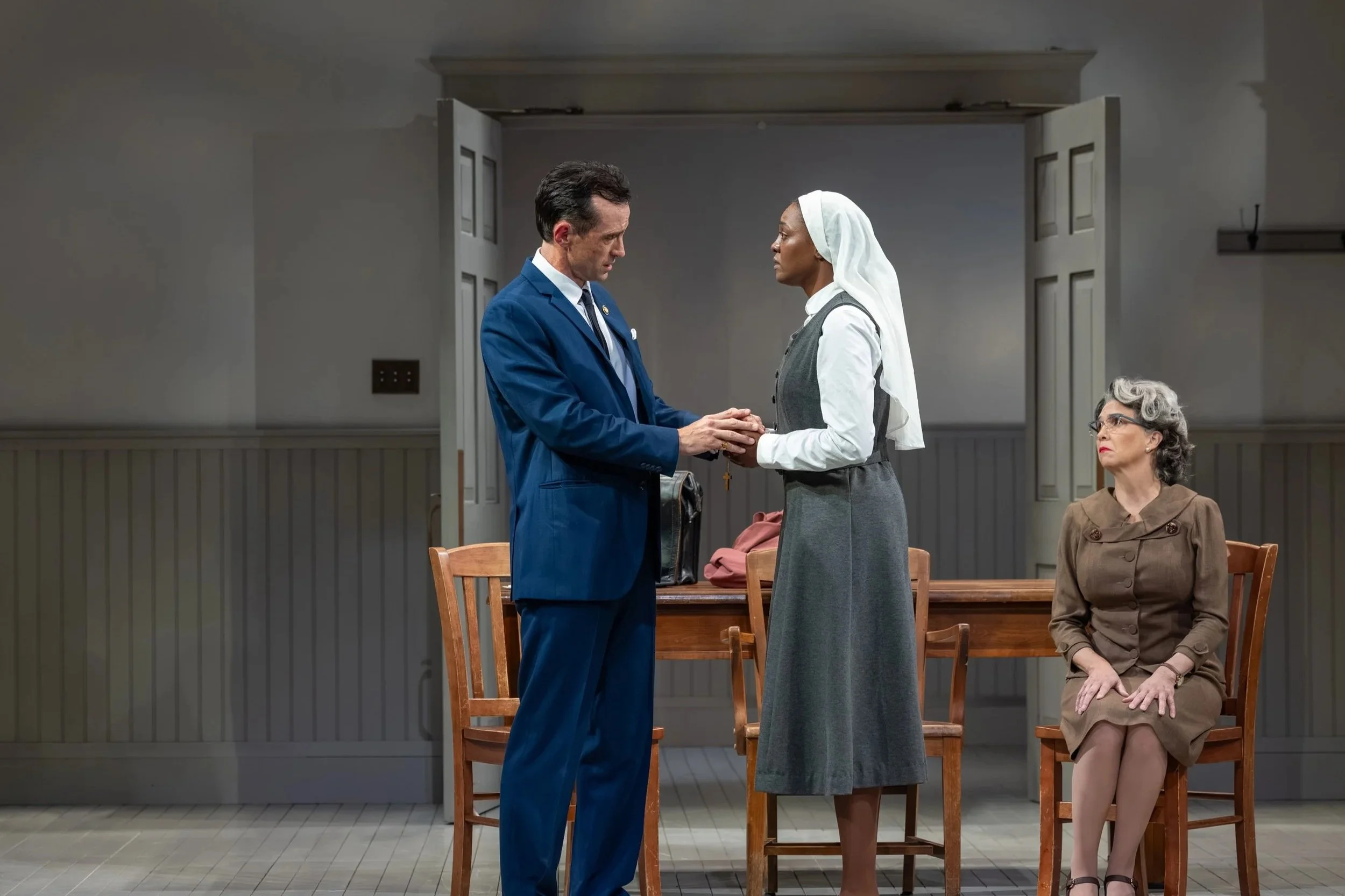
Nathan Darrow as The Duke, Renea S. Brown as Isabella, and Holly Twyford as Escalus in Folger Theatre’s production of William Shakespeare’s Measure for Measure, directed by Psalmayene 24. Photography by Erika Nizborski.
Magnificent performances and brilliant staging propel a “problem play” in Folger Theatre’s Measure for Measure
by Gregory Luce
Measure for Measure is counted as one of Shakespeare’s “problem plays,” in part due to its sometimes uneasy veering between comedy and tragedy. Like the comedies, it ends with impending marriage—four in fact!—while at the same time, as in a tragedy, the machinations of several characters nearly result in several deaths. Further, the play becomes extremely complicated as it nears its end and a number of plot tangles are not fully unraveled. In addition, at times the motivations of several major characters are unclear.
Despite these difficulties, the Folger’s presentation triumphs as a result of the excellent direction of Psalmayene 24 and the uniformly magnificent performances and brilliant staging.
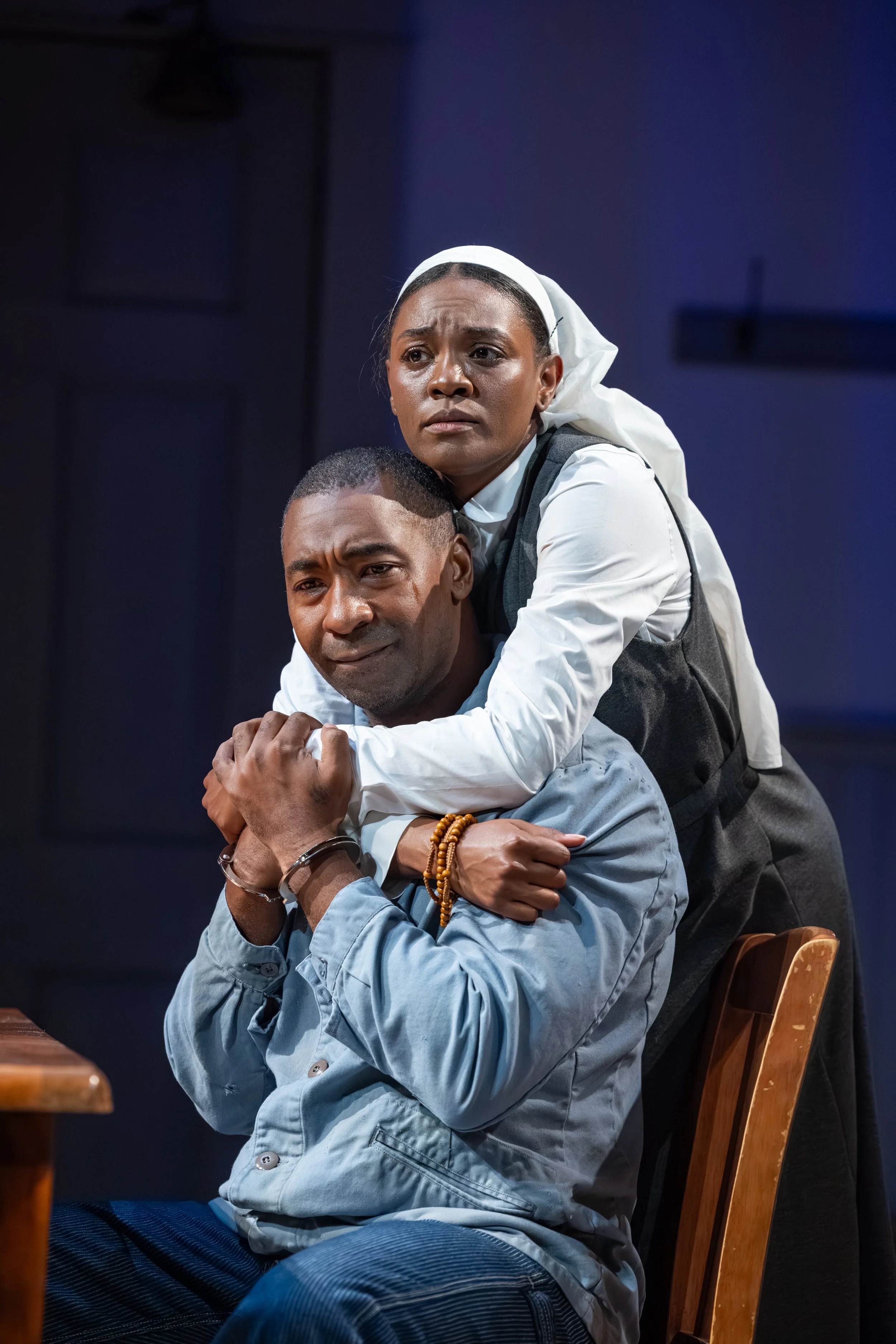
JaBen Early as Claudio and Renea S. Brown as Isabella in Folger Theatre’s production of William Shakespeare’s Measure for Measure, directed by Psalmayene 24. Photography by Erika Nizborski.
The director’s choice to set the play in the Jim Crow South of the 1950s is intriguing and raises important questions. Why choose this setting when there is no overt racial theme in the source material? Indeed the casting mixes Black and other actors of color with white performers with no obvious connection between race and character. However, as director Psalmayene 24 explains in the program note, “The themes and the nature of the relationships in this play feel cannily aligned with the history and spirit of the racially segregated South.” For me, the most striking facet of this setting lies in the fact that Claudio (JaBen Early), who is Black, is sentenced to death for fornication with his now-pregnant white fiancee, Juliet (who, as beautifully portrayed by Maryanne Henderson, conveys her terror, sadness, and love for Claudio entirely through facial expressions and movement). Though no explicit racial motive is behind this harsh sentence (the law mandates such punishment), a viewer who is aware of the history of racism and white supremacy in the American South will be reminded of anti-miscegenations laws and extrajudicial executions of Black men accused of sexual relations with white women.
JaBen Early’s Claudio, who radiates anger, fear, and defiance in a small role, makes one wish to see this actor in a meatier part. Jonathan Feuer as Claudio’s friend Lucio, is wonderful portraying a character who could have been heroic—he tries to save Claudio and brings Claudio’s sister Isabella (Renea S. Brown) to plead for her brother’s wife—but whose scheming nature ultimately undermines his kindness and leads to a fatal consequence. Feuer’s weaselly charm and frequently salacious gestures are a guilty joy to behold.
Several actors shine in smaller but significant parts. Ryan Sellers as the very funny constable Elbow is reminiscent of Barney Fife in his outsized sense of justice and frequent malapropisms. Likewise, John Sygar as Froth, a brothel customer brought in for judgement, and Chinai Routté as Mistress Overdone, madam of said brothel, provide much comic relief, Sygar’s timidity contrasting with Routté’s flamboyance and brassiness.
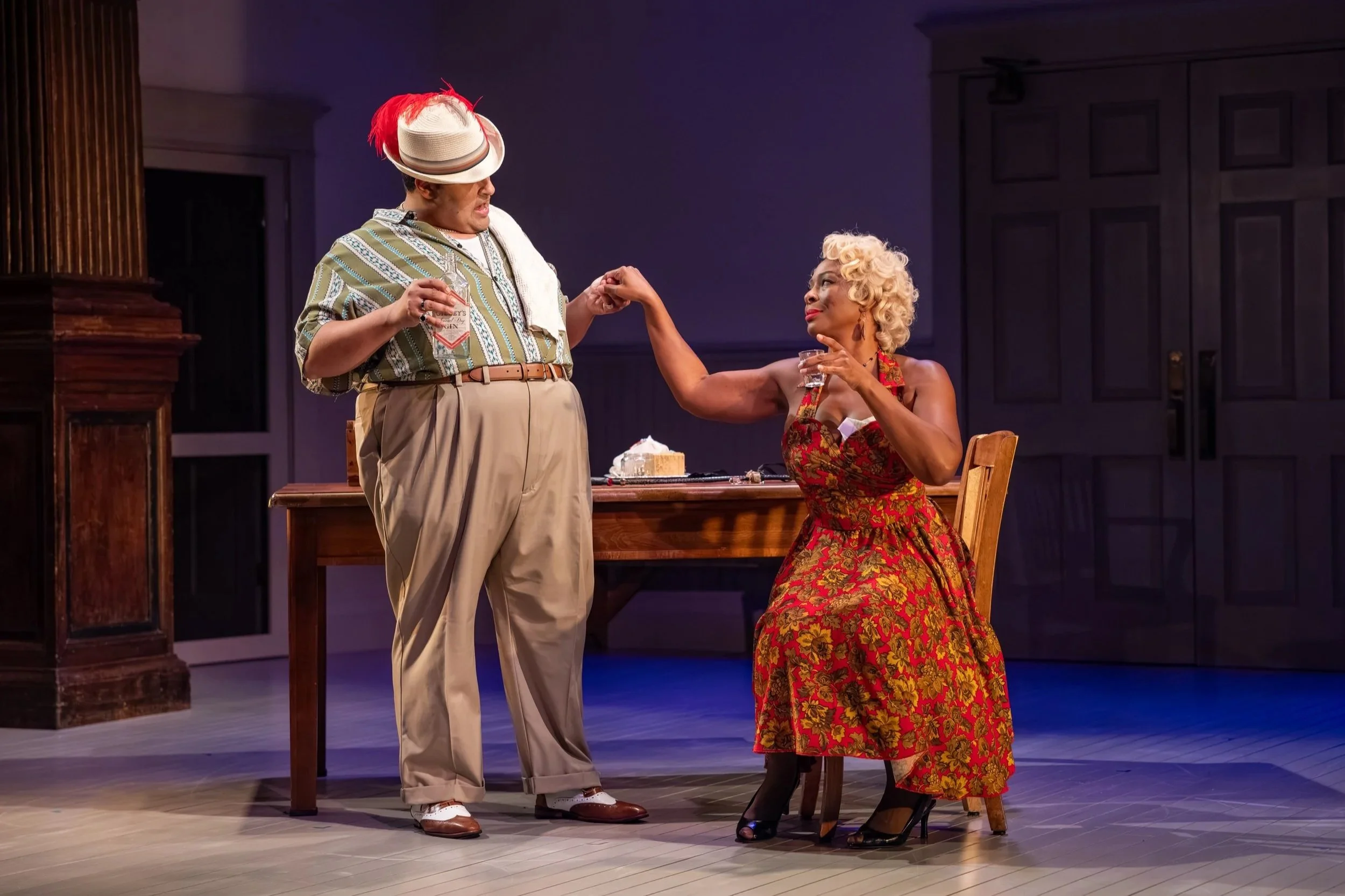
Ahmad Kamal as Pompey and Chinai Routté as Mistress Overdone in Folger Theatre’s production of William Shakespeare’s Measure for Measure, directed by Psalmayene 24. Photography by Erika Nizborski.
Ahmad Kamal as Mistress Overdone’s raffish pimp is a standout. He delivers consistently witty lines with a sleazy charm and striking self-confidence.
Moving up the scale to the larger roles, one of my favorite performances is given by Sean Fri in a role that could easily fade into the background, that of the Provost. Though on first appearance he seems colorless, constantly in motion performing his assigned tasks efficiently yet bloodlessly, his true character gradually emerges. Sympathetic to Claudio but constrained by his duty, he readily accepts the opportunity to conspire with the Duke (Nathan Darrow) to free Claudio and shows genuine concern for Isabella. The way Fri allows these traits to emerge slowly is one of the true pleasures of this play.
And D.C theater veteran Holly Twyford is similarly compelling as Esculus, a role normally played by a male actor. Her southern accent is pitch perfect (though all the speaking cast members handle this potential pitfall very well). Twyford brings a briskness to the role that masks but cannot conceal her underlying warmth and advocacy for mercy over justice.
Renee Elizabeth Wilson as Mariana, Angelo’s wronged former fiancee) powerfully portrays grief, loneliness, and a sense of having been betrayed.
And finally to the leads. In my view this production has three main characters: Duke Vincintio (Nathan Darrow), Angelo (Lee Osorio), his temporary replacement as governor of Vienna, and the absolute standout Renea S. Brown as Isabella.
Darrow and Osorio carry off equally well the portrayals of characters, neither of whom is exactly what they seem in the beginning. The Duke, seemingly a wise and kind ruler, departs Vienna on the pretext of official business, leaving Angelo in charge. But we discover that his real purpose is to have Angelo take the heat for enforcing the law so that he (the Duke) will retain his popularity. Although he eventually dispenses justice for all concerned, his occasional displays of cruelty and arbitrariness come as a shock.
Likewise, Angelo appears to be a dedicated, at times almost ruthless, enforcer of the law. In his monologue following Isabella’s departure, Osorio beautifully reveals his own human weakness as he tries to convince us—and himself—that his lust for Isabella and intention to offer clemency to Claudio in exchange for sex with her is somehow justified. His softening at the end under the Duke’s pretended sentence of death is equally moving.
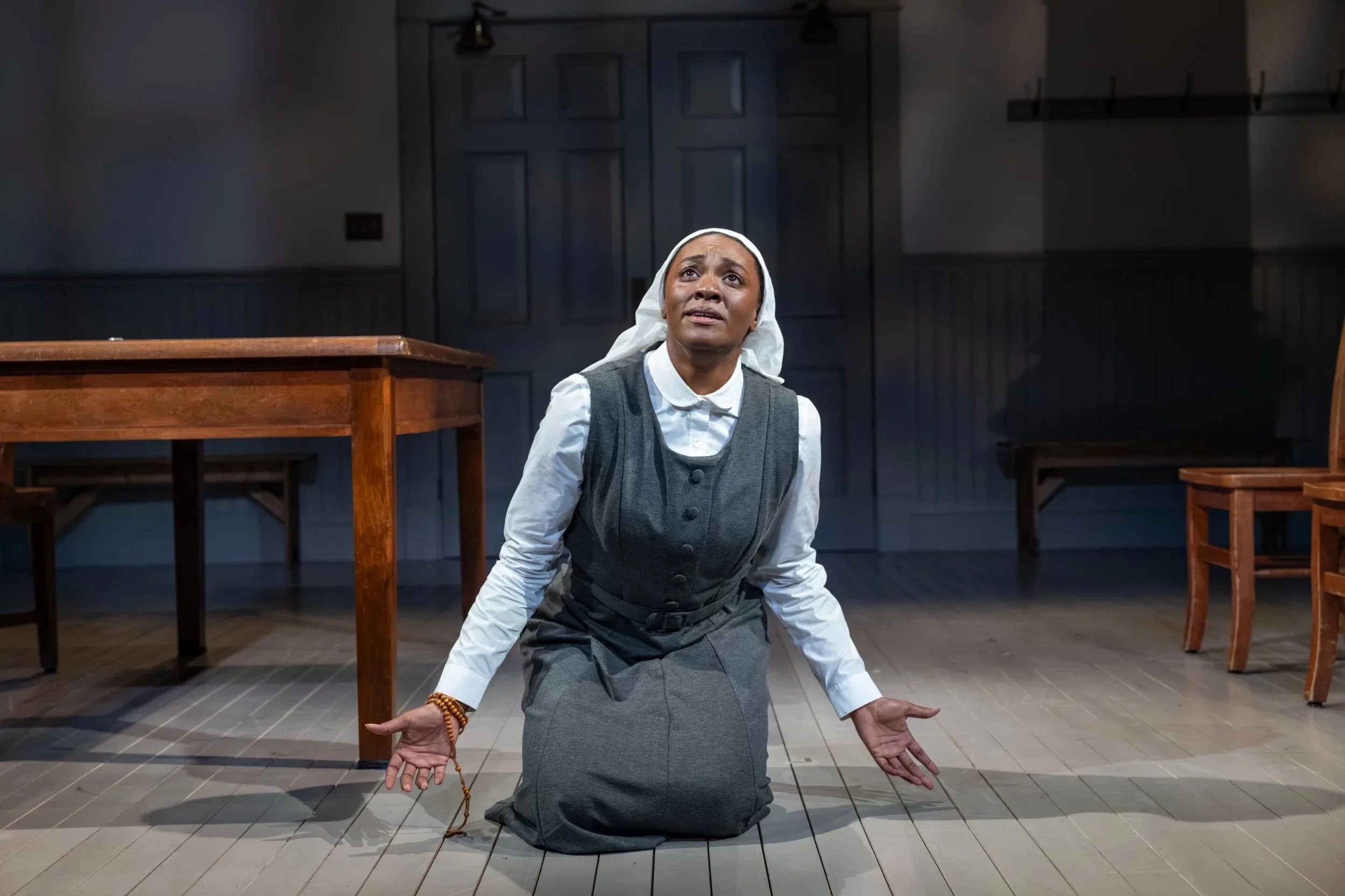
Renea S. Brown as Isabella in Folger Theatre’s production of Measure for Measure, by William Shakespeare, directed by Psalmayene 24. Photography by Erika Nizborski.
And finally, it is Renea S. Brown’s Isabella who brings the most powerful performance to the stage. She powerfully conveys a wide range of emotions from grief to fear to outrage in her trying to cope with her brother’s impending execution. Her resignation and sadness when she is falsely informed that Claudio has been executed and her relief and ultimate joy at Claudio’s release are extremely moving. Hers is clearly an award worthy performance.
Along with the remarkable acting, the scenic design by Debra Booth is striking in its simplicity and utility. The set is an unadorned room that appears to be a train or bus station complete with White and Colored water fountains and a Colored Waiting Room sign. The props are rearranged for scene changes by the actors themselves using the brilliant choreography of Tony Thomas, who also creates a stunning and very humorous prologue in which the entire cast enters dancing to the fabulous music composed by Kokayi. The music overall enhances the production, giving depth and texture to the time and place setting.
Despite some flaws in Shakespeare’s plot, the cast and crew of Measure for Measure present a dazzling and highly entertaining evening of theater.
Measure for Measure runs through November 1 at The Folger Theatre, located at 201 East Capitol Street, SE
Washington, DC 20003. The play’s runtime is two and a half hours with a 15-minute intermission. Get tickets here or by calling the Box Office at 202-544-7077.
Gregory Luce is the co-founder and poetry editor of Washington Unbound. He has published six chapbooks. He lives in Arlington and writes a monthly column for the online arts journal Scene4.